For today’s professional seeking career advancement, the greatest initial barrier is no longer the competition but the ubiquitous Applicant Tracking System (ATS). These sophisticated software programs have fundamentally redefined the job application process, acting as necessary digital gatekeepers that screen, score, and rank candidates long before a human recruiter dedicates their limited time to review an application.
Successfully navigating the modern job search means treating the resume not just as a historical document but as a technically optimized asset designed to achieve compliance.
Quick Summary
Contents
Understanding the Applicant Tracking System (ATS)
A. The Scale of the Digital Filter: Why ATS Compliance is Non-Negotiable
The adoption rate of ATS software across large enterprises demonstrates that optimization is not a competitive edge but a mandatory requirement for engagement. The analysis of Fortune 500 companies in 2025 revealed that 97.8% utilize a detectable ATS system. This near-universal implementation across the largest corporations confirms that the corporate job application pipeline is overwhelmingly mediated by software.
Furthermore, based on Recruit CRM, this trend is pervasive across all organizational sizes: 93% of recruitment professionals rely on an ATS, including 60% of small businesses and 80% of large organizations.
The professional must recognize that failure to optimize for ATS compatibility results in automatic exclusion from nearly all major corporate pipelines. The market dominance of just two platforms further narrows the required optimization target. According to Jobscan’s report on ATS usage, over 52% of Fortune 500 companies rely on either Workday (39% usage rate) or SuccessFactors (13.2% usage rate) for their talent acquisition needs.
When selecting an ATS checker tool, its proven compatibility with these dominant platforms is paramount, ensuring that the time and effort invested are aligned with the technical reality of the current recruitment landscape.
B. Dissecting the Algorithm: Parsing, Scoring, and the Contextual Shift
The mechanical process of ATS involves several stages designed to automate the initial screening workload. First, the system utilizes Optical Character Recognition (OCR) and Natural Language Processing (NLP) to perform resume parsing, extracting structured data such as contact information, work history, and skills. This parsing is followed by a rigorous keyword matching process, where the ATS identifies and prioritizes job-relevant terms, comparing them directly against the job description requirements.
Modern ATS software then assigns a weighted score, assessing various factors, including keyword relevance, density, and placement, alongside formatting integrity and alignment with the job description. According to GetHirex, candidates typically receive an Intelligent Selection score, with scores ranging from 70% to 100% generally progressing to human review. If a resume fails to meet the requisite scoring threshold, often applications are automatically rejected.
Crucially, the scoring algorithms have become sophisticated, shifting emphasis from simple keyword counting to contextual relevance. While older systems might have rewarded keyword stuffing, modern ATS detects and penalizes this tactic. Resumes with over 20 skills listed separately suffered a 67% rejection rate, compared to a 34% rejection rate when those skills were integrated logically within the work experience sections, notes EDLIGO.
This dramatic difference reveals that the system favors skills that are demonstrated and proven in context, such as using terms like “Python programming” or “Python scripting” when the core requirement is “Python”. Therefore, optimization efforts must focus not merely on having the right keywords, but on showcasing their contextual application within the professional narrative.
C. The Hidden Rejection Factors: The Formatting Trap
Many qualified professionals believe their rejection is solely due to a qualification mismatch, but data reveals that technical failures are responsible for a massive portion of exclusions. Only 57% of resume rejections analyzed were due to a qualification gap. A significant 43% of rejections occurred due to technical non-compliance, including parsing errors (23%) and formatting issues (12%).
Close to 50% of job rejections are not as a result of qualification mismatch, but due to technical failures in resumes.
This finding is sobering: nearly half of all rejections occur before the applicant’s skills or experience are even evaluated. EDLIGO reveals that complex formatting elements such as tables, columns, text boxes, and graphics can break the ATS extraction process, rendering the content unreadable.
Furthermore, 88% of employers report that highly qualified candidates are routinely excluded because of internal ATS configuration failures, not lack of ability. For an otherwise qualified candidate, ensuring the resume’s structural integrity and clean parsing ability is the single most important action to improve their odds. This critical task elevates the necessity of specialized ATS checker tools that prioritize format and structure validation over content analysis alone.
Navigating the AI Paradox: Optimization in the Age of GAI
The current hiring landscape is defined by an accelerating adoption of Artificial Intelligence (AI), creating a new paradox where candidates must leverage generative AI (GAI) to bypass screening systems that are themselves increasingly AI-driven.
A. The Explosive Growth of AI Screening and the Bias Paradox
The shift toward automated screening is occurring rapidly. Comprehensive research indicates that 48% of hiring managers currently use AI to screen resumes, a figure projected to jump dramatically to 83% by the end of 2025. This dramatic increase represents the fastest adoption rate of hiring technology in recent memory, suggesting that, for high-volume roles, human review may soon become a rarity until the final stages of the process.
This acceleration is occurring despite recognized ethical concerns. A significant 67% of companies using AI hiring tools acknowledge that these systems introduce bias into hiring decisions. Studies show that AI systems can exhibit biases, such as favoring white-associated names 85% of the time compared to 9% for Black-associated names, reveals The Interview Guys..
Furthermore, this bias often permeates the human review process. Research has shown that when human reviewers work alongside even moderately biased AI recommendations, their decisions tend to mirror the bias presented by the machine, either favoring or disfavoring non-white candidates.
This situation means that optimization is a battle being fought between the candidate’s GAI tools and the employer’s screening AI. TopResume advises professionals to utilize GAI tools responsibly, using them to refine and tailor their application materials while adhering to ethical guidelines.
The objective must be to leverage the power of GAI for optimization—such as clarifying language or ensuring metrics are prominent—without allowing the resulting application to sound wholly machine-generated, which employers increasingly notice.
Top digital skills for teachers
Find out top in-demand digital skills required by teachers in 2026 and beyond.
B. The Quantifiable Imperative: Metrics as the Universal Language
In an environment increasingly dominated by algorithmic screening and recognized bias, the most effective strategy is to rely on objective, quantifiable data that is difficult for any system or human reviewer to ignore. This principle, known as the quantifiable imperative, demands that professionals use data to demonstrate impact.
Going forward, a resume’s ability to “lean heavily on data” will be essential, quantifying achievements such as the percentage by which sales grew or the number of clients acquired
AI tools are particularly useful for this task, helping professionals transform vague descriptions, such as “Led a sales team,” into powerful, metric-driven statements like, “Led a 12-person sales team that increased quarterly sales by 12%”.
This emphasis on quantifiable achievements aligns perfectly with the need to stand out in the minimal time a human recruiter spends scanning an application (an average of seven seconds). The use of concrete metrics resists algorithmic distortion and provides undeniable proof of value, acting as the clearest signal of success. Consequently, the most effective ATS checker tools must prioritize the assessment of “Measurable Results” and the “Quantifying Impact” of the professional experience.
Finally, recognizing the evolution of required skills, nearly half of hiring managers (47%) consider AI abilities, such as machine learning and generative AI tools, among the top five desired hard skills for candidates.
C. Selection Methodology for This Review
The ten ATS resume checkers reviewed in the subsequent sections were selected based on three core criteria, prioritizing high return on investment (ROI) for the ambitious professional:
- AI-Driven Depth: The tool must demonstrate the capability to analyze not just keyword presence but semantic context, offering content-based suggestions that improve the quality of the bullet points, moving beyond simple keyword matching.
- Structural Integrity Check: Given the significant risk of technical rejection (the 43% failure rate), the tool must provide robust validation of formatting and parsing integrity against major ATS platforms.
- Actionability and ROI: The checker must provide clear, personalized, and actionable advice that genuinely streamlines the optimization process. Preference was given to tools that offered effective free or affordable freemium tiers that deliver tangible value.
The Top 10 ATS Resume Checkers: A Detailed Product Analysis
A detailed analysis of the leading ATS resume checkers for 2026 is provided below, focusing on their unique strengths and strategic applications.
1. Jobscan: The Industry Standard for Match Rate Perfection
Jobscan is widely recognized as the preeminent tool for professionals seeking the highest possible match rate for a specific job application. It uses sophisticated AI and machine learning to analyze how well a resume and cover letter are tailored for a particular job, claiming its optimization tools can increase interview chances by 50%. It is the benchmark against which other targeted optimization tools are often measured.
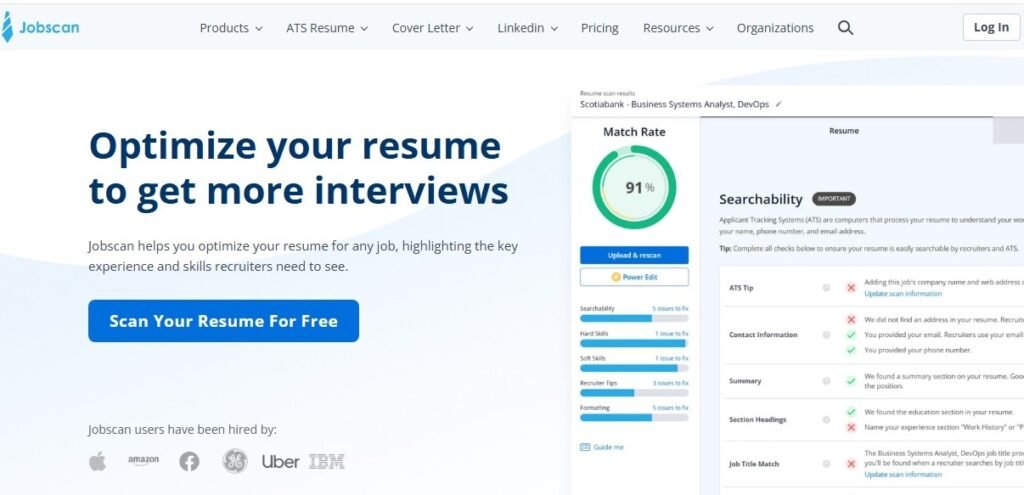
Jobscan provides an instant analysis of resume alignment with a specific job description, focusing intensely on keyword identification and optimization to defeat ATS filters.
Pricing:
Freemium/Paid Subscription. The free version includes a limited number of scans per month. Premium access, which unlocks the most powerful tools, is offered at a high-tier price point, ranging from $29.99/month (Quarterly subscription) to $49.95/month (Monthly subscription). Past user accounts have noted the high expense of premium access, describing the cost as “expensive as sin”.
Key Features:
- Resume Score
- Resume Optimization Report
- Power Edit (a real-time resume editor)
- LinkedIn Optimization Tool
- Cover Letter Generator.
Pros:
- Delivers exceptional, granular insights into missing hard skills, soft skills, and crucial keywords
- The Power Edit feature is highly effective for making real-time, targeted changes based on the analysis
- Highly specialized for targeted applications.
Cons:
- The high price point is the primary barrier for many job seekers
- The free version offers limited utility, requiring a significant financial commitment for high-volume use.
Best For:
Professionals applying for highly competitive, high-value roles where maximizing the match rate is critical, and who possess the budget to invest in a specialized, top-tier optimization tool.
2. Resume Worded: The Contextual Content Specialist
Resume Worded’s strength lies in its ability to move beyond basic keyword identification, helping users integrate keywords contextually within their work experience narratives. This directly addresses the modern ATS’s preference for proven skills over isolated lists.
This free AI tool focuses on showing users the important skills missing from their resume when compared against a specific job description. It provides detailed suggestions on how to write professional bullet points that naturally incorporate those missing terms.
Pricing: Free/Freemium.
The core Targeted Resume Checker, which includes keyword scanning and relevancy scoring, is entirely free.
Key Features:
- Instant Relevancy Score (comparing resume to job posting)
- AI-Powered Writing Suggestions
- Identification of both Hard and Soft Skills
- Contextual keyword scanner.
Pros:
- Outstanding focus on content quality and contextual skill integration, effectively preventing resumes from being flagged for keyword stuffing
- Provides AI-generated lines and bullet points to quickly add missing skills.
- The rapid tailoring process can be completed in less than 30 seconds.
Cons:
- Less emphasis on complex formatting and structural integrity checks compared to template-focused tools.
Best For:
Job seekers who have structurally sound templates but struggle to integrate job description keywords naturally and contextually. It is ideal for ensuring skills are demonstrated through achievements rather than listed in isolation.
3. Novorésumé: Structural Integrity and Format Assurance
Novorésumé is specifically engineered to combat the high rate of technical rejection caused by poor formatting and parsing errors, focusing on the structural robustness of the application document.
The ATS Resume Checker finds out if a resume “will survive the digital gatekeepers,” citing that 75% of qualified candidates fail to make it to the interview stage due to ATS scans. It checks formatting, keywords, and structure to ensure parsing compliance.
Pricing: Freemium/Paid Subscription
A basic “Quick ATS Check” is available for free without sign-up. The “Complete ATS Analysis” requires registration, and premium access for full reports, one-click fixes, and templates starts around ~$16/month.
Key Features:
- Detailed ATS Score across 5 Key Areas (including primary focus on Format & Structure)
- Format Auto-Correction using tested ATS-optimized templates
- Personalized Improvement Suggestions
- It is tested against major ATS systems and developed with input from HR professionals.
Pros:
- High reported user success, with 87% of users who optimize with the tool reporting increased interview rates.
- It is template agnostic, working with non-Novorésumé files
- Its detailed focus on structural issues provides the highest assurance against the 43% of rejections caused by technical failure.
Cons:
- Supports only PDF file format
- Detailed analysis requires submission of an email address
- The premium price is slightly higher than some integrated builder competitors.
Best For:
Qualified professionals whose primary concern is the technical compliance of their document. It is the go-to choice for fixing complex formatting issues and ensuring structural integrity before application.
4. MyPerfectResume: Comprehensive, Accessible, and Free
MyPerfectResume provides an expansive, entirely free checking utility that focuses on ensuring completeness, customization, and general grammatical precision.
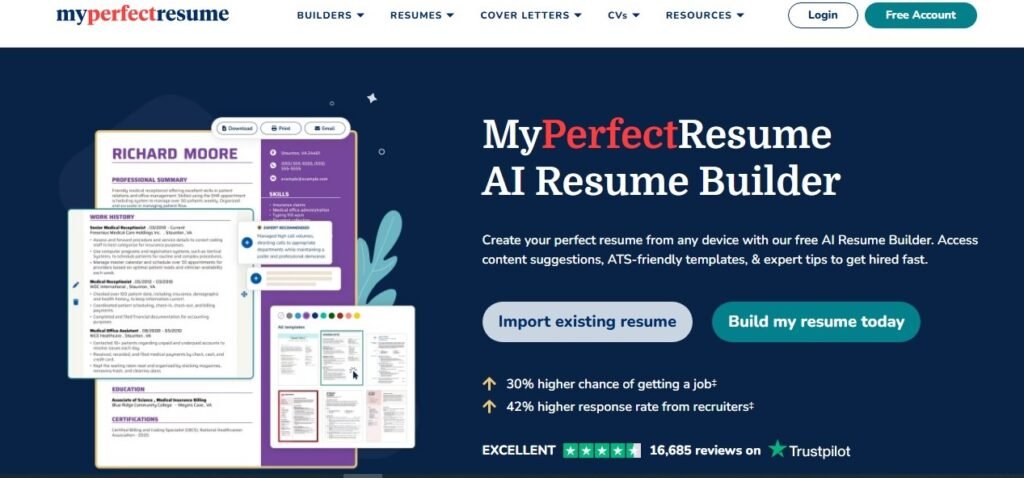
The Free ATS Resume Checker scans over 30 criteria to provide instant suggestions for improving the resume score. It is designed to prevent resumes from being filtered out by screening software that looks for key qualifications.
Pricing: Free
The core ATS Resume Checker functionality is offered at no cost.
Key Features:
- Checks for measurable results, optimal length (preferring a concise one-page resume), word choice (action verbs), spelling and grammar, and comprehensive contact information.
- It explicitly scans for customization details necessary to highlight job fit.
Pros:
- Provides a robust, multi-criterion check completely free of charge
- Users who optimize with the tool report a 30% higher chance of getting a job and a 42% higher response rate from recruiters
- Excellent for identifying and correcting basic, yet crucial, application errors.
Cons:
- Offers less nuanced content suggestions or deep contextual keyword analysis compared to high-end, paid AI tools.
Best For:
Budget-conscious professionals, students, or high-volume job seekers who require a reliable, free tool to ensure their application is customized, error-free, and compliant with basic ATS filters before submission.
5. Kickresume: The Design and AI Balance
Kickresume strikes an effective balance between aesthetic quality, structural robustness, and AI-powered content generation, making it a compelling option for those who need a visually impressive yet compliant document.
Known for its polished, modern templates that are rigorously tested for ATS-friendliness, Kickresume integrates an advanced AI resume checker and generator, r/ResumeCoverLetterTips-Reddit reveals.
Pricing: Freemium/Paid Subscription
A free version is available but limited. Premium features, including advanced AI writing assistance and full template access, start at an affordable ~$7/month.
Key Features:
Built-in AI resume and cover letter generator, LinkedIn profile to resume builder, ATS resume checker, and resume tailoring to job position. The templates are designed to impress both human recruiters and parsing machines.
Pros:
- Considered the best overall for quality and balance, offering highly readable and aesthetically pleasing templates
- The intuitive platform and affordable premium price make advanced AI features highly accessible.
Cons:
- The free version is heavily restricted
- The most powerful AI features require a subscription.
Best For:
Creative professionals, tech workers, or any candidate who needs a resume that not only passes the technical scan but also provides a strong, modern visual impression to the human recruiter.
6. SkillSyncer: The Keyword and Tracker Utility
SkillSyncer focuses on efficiency, combining a straightforward ATS scanner with essential job application management tools.
SkillSyncer is a free resume scanner, job application tracker, and AI-powered tool designed to automate and optimize the resume quickly. It compares the resume directly to job descriptions, mimicking the process of an ATS.
Pricing: Free/Paid Subscription.
The core ATS Resume Scan is free. Premium Quarterly access, which unlocks advanced features, is available for $11.62/month ($34.86 billed every three months).
Key Features:
- Resume Scanner
- Job Application Tracker (CRM)
- AI tailoring tools
- Simple ATS readability checks.
Pros:
- The integrated application tracker is a significant organizational advantage for active job seekers
- The free offering provides solid keyword and ATS readability checks without unnecessary complexity
- The premium tier is highly affordable.
Cons:
- The depth of content analysis and suggested improvements may be less nuanced than high-end tools like Jobscan.
Best For:
High-volume job seekers who manage many applications simultaneously and require a streamlined utility to handle both rapid tailoring and pipeline organization.
7. EnhanCV: Maximizing Quantifiable Impact
EnhanCV specializes in content refinement, with specific features designed to help professionals elevate their descriptive language, particularly regarding metrics and quantifiable impact.
The ATS Checker evaluates the resume across 16 criteria in 5 key categories crucial for passing the ATS. It emphasizes content categories such as quantifying impact and reducing unnecessary repetition.
Pricing: Freemium/Paid Subscription.
Pricing varies. Premium access is required to unlock the most valuable content optimization features, such as the detailed check for quantifying impact and advanced grammar checks.
Key Features:
- Detailed ATS Checker
- Content review
- ATS Parse Rate analysis
- Quantification Check (Premium)
- Spelling & Grammar (Premium).
Pros:
- Excellent for mid-career and senior professionals who must translate years of service into high-impact, metrics-driven narratives, directly addressing the quantifiable imperative trend
Cons:
- The most strategic content-refinement features are locked behind the premium subscription.
Best For:
Experienced professionals and managers whose primary goal is to ensure their achievements are articulated using strong, quantifiable metrics and who need assistance refining the professional narrative for maximum impact.
8. InterviewBetter: Holistic Readiness Check
InterviewBetter takes a unique approach by linking ATS compliance directly to the subsequent interview process, offering a cohesive platform for full application readiness.
A newer tool that offers an ATS score and identifies missing keywords, with the added benefit of integrated mock interview services.
Pricing: Freemium/Paid Subscription
Pricing is tied to the full suite of services, including interview preparation tools.
Key Features:
- ATS score assessment
- Keyword gap identification
- Mock interview capabilities.
Pros:
- Provides a seamless transition from document optimization to verbal preparation, which is ideal for candidates who struggle with translating their written resume content into effective interview answers. The bonus features provide significant value for overall job readiness.
Cons:
- The focus is necessarily split between the resume and the interview, meaning the ATS analysis might be less specialized or granular than dedicated matching platforms like Jobscan.
Best For:
Candidates seeking an all-in-one preparation suite who want to ensure their optimized resume content is integrated into their interview strategies.
9. Teal: The Workflow Organizer
Teal focuses on minimizing the administrative burden of the job search, integrating a functional ATS checker with a powerful job application customer relationship management (CRM) system.
An AI-powered platform designed to streamline the entire job search process, offering quick resume tailoring and efficient job tracking.
Pricing: Free/Freemium
Teal is recommended as one of the best free platforms that allow users to build a complete, ATS-safe resume without immediate premium upgrade requirements.
Key Features:
- Integrated Job Application Tracker
- AI resume tailoring
- Robust resume builder.
Pros:
- Highly recommended for its organizational capabilities and cost-effectiveness
- It effectively combines the necessary scanning function with the broader task of managing an active job search pipeline.
Cons:
- The optimization features prioritize speed and volume management, potentially offering less intense deep-matching analysis than specialized tools.
Best For:
High-volume job seekers who need robust organizational tools to manage and track dozens of tailored applications, reducing fragmentation in the job search process.
10. ResumeGenius: Speed and Simplicity
ResumeGenius is designed for rapid deployment, focusing on providing a fast, simple path to an ATS-safe resume for urgent or basic needs.
Known for being the fastest way to generate a resume, it uses straightforward templates and one-click content suggestions based on the job title.
Pricing: Paid Subscription
This tool typically requires payment to download the finished resume document, with prices starting around ~$8/month (often tied to trial periods).
Key Features:
- Rapid builder
- One-click content suggestions
- Reliable, simple templates that are structured for parsing
Pros:
- Exceptional ease of use and speed
- A basic, compliant resume can often be created in under 10 minutes, making it ideal for immediate needs
Cons:
- The requirement for payment upon download limits its utility as a free checker tool.
- The templates, while clean and ATS-friendly, are often visually limited and rigid
Best For:
First-time resume builders, or professionals needing to quickly create a basic, ATS-safe document from scratch with minimal effort and learning curve.
Structured Data Review and Strategic Placement
The market for ATS resume checkers exhibits a clear segmentation based on cost and feature specialization. Tools fall into three primary categories: free utilities focusing on structure and basic keywords (MyPerfectResume, Resume Worded); mid-tier subscriptions offering a balance of AI and design (Kickresume, SkillSyncer); and high-end platforms delivering intense, granular, high-stakes matching (Jobscan).
The choice of tool should therefore be dictated by the user’s primary weakness and the competitiveness of the targeted role.
The following tables provide an executive summary of the comparison data and map specific ATS vulnerabilities to the tools that best address them.
Table 1: Primary Feature and Pricing Comparison Matrix
| Tool Name | Pricing Model | Average Monthly Cost (Premium) | Key Differentiator | Best For |
| Jobscan | Freemium/Paid | ~$30 – $50 | Deep Job Description Matching & Score | Highly targeted applications and expensive roles. |
| Resume Worded | Free/Freemium | N/A (Free ATS Checker) | Contextual Keyword Analysis & Content Improvement | Quick, free keyword gap analysis and writing assistance. |
| Novorésumé | Freemium/Paid | ~$16 | Format/Structure Compliance & Tested Templates | Fixing complex formatting issues and ensuring structural integrity. |
| MyPerfectResume | Free | N/A (Free ATS Checker) | Comprehensive Error & Customization Check | Budget-conscious users seeking error-free, customized applications. |
| Kickresume | Freemium/Paid | ~$7 – $10 | AI Generation, Design, and Overall Quality | Users needing AI assistance with content generation and modern templates. |
| SkillSyncer | Free/Paid | ~$11.62 | Keyword Matching & Application Tracking | High-volume job seekers needing simple matching and organization. |
| EnhanCV | Freemium/Paid | Paid Varies | Emphasis on Quantifying Impact and Content Quality | Professionals needing to refine achievements with strong metrics. |
| InterviewBetter | Freemium/Paid | Paid Varies | ATS Score Check combined with Interview Prep | Candidates seeking holistic application and interview readiness. |
| Teal | Free/Freemium | Paid Varies | Integrated Job Tracker and Quick Resume Tailoring | Organizing an active, high-volume job search. |
| ResumeGenius | Paid Subscription | ~$8 – $30 | Speed of Creation and Basic Template Delivery | First-time resume builders or those needing rapid deployment. |
Table 2: Solution Mapping: Checker Features vs. ATS Vulnerability
| Core ATS Vulnerability | Specific Challenge | Checker Feature Solution | Example Tools |
| Parsing Failure (43% Rejection) | Tables, columns, graphics breaking extraction. | Format Auto-Correction and Template Verification. | Novorésumé, MyPerfectResume, Kickresume |
| Low Match Rate Score | Missing essential hard skills and job title keywords. | Resume/JD Comparison, Keyword Scanner, Relevancy Score. | Jobscan, Resume Worded, SkillSyncer, Teal |
| Keyword Stuffing Detection | Isolated skills lists lacking context or proof. | AI Writing Suggestions for Contextual Integration. | Resume Worded, EnhanCV, Jobscan |
| Weak Content Quality | Lack of measurable results and action verbs. | AI Content Enhancement/Bullet Point Generators. | Resume Worded, Jobscan, EnhanCV, MyPerfectResume |
Beyond the Score: Advanced Strategies for ATS Compliance and Human Readability
Successful resume optimization requires addressing both the technical screening mechanisms (the ATS) and the subjective review conducted by the human recruiter, which typically lasts only seven seconds.9 The most effective tools enable strategies that satisfy both audiences.
A. The Contextualization Mandate: Integrating Skills into the Narrative
As established by the data showing that skills embedded in experience descriptions are favored over isolated lists, the modern resume must prioritize contextual proof. The system rewards demonstrated skill application.

The professional must consciously avoid using the skills section as a simple keyword dumping ground. Instead, the focus should be on utilizing optimization tools, such as Resume Worded and EnhanCV, that specifically analyze the surrounding text of a keyword to ensure it is used in an action-oriented and contextualized manner.
This strategic embedding of keywords within accomplishments ensures that the professional’s experience is fully valued by sophisticated NLP systems.
B. The Resume Headline Advantage: Optimizing Titles for Searchability
The resume headline, or professional summary, is a critical piece of real estate, functioning as the first impression and the primary SEO mechanism for both the ATS and the human recruiter. A compelling headline must include the job title, relevant experience, and a key accomplishment.
Statistical evidence underscores the importance of this feature: applications that include the exact job title from the posting are 10.6 times more likely to receive an interview request than those that do not. This requirement elevates the headline from a formality to a strategic necessity.
The headline acts as immediate SEO for the ATS, enabling a direct match, and simultaneously acts as the hook for the recruiter during their rapid seven-second scan. Checker tools like Jobscan and MyPerfectResume, which analyze the professional summary against targeted keywords, are vital for ensuring this section is maximally optimized for dual-audience impact.
C. Formatting for Perfection: PDF vs. DOCX and Clean Templates
The 43% formatting rejection rate remains a massive vulnerability, even for highly skilled candidates. While many professionals debate the optimal file format (PDF vs. DOCX), the core issue is the internal structure of the document, not the wrapper. Complex elements such as shading, non-standard fonts, text boxes, tables, and columns—used to achieve visual design—are the primary culprits that confuse ATS OCR readers.
To mitigate this risk, professionals should utilize simple, tested templates, such as those offered by Kickresume or Novorésumé. The key is structural simplicity.
When using a non-template approach, submitting a simple, clean DOCX file may offer the highest parsing reliability across the broadest range of legacy and modern ATS platforms, provided the document avoids all graphical or multi-column layouts. If a PDF is used, it must be generated from a structurally clean source document to prevent parsing errors.
Conclusion: Investing in Your Application Success
The modern job application process is irrevocably digital. Professional success is now contingent upon recognizing and mastering this technical reality. The evidence demonstrates that a candidate must treat their resume as a technically optimized document to satisfy the ATS and as a persuasive marketing asset that leverages quantifiable metrics to impress the human recruiter.
The greatest immediate threat to a qualified professional’s application is the 43% chance of technical rejection due to formatting or parsing failures. The most effective countermeasure against this, and against the low match scores assigned by keyword-focused algorithms, is the strategic utilization of an ATS resume checker.
The correct tool choice depends entirely on the candidate’s primary weakness:
- If the issue is costly parsing failure or structural compliance, tools like Novorésumé offer the highest guarantee of integrity.
- If the issue is low content match rate and poor contextual keyword integration, free tools like Resume Worded provide immediate, high-value content solutions.
- If the professional is targeting highly competitive, executive-level roles and requires the most granular, data-intensive analysis available, a premium investment in Jobscan is warranted.
- If the priority is workflow organization and managing high application volumes, Teal offers the most integrated solution.
Investing time, and potentially capital, in a specialized ATS checker is the highest return on investment decision a professional can make to ensure their qualifications bypass the digital filter and secure the vital moment of human review. The comparison matrix presented in Section IV provides a precise roadmap for selecting the optimal tool tailored to every strategic job search requirement.
FAQs
Here are the Frequently Asked Questions about ATS resumes:
Jobscan’s Resume Builder: Specifically designed to optimize for ATS compliance.
Enhancv: Templates are tested for compatibility with top ATS systems.
Key features of an ATS-friendly format include:
Simple, One-Column Layout: Avoids complex tables, text boxes, and multiple columns that can confuse the ATS’s parsing ability.
Standard Headings: Use clear, common section titles like “Work Experience,” “Education,” and “Skills.”
Common Fonts and Formatting: Stick to standard fonts (like Arial or Times New Roman) and avoid excessive graphics or logos.
Uploading your resume and often the target job description.
Scanning your resume for keywords, formatting errors, and structure issues.
Providing a compatibility score and a detailed report with actionable suggestions for improvement (e.g., adding missing keywords or simplifying the format).
However, to significantly increase your chances of passing the initial screening, especially in competitive fields, most experts recommend aiming for a score of 75% or higher, with scores in the 85-100% range being “Excellent.” A higher score indicates a stronger alignment with the job posting’s keywords and requirements.
Jobscan: Known for comparing your resume directly against a job description and providing a match rate score.
Novorésumé: Provides a basic, free quick-check compatibility score and detects primary formatting issues.
Still have more questions?
Reach us now!
Contact UsJoin the Career Intelligence Community
Get exclusive data insights, downloadable tools, and mindful career strategies delivered monthly — no fluff, no spam.