
Landing a high-paying job is often perceived as a matter of luck or timing, but extensive research demonstrates that it is, in fact, a measurable, strategic outcome driven by the proactive and evidence-based application of market dynamics.
This is not a guide to quick fixes, but a comprehensive, professional blueprint designed for ambitious individuals who understand that career acceleration requires deliberate investment and focused strategy.
In today’s highly competitive global labor market, professionals must move beyond traditional job search tactics. Simply submitting applications or hoping for the best is a fundamentally low-leverage approach.
Success in securing top-tier compensation hinges on simultaneously optimizing across several critical dimensions of one’s professional life. We shift the perspective from passively searching for work to actively positioning oneself as a premium asset that commands top market value.
This evidence-based guide distills the complex process of career advancement into a focused, actionable system. It moves past generic advice to present a clear, six-pillar framework—spanning from specialized skill acquisition and industry selection to sophisticated compensation negotiation—that forms the backbone of sustained financial success.
By adopting this strategic methodology, the path to consistently landing high-paying jobs becomes less about chance and more about calculated, resilient action.
These pillars represent the non-negotiable areas where you must invest time, capital, and focused effort.
🔑 Key Takeaways

- High-Paying Jobs are Strategic: Securing top compensation is a measurable, strategic outcome, not a result of chance or luck.
- Invest in High Financial Mass: Prioritize advanced education or specialized, high-velocity certifications to build superior economic resilience and value.
- Industry Selection is Paramount: Deliberately position your career in high-margin, high-growth sectors (e.g., AI-exposed industries) where wealth concentration is highest.
- Master High-Premium Skills: Focus on capabilities that offer exponential wage premiums, such as AI fluency, data science, alongside core human-centric skills like negotiation.
- Social Capital is Essential: Systematically build and leverage professional networks to access the hidden job market, where 30% to 50% of hires occur.
- Quantify Your Achievements: Treat self-marketing as a business prospectus, quantifying all achievements to successfully pass the critical recruiter screen.
- Always Negotiate Compensation: Negotiation is non-optional; securing the average 18.83% compounded return is critical for long-term financial growth.
- Prioritize Action Over Caution: Success is underpinned by a resilient, proactive mindset that embraces calculated risk-taking.
Contents
1. Defining and De-Risking the High-Wage Career
1.1 The Quantitative Reality of Earning Potential and Risk Mitigation
Securing a high-paying role begins with a strategic understanding of the labor market’s quantitative relationship between educational investment and financial return.
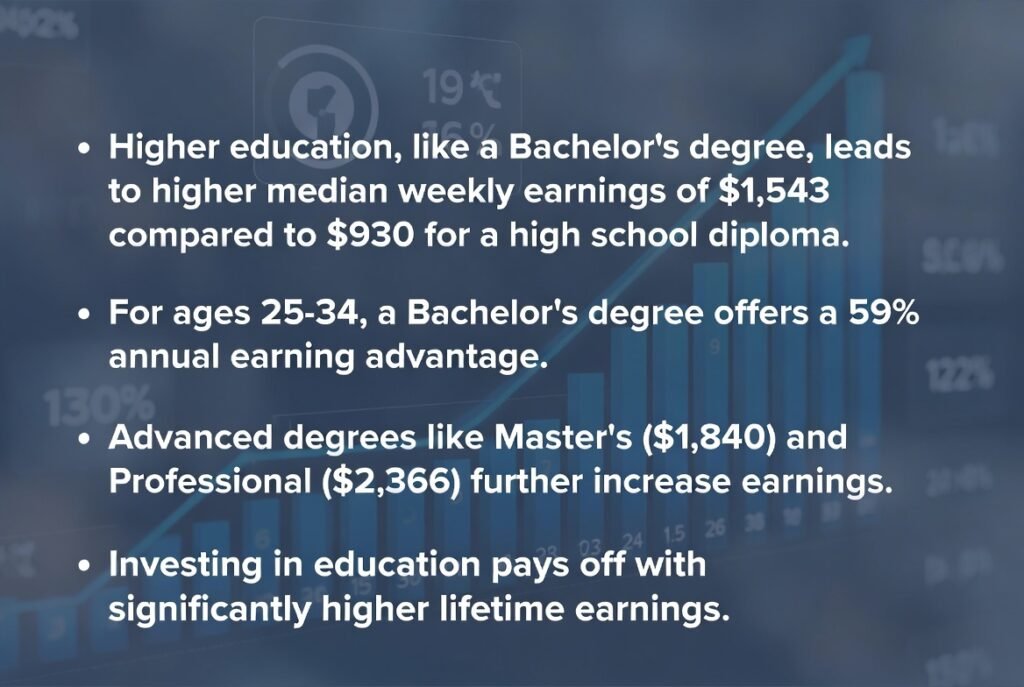
Data published by the Bureau of Labor Statistics (BLS) confirms that higher educational attainment remains the most reliable foundation for superior lifetime earnings and career stability. An individual who holds a Bachelor’s degree commands a median usual weekly salary of $1,543.
This figure is significantly higher than the median weekly earnings for those whose highest attainment is a high school diploma, which stands at $930.
For younger professionals aged 25 to 34, a bachelor’s degree provides a median annual earning advantage of 59% over those who only completed high school.
The financial ceiling continues to rise commensurate with advanced academic specialization. Professionals with a Master’s degree report median weekly earnings of $1,840, while those possessing a Professional degree achieve the highest median weekly earnings at $2,363.
These figures illustrate the enduring power of academic capital as the primary predictor of career income potential.
Crucially, advanced education serves an equally vital function as a potent economic risk mitigation strategy. Analysis of unemployment rates demonstrates a clear correlation between educational level and career stability.
The unemployment rate for individuals with a Professional degree is exceptionally low at 1.3%, rising slightly to 2.2% for Master’s degree holders and 2.5% for those with a Bachelor’s degree.
This stability offers a sharp contrast to the economic vulnerability experienced by high school graduates, who face an unemployment rate of 4.2%.
This massive variance indicates that high educational attainment is not merely a path to wealth accumulation; it provides robust economic resilience.
The higher educational level creates a greater buffer against job loss during economic contractions, effectively de-risking a professional’s career trajectory by offering approximately three times the protection against unemployment compared to a high school education alone.
1.2 Industry Selection: Identifying Where Wealth Concentrates
High compensation is not randomly dispersed throughout the economy; it is concentrated in high-growth, high-margin sectors where the capacity for profit generation is maximized.
Compensation figures from 2024 highlight the premium associated with being positioned within financially robust industries. The Communications industry, for example, was identified as a top-performing S&P 500 sector and reported a substantial 22% increase in end-of-year bonuses year-over-year.
Conversely, sectors with lower margins, such as personal services and tourism and accommodations, saw bonus amounts decrease by 10% and 7%, respectively.
In response to persistent labor costs and economic uncertainty, organizations are strategically recalibrating their compensation budgets.
This results in a hyper-stratified compensation model where financial rewards are disproportionately funneled toward the organizational apex. Companies are increasingly concentrating large bonuses among fewer, key employees to reward top talent without inflating overall payroll.
This approach validates the necessity of choosing high-margin sectors, as these industries offer the highest probability of an individual being identified as “key talent” and consequently receiving these concentrated budget allocations.
To secure a high-paying job, one must deliberately choose industries and specialized roles that are directly accountable for extreme value creation and technological leverage within the firm.
It is necessary to acknowledge that structural factors also play a measurable role in wealth acquisition.
Academic research indicates that in some markets, connections and kinship provide a tangible, non-meritocratic advantage. Close relatives of public employees and politicians are statistically more likely to secure employment in both public and private sectors and attain higher salaries.
This structural deficiency suggests that less qualified individuals can benefit from established networks and hiring practices.
Furthermore, existing wage gaps and gender sorting compound this effect, resulting in white men from high-income families benefiting from nepotistic practices significantly more than poorer populations, women, and minorities, thereby reinforcing intergenerational income inequality.
2. Strategic Education ROI and Credential Velocity
2.1 Degree vs. Certification: A Quantifiable ROI Comparison
The decision between a traditional four-year degree and an accelerated technical certification or coding bootcamp involves weighing long-term financial mass against short-term financial velocity.
Analysis of career outcomes reveals a clear trade-off that determines the optimal path for different professional goals.
A Computer Science (CS), for example, degree represents the investment in long-term financial “mass.” While the upfront education costs are steep, ranging from $40,000 to $120,000, CS degree holders start at a higher salary ($80,000+) and achieve the highest potential 10-year earnings, projected between $1.1 million and $1.5 million.
Although the financial breakeven point is longer (three to five years), the degree offers a “Very High” career ceiling, essential for entry into complex research and executive leadership pipelines.
Technical bootcamps, conversely, offer superior financial velocity. These programs have significantly lower costs, averaging between $11,000 and $14,500, and lead to rapid professional deployment with starting salaries between $65,000 and $69,000.
The low investment and rapid deployment allow bootcamp graduates to recover their investment within a quick 14 to 18 months, providing a high short-term ROI.
The modern labor market, driven by skills-based hiring, is closing the gap in employer preference for general technical roles.
The choice between the two is therefore strategic: professionals targeting executive roles requiring broad theoretical knowledge should pursue the degree’s long-term capital, while mid-career professionals seeking rapid, lucrative pivots should prioritize the high-velocity, low-cost certification model.
Table 1: Comparative ROI: Educational Attainment vs. Specialized Training
| Educational Path | Median Weekly Earnings (BLS) | Unemployment Rate | Typical Breakeven Time (Investment) | 10-Year Earning Potential |
| Professional Degree | $2,363 | 1.3% | N/A | Highest |
| Master’s Degree | $1,840 | 2.2% | N/A | Very High |
| Bachelor’s Degree | $1,543 | 2.5% | 3-5 Years | $1.1M – $1.5M |
| Technical Bootcamp | Estimated $1,250 (Starting) | Strong Placement (71-79% in 6 mo.) | 14-18 Months | $950K – $1.2M |
| High-School Diploma | $930 | 4.2% | N/A | Lower |
Data source: Bureau of Labor Statistics (2024)
2.2 Accelerated Credentials: The Power of Niche Specialization
Specialized professional certifications function as critical career accelerants, offering a fast track to six-figure compensation by validating expertise in highly in-demand technical and managerial niches.
According to Research.Com, these credentials can often be completed in as little as six to twelve months, providing high salary access without the time commitment of a traditional degree.
High-value certifications are heavily concentrated in IT, Cybersecurity, and Project Management. Examples include:
- AWS Certified Solutions Architect – Associate, which is associated with average salaries ranging from $120,000 to $150,000
- Google Cloud Professional Data Engineer certification, with earnings potential of $110,000 to $160,000
- Management credentials like the Project Management Professional (PMP) certification correlate with average salaries of $95,000 to $135,000 across diverse industries like construction, healthcare, and finance.

These credentials are highly valued because they signal validated, practical expertise to employers, directly reducing the training burden and justifying premium compensation.
2.3 Navigating Non-Degree High-Earning Pathways
Not all high-paying jobs require advanced academic credentials. Strong compensation can be achieved through specialized skilled trades and technical sales roles that prioritize on-the-job training and apprenticeships, requiring only a high school diploma or equivalent for entry.
The skilled trades, particularly union-protected fields such as electrical work, plumbing, and ironworking, often offer superior wages and benefits. Entry is facilitated through paid apprenticeships or on-the-job instruction.
For instance, roles in renewable energy are experiencing high growth rates and solid pay. Bureau of Labor Statistics 2025 report on the fastest growing occupations projects Wind Turbine Service Technicians to grow by 50% and earn a median pay of $62,580 per year.
These pathways demonstrate that applied, specialized technical skills are a highly valued form of capital, providing a reliable route to strong economic outcomes.
Similarly, specialized B2B roles, such as Wholesale and Manufacturing Sales Representatives, offer competitive earnings with only moderate on-the-job training required. While the BLS median pay is around $74,100, the average annual salary, reflecting commission structures, is closer to $89,903.
Success in these fields requires highly developed negotiation skills and deep product knowledge, confirming that specialized sales expertise provides an accelerated path to high earnings.
3. Developing High-Premium, Future-Proof Capabilities
3.1 The Exponential Value of AI Fluency and Data Competency
The contemporary labor market rewards technological leverage disproportionately, creating a significant divergence in earning potential based on fluency in emerging technologies. This is best demonstrated by the financial premium associated with Artificial Intelligence (AI) skills.
Analysis by PwC Global AI Jobs Barometer shows that workers skilled in AI commanded an average wage premium of 56% in 2024. This premium nearly doubled from the 25% reported in the preceding year, confirming the rapid escalation of demand for these skills.
This massive financial reward is directly substantiated by organizational performance metrics: industries most exposed to AI, such as software publishing and financial services, have seen productivity growth almost quadruple, increasing from 7% to 27%.
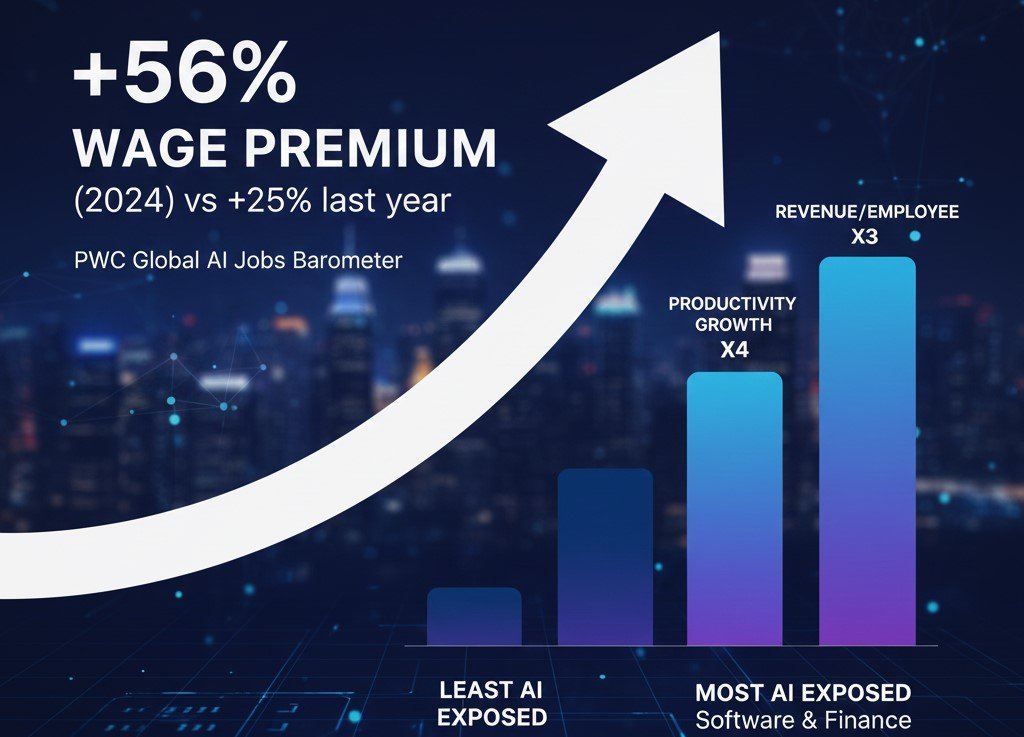
According to PwC, AI-exposed industries are now experiencing three times higher growth in revenue per employee than the least exposed industries.
The vast wage premium for AI skills confirms that the labor market is segmenting into two tiers:
- those who apply productivity-enhancing tools and
- those whose jobs are merely exposed to automation.
The 56% premium is the price employers pay for extreme leverage and value creation. To command high pay, professionals must master Generative AI and Data Science tools to become architects of organizational efficiency, ensuring they are positioned at the apex of value generation.
This exponential rate of change also means that the skills employers seek are evolving 66% faster in jobs most impacted by AI, emphasizing the absolute necessity of continuous learning agility.
3.2 The 2025-2030 In-Demand Skills Matrix
High-paying roles require a strategic investment in both advanced technical expertise and sophisticated human capabilities.
The major trends transforming the labor market through 2030, including technological advancements and broader digital access, are driving demand for a distinct matrix of competencies.
Technical Core Skills
The core technical skills fueling job growth are concentrated in data management and infrastructure security. The top three fastest-growing technical skills are technological literacy, networks and cybersecurity, and AI and big data.
Specifically, high-demand technical skills include data analytics (identified as the fastest-growing skill), machine learning, data visualization, and generative AI modeling.
These skills are non-negotiable for professionals targeting decision-making roles in the data-driven enterprise.
Read more:
Top tech skills for non-tech professionals
7 in-demand skills to add to your resume now (and 3 to delete immediately)
Best digital skills for teachers to learn now
Human-Centric Competencies
Technical competence is necessary for entry, but human-centric skills are what unlock senior and executive compensation. The market increasingly demands skills that automation cannot replicate, such as:
- leadership and management
- advanced communication and negotiation
- critical thinking
- problem-solving, and
- continuous learning agility.
These competencies are essential for managing complexity, leading diverse teams, and successfully navigating the strategic challenges presented by rapid technological change.
Table 2: The Future Skills Premium: Quantifying Wage Increases by Competency Area
| High-Demand Skill Area | Industry Example | Observed Wage Premium/Salary | Projected Growth Driver (2025-2030) |
| Artificial Intelligence (AI) Fluency | Software Publishing, Financial Services | 56% Wage Premium | Quadrupled Productivity Growth in exposed industries |
| AWS/Cloud Architecture (Certification) | Information Technology | $120,000 – $150,000 Salary | Digital Transformation and Cloud Migration |
| Data Science and Analytics | All Sectors (The Data-Driven Enterprise) | Fastest-Growing Skill | AI and Information Processing Advancements (86% transformative) |
| Project Management Professional (PMP) | Construction, Healthcare, IT | $95,000 – $135,000 Salary | Management of complex, cross-functional projects |
Source: PwC Global AI Jobs Barometer, World Economic Forum 2025 Report on The Future of Jobs, Toggl Hire (2025), and Research.com
4. The Hidden Market Advantage: Leveraging Professional Networks and Social Capital
4.1 The Referral Multiplier Effect: Why the Hidden Market Wins
A disproportionate number of high-paying jobs are secured through the hidden job market, relying on employee referrals rather than public postings. According to Employee Referral Statistics by Electroiq, employee referrals constitute 30% to 50% of all hires in the United States.
Companies heavily favor referrals because they significantly reduce hiring risk, transforming the abstract credentials of a resume into a verified quality signal.
Referred candidates are five times more likely to be hired compared to those from other sources. This preference is financially justified by improved performance metrics: referral hires show a 33% increase in job performance and exhibit substantially better retention rates, with 45% staying past four years compared to 25% of job board hires. Companies also realize an average cost saving of $3,000 per referral hire.

The conclusion from these statistics is that social capital functions as a form of de-risking capital. High-stakes, high-paying roles demand known, proven, and low-risk candidates.
Utilizing a professional network to secure a referral allows a candidate to transition from an anonymous applicant into a pre-vetted, high-quality investment prospect for the organization.
Table 3: The Referral Advantage: Performance and Retention Metrics
| Metric | Referred Hires Data | Non-Referred (Job Board) Hires Data | Quantifiable Benefit to Employer |
| Likelihood to be Hired | 5 Times More Likely | Baseline | Access to high-paying, hidden roles |
| Job Performance Improvement | 33% Increase | Baseline | Higher quality of hire |
| Retention Rate (4+ Years) | 45% | 25% | 40% Increase in Retention |
| Recruitment Cost Savings | ~$3,000 per Hire | Higher | Reduced cost of turnover |
4.2 Strategic Networking and Social Capital Development
Networking must be executed strategically to yield measurable financial benefits. Research indicates that individuals who actively network are statistically more likely to receive promotions and salary increases.
Furthermore, strong professional networks among employees contribute to organizational performance and knowledge-sharing, demonstrating that relationships are a form of corporate competitive advantage.
Effective networking is characterized by authenticity and a strategic focus on quality contacts. It requires establishing a genuine, reciprocal “give and take” dynamic rather than focusing purely on extraction.
Professionals should dedicate time to nurturing “loose ties” over long periods, as these contacts often lead to unexpected high-value opportunities.
Strategy involves preparation: developing a concise, engaging elevator speech, utilizing professional platforms like LinkedIn, and actively engaging in online conversations to support colleagues and contribute meaningfully to the community.
4.3 Mastering the High-Leverage Referral Request
The effectiveness of a referral request depends entirely on its specificity and personalization. The fundamental rule is to always ask for a recommendation for a specific, open, and currently advertised job vacancy. Vague requests force the contact to expend effort searching and rarely result in successful outcomes.
When approaching loose connections or strangers, the request must be highly personalized and structured to maximize the likelihood of a positive response.
You should begin by reminding the contact of their existing connection, explaining clearly why they were chosen for the request, and providing explicit context regarding their skills, qualifications, and the unique value they would bring to the role.
This detailed context allows the contact to easily justify and execute the referral. For loose ties, a discreet request, such as asking to be pointed toward the correct decision-maker, is often more successful than a direct demand for an introduction.
5. Executive Branding and Quantifiable Self-Marketing
5.1 The 7.4-Second Rule: Structuring Achievements for Recruiter Impact
High-paying jobs are high-stakes hires, and the candidate’s application materials must function as an immediate, persuasive argument for investment.
Recruiters allocate an average of only 7.4 seconds to skim a resume before making an initial determination. If the document does not immediately convey quantified value, it is discarded.
Quantification of achievements—based on ResumeWorded—is the single most effective strategy for creating an impactful resume.
High earners speak the language of business results. They translate their accomplishments into tangible metrics of:
- organizational benefit, such as: revenue, profit, or sales generated
- the percentage by which costs were reduced or efficiency was increased;
- time saving
- the quantity and scope of projects managed.
The inability to quantify past impact fundamentally undermines the justification for a high future salary. By focusing on metrics, the resume transitions from a descriptive job history to a predictive prospectus of future organizational ROI.
5.2 Quantifying the Non-Quantifiable: The Soft Skills of Hard Numbers
Professionals in roles that are not directly responsible for profit and loss (P&L)—such as HR, operations, and service roles—must develop creative ways to quantify the impact of their soft skills and efficiency gains.
For roles outside of direct revenue generation, value can be communicated through metrics related to scope, frequency, and collaboration results. This includes using:
- frequency-based metrics (“Handled 50+ customer inquiries weekly”), or
- scope metrics (“Managed scheduling for a 20-person department”).
Achievements involving teamwork must be framed around measurable outcomes, such as the implementation of a new process that resulted in improved workflow efficiency across cross-functional teams.
To maintain momentum in the short reading window, every bullet point should begin with a strong action verb (e.g., “Led,” “Spearheaded,” “Developed”) to effectively convey leadership, problem-solving, and creative impact.
Learn how to quickly optimize your resume for the high-paying position you are about to apply for.
5.3 The Executive Personal Brand and Digital Credibility
For candidates targeting high-paying leadership and executive roles, a personal brand is indispensable.
A personal brand—the unique collection of values, experiences, and associations attached to an individual—establishes credibility, inspires trust, and is a critical factor in career advancement. Strong executive reputations are known to directly impact employer credibility and shareholder value.
Digital credibility is now integral to the vetting process. According to Social Media Recruitment Statistics 2025 by StandOut CV, a significant 84% of recruiters screen candidates’ social media activity.
This process assesses whether the candidate’s values align with the company culture, verifies professional claims, and identifies potential risks.

Consequently, as a professional, you must proactively cultivate your online presence. You can utilize platforms like LinkedIn, X (Twitter), and engage in relevant industry forums (e.g., specialized subreddits or ResearchGate) to establish yourself as an expert.
This digital presence should focus on engaging in conversations, supporting colleagues, and serving as an active, contributing member of the professional community.
6. Maximizing Compensation: Negotiation and Psychological Resilience
6.1 The 18.83% Difference: The Financial Imperative of Negotiation
The most significant single opportunity for immediate and long-term financial gain is effective salary negotiation.
The evidence confirms this skill’s massive ROI: professionals who negotiate their salary offers receive an average increase of 18.83% over those who accept the initial offer, with some documented cases securing increases up to 100%.
This initial gain compounds over the course of an entire career, affecting every subsequent raise, bonus, and retirement calculation. This compounding effect establishes negotiation as the single highest-leverage financial tool a professional can employ.
Despite this quantifiable return, data indicates a significant self-imposed barrier: 55% of workers still fail to attempt negotiation, even though 66% of those who do successfully achieve their requested terms.
High earners view negotiation not as a risk, but as a mandatory financial activity essential for maximizing lifetime wealth.
Explore how to negotiate for salary after a job offer (plus 150+ salary negotiation scripts in PDF)
6.2 The Strategic Negotiation Framework
Successful negotiation is a strategic process built on data, preparation, and psychological control.
The negotiation strategy must be anchored in comprehensive market research and data to ensure the requested salary is defensible and leverages external factors like local pay transparency laws.
Experts recommend utilizing a hybrid competing-collaborative strategy: be firm on the desired financial goal (anchoring high) but flexible on the composition of the total offer, incorporating non-base elements like equity, sign-on bonuses, or structured benefits.
The psychological element of negotiation is paramount. Professionals must manage their internal dialogue, resisting the impulse to concede before the discussion even begins.
Preparation must include an enthusiastic and well-articulated defense of the candidate’s unique value proposition and the development of strong alternatives to the current offer, which increases flexibility at the negotiation table.
6.3 Strategic Career Movement: Investing in Future Leverage
Achieving high-paying senior roles often requires deliberate strategic career movement beyond simple vertical progression. According to INTOO, lateral (horizontal) career moves, even if they do not immediately confer a salary increase, are critical investments in future leverage.
Lateral moves are essential for gaining the diversified skill sets and organizational breadth required for executive leadership.
By viewing a horizontal shift without an immediate raise as an investment, the professional is strategically deferring a salary increase for a much larger payoff later. The breadth of experience gained in such a move increases the individual’s value within the organization, positioning them for the highest compensation tiers later on when that diverse expertise is leveraged for a major executive promotion.
6.4 The Mindset of the High Earner: Proactivity, Resilience, and Risk
The pursuit of high compensation is intrinsically linked to psychological traits that drive self-discipline, action, and calculated risk tolerance.
Proactivity and Resilience
A proactive personality—the disposition to take initiative and drive change—is directly linked to extrinsic career growth, including accelerated promotion speed and higher pay (remuneration).
High earners exhibit key psychological traits such as self-discipline, resilience, and delayed gratification, choosing to forgo immediate rewards in favor of long-term financial success through persistent saving and investing.
Proactive individuals are inherently equipped to handle challenges and pursue goals with persistence.
The Reward for Calculated Risk
High-paying environments reward action and learning derived from experience. Research on risk-taking behavior in the workplace shows that successful risk-takers are 79.0% more likely to be promoted.
Crucially, the data indicates that even those who are identified as failed risk-takers are advantaged over those who are entirely risk-avoidant: failed risk-takers are rated as more likely to be promoted (55.7%) and more likely to be sent to high-potential leadership training (65.1%).

This suggests that organizations view proactive effort and the resulting failure as developmental. The largest psychological barrier to a high-paying job is not a fear of failure, but the inertia and risk aversion that prevent calculated action.
Conclusion: The Six Pillars of Landing High-Paying Jobs
Landing a high-paying job is a measurable, strategic outcome determined by the proactive, evidence-based application of market dynamics, not by chance. The strategic professional must simultaneously optimize along these six critical pillars:
- Foundational Investment: Utilize advanced education or specialized, high-velocity certifications to establish high financial mass and superior economic resilience.
- Industry Selection: Deliberately position one’s career in high-margin, high-growth sectors where wealth generation is concentrated (e.g., AI-exposed industries).
- Skill Acquisition: Focus on mastering high-premium skills (AI fluency, data science) that offer demonstrable leverage and command exponential wage premiums, alongside core human-centric skills (negotiation, leadership).
- Social Capital: Systematically build and leverage professional networks, focusing on high-quality contacts to access the hidden job market where 30% to 50% of hires occur, drastically de-risking the hiring process.
- Professional Positioning: Treat self-marketing as a business prospectus, quantifying all achievements to pass the critical 7.4-second recruiter screen, and maintaining a robust, credible personal brand online.
- Compensation Maximization: Always negotiate salary to secure the average 18.83% compounded return, underpinned by a resilient, proactive mindset that prioritizes calculated risk-taking and action over caution.
Take Action
The evidence is clear: your career trajectory is a product of your strategy, not your environment. Reading this guide is the first step; the application of its principles is the imperative. Do not wait for an opportunity—create it.
Don’t just read about how people land high-paying jobs—take action now.
Begin by auditing your current professional position against the Six Pillars of High-Pay Acquisition, and then explore the wealth of related resources essential for comprehensive professional growth: delve into pragmatic salary negotiation guides (featuring 150+ free scripts), access evidence-based content on professional wellbeing, and identify the top in-demand skills you need to add to your resume now.
Your market value is determined by the action you take next. Start optimizing today.
Join the Career Intelligence Community
Get exclusive data insights, downloadable tools, and mindful career strategies delivered monthly — no fluff, no spam.