Thinking of how to become a commercial pilot in Kenya? This article offers a step-by-step guide for aspiring pilots, outlining the training path from Student Pilot License to Airline Transport Pilot License.
- The total cost of training ranges from KSh 7M to 10M ($48K–$70K+), depending on the flight school and ratings pursued
- Graduates can expect competitive salaries, from KSh 60,000/month as flight instructors to over KSh 2.5M/month for senior airline captains, making pilot careers in Kenya both high-stakes and highly rewarding.
Contents
Introduction
The Kenyan aviation industry is entering one of the most exciting growth phases in its history.
According to aviation industry data from IATA and the Kenya Civil Aviation Authority (KCAA) Kenya’s aviation sector now contributes over KSh 425 billion annually to the economy and supports more than 460,000 jobs across airlines, airports, tourism, cargo logistics, and aircraft maintenance.
At the heart of this expansion is a critical shortage of qualified commercial pilots.
As Nairobi strengthens its position as a major African aviation hub—alongside Kigali and Johannesburg—airlines are rapidly expanding fleets, opening new regional and international routes, and hiring pilots faster than training schools can supply them.
At the same time, Kenya is investing heavily in:
- Jomo Kenyatta International Airport (JKIA) modernization
- Wilson Airport upgrades
- Expansion of regional airports across the coast and Rift Valley
This combination of booming demand + limited pilot supply has pushed pilot salaries to record levels, making aviation one of the highest-paying professional careers in Kenya.
However, becoming a pilot in Kenya requires:
- Careful financial planning
- Strong academic discipline
- Strict medical compliance
- Strategic school selection
This complete guide explains exactly how to become a commercial pilot in Kenya, including:
- Training requirements
- Step-by-step licensing process
- Best flight schools
- Cost breakdown
- Salary expectations
- Career progression
So you can decide whether this high-reward career path is right for you.
The Aviation Opportunity in Kenya: What’s Driving Pilot Demand?
Industry forecasts from IATA and African aviation market analysts indicate that African air travel demand is now growing faster than the global average, driven by:
- Rising middle-class incomes
- Growth in regional tourism
- Expansion of low-cost carriers
- Increased business travel across East and Central Africa
At the same time, airlines face a global pilot shortage, with over 24,000 unfilled pilot positions projected in 2026 alone, and a deficit expected to exceed 80,000 pilots worldwide by 2032.
In Kenya, airlines such as:
- Kenya Airways
- Jambojet
- Safarilink
- Regional charter and medical evacuation operators
are aggressively recruiting both locally trained and foreign pilots.
This shortage is reshaping:
- Hiring standards
- Salary structures
- Training investments
- Career acceleration
For aspiring aviators, this creates a rare window of opportunity.
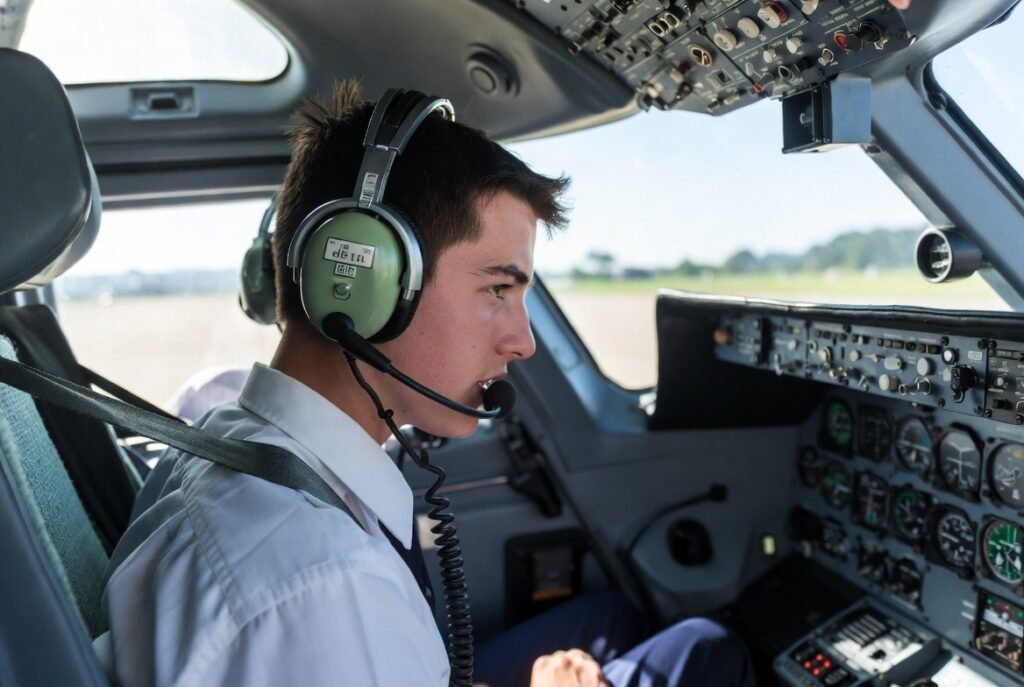
Step-by-Step Path to Becoming a Commercial Pilot in Kenya
Kenyan aviation licensing follows a structured, progressive system regulated by the Kenya Civil Aviation Authority (KCAA).
Your journey to the cockpit follows four main stages:
- Private Pilot License (PPL)
- Commercial Pilot License (CPL)
- Multi-Engine Instrument Rating
- Airline Transport Pilot License (ATPL)
Let’s break down each step clearly.
RECOMMENDED FOR YOU:
How people land high-paying jobs
Phase 1: Private Pilot License (PPL) – Your First Real Milestone
According to Aviators of Tomorrow, the Private Pilot License (PPL) allows you to fly aircraft for personal and recreational purposes, but not for commercial pay.
Based on the Kenya School of Flying, Private Pilot License (PPL) Course is your first step into the skies. It’s designed for aspiring pilots and it takes four to six-month. The training combines essential theory and hands-on flying experience to prepare you for a rewarding aviation career.
However, in modern aviation training, the PPL is considered the foundation stage for all professional pilots.
Admission Requirements for Private Pilot License (According to KSOF)
| Category | Requirement Detail |
| Age | Minimum 16 years to begin training |
| Academics | KCSE C+ (Min. C+ in Math, English, Geography & a Science) |
| Medical | Certificate from an accredited Aviation Medical Examiner |
| Security | Valid Certificate of Good Conduct |
| Identity | Copies of ID, Birth Certificate, or Passport |
| Academic Records | Copies of all relevant Academic Papers |
| Photography | 6 Photos total (3 Standard size & 3 sized 2cm x 2.5cm) |
| Written Exams | Internal tests in Math, English, and Psychometrics |
| Aptitude | 5-Lesson Flight Assessment to evaluate readiness |
What You Learn at PPL Level
- Aircraft handling
- Navigation
- Meteorology
- Aviation law
- Human performance
- Emergency procedures
You must pass both written exams and a practical flight test (General Flight Test – GFT) conducted by an authorized examiner.
At this stage, students also earn an English Language Proficiency (ELP) rating, which determines international flying eligibility.
The Cost of Private Pilot License (PPL)
This phase builds your flying foundation and introduces you to aviation theory, aircraft handling, and airspace operations.
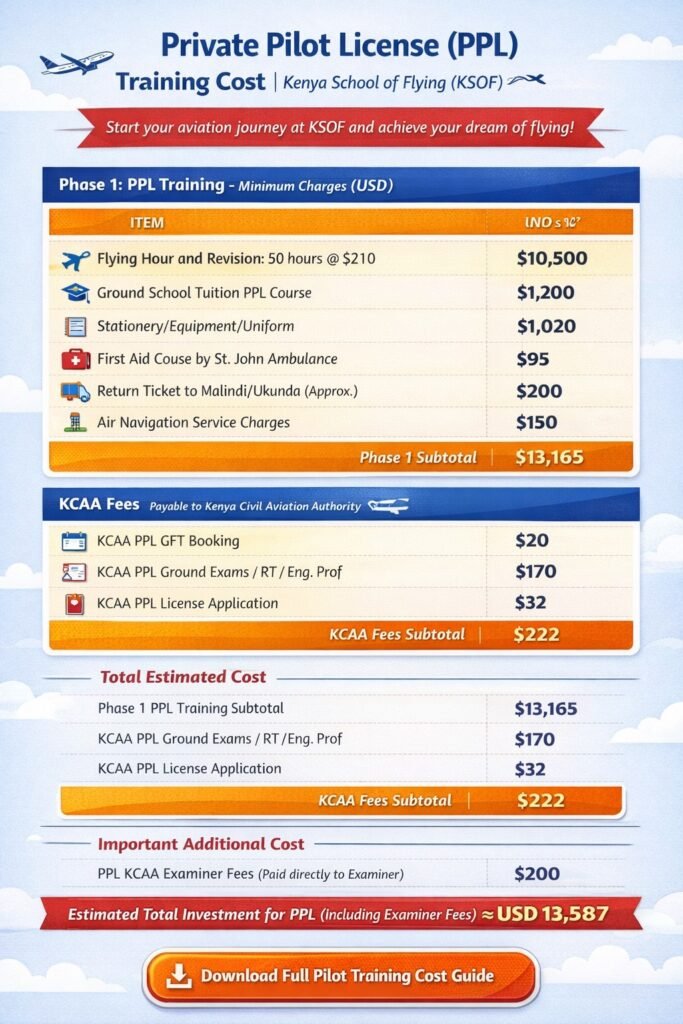
Based on data from Kenya School of Flying and West Rift Aviation, here is the typical PPL cost breakdown:
| Cost Item | Estimated Cost (USD) | Approx KES |
|---|---|---|
| Flight Training (45–50 hrs) | $9,450 – $10,500 | 1.35M – 1.50M |
| Ground School Tuition | $1,200 | 170k |
| Headset, Uniform & Gear | $1,000 – $1,100 | 145k – 160k |
| Registration & Induction | $30 – $100 | 4k – 15k |
| KCAA Exams & Licensing | $220 – $390 | 30k – 55k |
| Estimated Total | $12,000 – $13,500 | 1.7M – 2.0M |
Key tip:
Students who fly 3–5 times per week complete faster and spend significantly less than those who train sporadically.
Phase 2: Commercial Pilot License (CPL) – Becoming a Professional Pilot
The Commercial Pilot License (CPL) allows you to fly aircraft for compensation and is mandatory for airline, charter, cargo, and corporate flying jobs.
Commercial Pilot License Requirements
| Requirement | Standard |
|---|---|
| Minimum Age | 18 years |
| Medical | Class 1 Certificate (mandatory) |
| Prerequisite | Valid PPL |
| Total Flight Time | 155 hours minimum |
| Application Fee | KSh 4,500 |
What Changes at Commercial Pilot License (CPL) Level?
Training becomes far more intensive and professional, focusing on:
- Advanced aircraft control
- Complex navigation
- High-performance maneuvers
- Multi-crew coordination
- Turbine engine theory
- Flight planning at airline standards
- This phase transforms you from a hobby pilot into a professional aviator. Enroll for Commercial Pilot License at Kenya School of Flying today.
Commercial Pilot License Cost
According to Kenya School of Flying article on Commercial Pilot License, progressing to the CPL phase requires an additional 155 to 160 flight hours, often in more sophisticated aircraft types.
This is the most expensive and demanding stage.
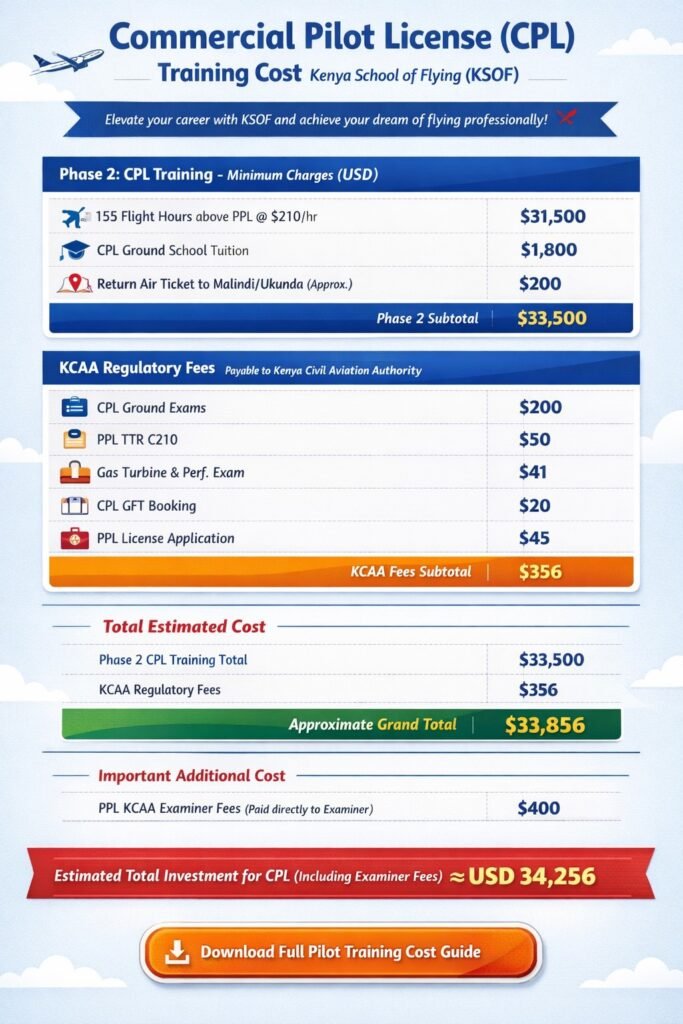
| Cost Item | Estimated Cost (USD) | Approx KES |
|---|---|---|
| Advanced Flight Hours (160 hrs) | $32,550 – $33,600 | 4.7M – 4.9M |
| CPL Ground School | $1,800 | 260k |
| KCAA Exams & Fees | $200 – $350 | 30k – 50k |
| Navigation & Admin Charges | $200 – $450 | 30k – 65k |
| Estimated Total | $35,000 – $36,500 | 5.0M – 5.3M |
Phase 3: Multi-Engine Instrument Rating Course
Kenya
Phase 3 marks the final and most advanced stage of Commercial Pilot training in Kenya, designed to transform you into a highly skilled multi-engine, instrument-rated professional pilot.
At the Kenya School of Flying (KSOF), this intensive six-week Multi-Engine Instrument Rating (ME/IR) course equips you with the technical expertise, precision, and confidence required to safely operate complex, multi-engine aircraft in all weather conditions.
Course Overview
Total Training Time: 40 Hours
- 20 Hours – Simulator Training (@ USD 65/hour)
Build mastery in instrument procedures, emergency handling, and advanced flight scenarios using state-of-the-art flight simulators. - 20 Hours – Seneca PA34 Multi-Engine Aircraft (@ USD 600/hour)
Apply your skills in real-world flying conditions aboard the Piper Seneca PA34, a proven multi-engine training aircraft. - 3 Hours – General Flight Test (GFT) (@ USD 600/hour)
Final practical assessment to demonstrate full competency in multi-engine and instrument flight operations.
Cost of Multi-Engine & Instrument Rating (ME-IR)
This phase makes you airline-ready, enabling you to fly twin-engine aircraft using instruments only.
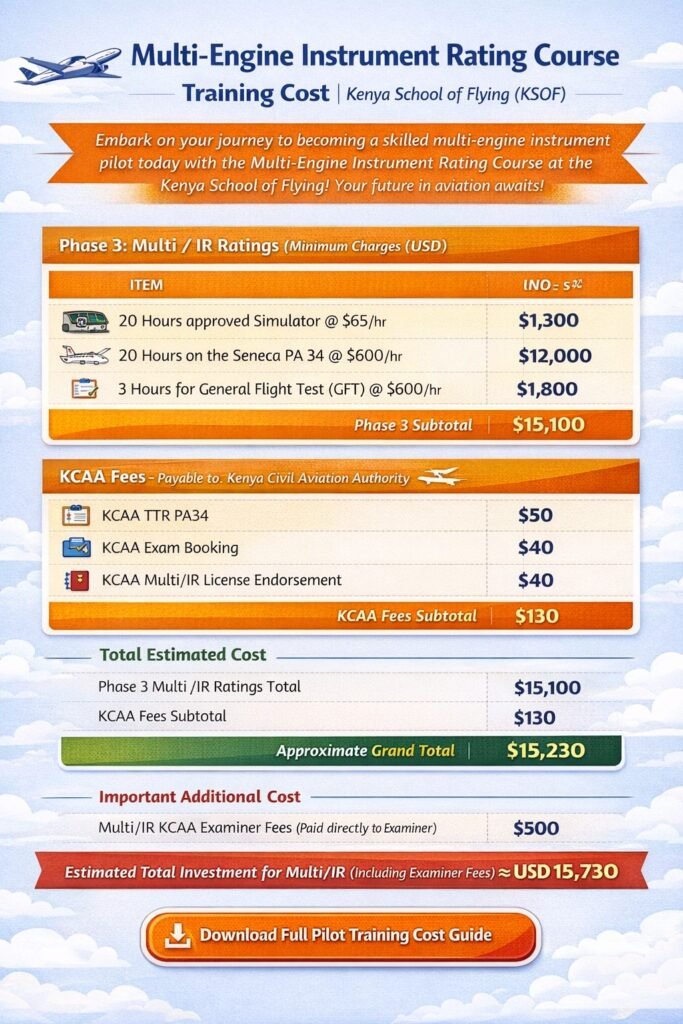
| Cost Item | Estimated Cost (USD) | Approx KES |
|---|---|---|
| Simulator Training | $800 – $1,300 | 115k – 185k |
| Multi-Engine Flight | $12,000 – $15,000 | 1.7M – 2.1M |
| KCAA Test & Examiner Fees | $500 – $1,000 | 70k – 145k |
| Estimated Total | $13,300 – $17,300 | 1.9M – 2.5M |
Total Cost of Becoming a Commercial Pilot in Kenya
| Training Stage | Estimated Cost |
|---|---|
| PPL | KSh 1.7M – 2.0M |
| CPL | KSh 5.0M – 5.3M |
| ME-IR | KSh 1.9M – 2.5M |
| Grand Total | KSh 7M – 10M |
Phase 4: Airline Transport Pilot License (ATPL) – The Captain’s License
The Airline Transport Pilot License (ATPL) is the highest pilot qualification, required to serve as airline captain.
Many pilots first earn a “frozen ATPL”, meaning they pass the theoretical exams but still need 1,500 flight hours to fully unlock captain privileges.
According to Kenya School of Flying, the Airline Transport Pilot License (ATPL) course is designed to broaden the knowledge of pilots holding a commercial pilot license and prepare them for the complexities of the airline environment.
An applicant for an Airline Transport Pilot License shall —
- Be at least twenty-one (21) years of age.
- Have a valid Class 1 Medical Certificate.
- Hold a valid and current Commercial Pilot License and an Instrument Rating.
- Pass a type rating exam if not rated on the aircraft category and class rating sought.
- Meet the required hours of this sub-part before applying for the practical test.
- Pass the required practical test for the specific aircraft type to be endorsed on the license.
ATPL Requirements
| Requirement | Standard |
|---|---|
| Minimum Age | 21 years |
| Medical | Class 1 Certificate |
| Total Flight Time | 1,500 hours |
| Prerequisite | CPL + Instrument Rating |
| License Fee | KSh 8,000 |
This is the level where pilots command wide-body jets, international routes, and executive-grade compensation packages.
Hidden Costs Most Students Ignore
These are the expenses that quietly destroy budgets:
1. Living Expenses
If training in Nairobi:
- Rent + food + transport: KSh 45,000 – 75,000/month
Over 18–24 months, this alone adds KSh 800k – 1.5M.
2. Examiner Fees
Paid directly to independent examiners:
- PPL: ~$200 (KSh 25,800)
- CPL / ME-IR: ~$500 (KSh 64,500)
3. Training Gaps
Inconsistent training doubles costs. Long breaks force students to redo lessons, increasing flight hours.
4. Aviation Apps & Gear
Modern pilots need:
- iPad + ForeFlight / Garmin Pilot
- Professional headset (Bose / David Clark)
Budget: $1,500 – $2,000 (KSh 193,500 – KSh 258,000)
Best Flight Schools in Kenya
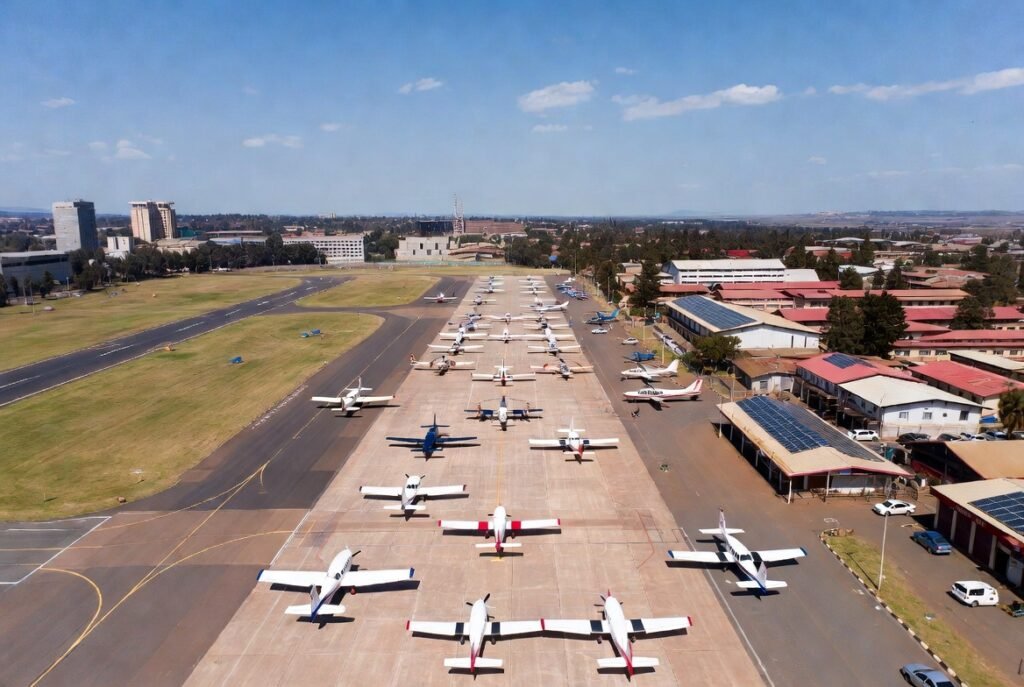
Kenya has one of Africa’s strongest pilot training ecosystems, centered around Wilson Airport, Nairobi, with satellite campuses in Malindi, Ukunda, Eldoret, and Orly.
Here are the top aviation training organizations (ATOs) in Kenya:
Kenya School of Flying (KSOF)
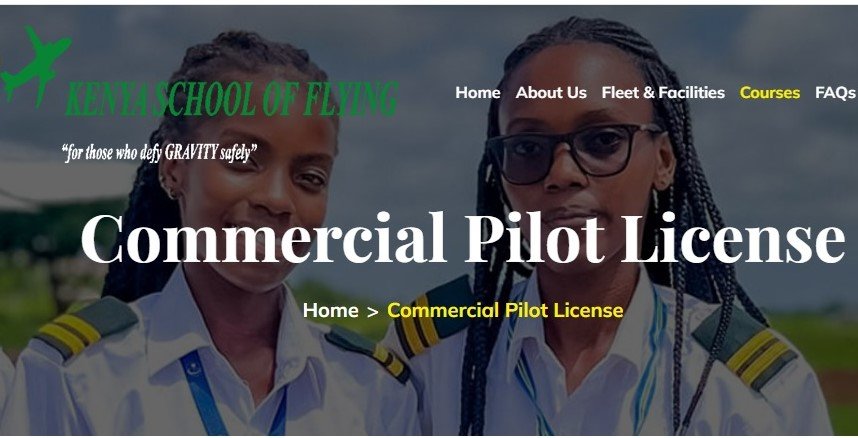
KSOF is Kenya’s largest and most internationally recognized flight academy.
Why students choose KSOF:
- Over 30 years of training experience
- Large modern fleet
- Full-motion flight simulators
- Multiple training bases
- Airline partnerships
Unique advantage:
Partnership with University of Eastern Africa, Baraton, allowing students to earn a BSc in Aviation Management alongside flight training.
Enroll for aviation courses at Kenya School of Aviation.
West Rift Aviation
Known for high instructional quality and strong maintenance culture.
Best for:
- Students seeking personalized instruction
- Modular training paths
- Flexible schedules
KAC Flying School (Kenya Aeronautical College)
Offers integrated pilot + engineering exposure, allowing students to understand both flight operations and aircraft maintenance.
Best for:
- Students interested in technical aviation careers
- Hands-on aircraft systems exposure
Ninety-Nines Flying School
One of Kenya’s oldest aviation schools, founded in 1975.
Best for:
- International students
- Multi-engine training
- Strong simulator programs
Flitestar Academy
Focused on airline-standard training and professional cockpit readiness.
Best for:
- Students targeting airline careers
- Intensive IFR and multi-crew programs
Other Recognized Training Institutions
- Alpha Aviation
- Standards Aviation
- East African School of Aviation (EASA – KCAA training directorate)
- Eldoret Aviation Training Institute (EATI)
How Long Does Pilot Training Take in Kenya?
| Stage | Typical Duration |
|---|---|
| PPL | 3 – 6 months |
| CPL | 12 – 18 months |
| ME-IR | 3 – 5 months |
| Total | 18 – 24 months |
Fast-track students can finish in 14–16 months, while slow-paced students may take 3–4 years.
Pilot Salaries in Kenya
Based on the 2026 Aviation Salary Report by The Flying Engineer, the global aviation industry offers record-breaking compensation packages for pilots, driven by a global pilot shortage that is projected to reach 80,000 unfilled positions by 2032. In Kenya, this has resulted in intense competition for experienced cockpit crew and a substantial increase in starting packages at regional airlines.
MUTHII W.M & ASSOCIATES reports that pilot compensation significantly outpaces other top-tier professions in Kenya.
According to AscendurePro’s salary outlook, a Kenya Airways captain can make up to KES 2 million per month (≈KSh 24M/year), and with flight allowances can reach about KES 30M.
Pilot pay in Kenya now ranks among the highest professional salaries.
Average Pilot Salaries in Kenya
According to hiring data from Kenyan airlines and global aviation recruitment agencies, here is what pilots earn:
| Career Level | Aircraft Type | Monthly Salary (KES) |
|---|---|---|
| Flight Instructor | Cessna 172 | 60k – 120k |
| Junior Pilot / Charter | GA / MedEvac | 100k – 250k |
| Regional First Officer | Dash 8 / ATR | 250k – 500k |
| Major Airline FO | B737 / B787 | 600k – 900k |
| Regional Captain | ATR / Dash 8 | 800k – 1.2M |
| Widebody Captain | B787 / B777 | 1.5M – 2.5M |
The Mechanism of Compensation of Commercial Pilot
Unlike traditional salary structures, commercial pilot earnings in 2026 are highly modular:
- Block Hour Pay: Most pilot contracts include a base salary plus a per-hour rate for actual hours flown. Larger and more sophisticated aircraft command higher hourly rates.
- Per Diems: Daily allowances for time spent away from the base ranging from Ksh 193.50 to Ksh 387.00 ($1.50 to $3.00) per hour away are meant to cover food and expenses during layovers. For a pilot on international routes, this adds a tax-free cushion to the take-home pay.
- Sign-On and Retention Bonuses: To prevent talent poaching by Middle Eastern and Gulf carriers (who offer $180,000-$320,000 tax-free packages), Kenyan carriers are increasingly offering retention incentives that can reach KSh 500,000 to KSh 1,000,000 for experienced captains.
Seniority Impact: Seniority within an airline’s roster determines nearly every aspect of professional life, including quality-of-life provisions, base flexibility, and preference for lucrative overtime trips.
Career Progression: From Student to Captain
Typical Career Path
- Student Pilot
- Private Pilot
- Commercial Pilot
- Flight Instructor / Charter Pilot
- Regional Airline First Officer
- Major Airline First Officer
- Captain
Time to command:
Typically 6–10 years, depending on training pace, airline hiring, and flight hours.
Job Market Reality in Kenya
Kenyan airlines aggressively recruit due to:
- Fleet expansion
- Pilot migration to Gulf carriers
- Regional tourism growth
- Cargo aviation boom
Major employers include:
- Kenya Airways
- Jambojet
- Safarilink
- Astral Aviation
- Various charter and medevac operators
Common Training Mistakes (And How to Avoid Them)
1. Flying Once a Week
Leads to:
- Slow skill development
- Cost overruns
- Training fatigue
Fix: Fly 2–4 times weekly.
2. Poor Radio Communication
Causes:
- Failed tests
- High cockpit stress
Fix: Practice ATC calls using live radio streams.
3. Poor Study Discipline
Aviation theory is intense.
Fix: Daily revision + mock exams.
Final Verdict: Is Becoming a Commercial Pilot in Kenya Worth It?
Yes, becoming a commercial pilot in Kenya is worth it if you:
- Can secure KSh 7M – 10M funding
- Have strong discipline and focus
- Are medically fit
Then aviation offers:
- One of the highest ROI careers in Kenya
- Global mobility
- Exceptional long-term earnings
- Prestigious professional identity
FAQs on How to Become a Commercial Pilot in Kenya
How much are pilot school fees in Kenya?
The total cost of pilot training in Kenya ranges between KSh 7 million and KSh 10 million (approximately $48,000 to $70,000+) to reach airline eligibility. A Private Pilot License (PPL) alone costs roughly KSh 1.7M – 2.0M, while the Commercial Pilot License (CPL) phase adds an additional KSh 4.5M – 5.5M. Fees are primarily driven by fuel prices, aircraft maintenance, and KCAA exam bookings.
What KCSE grade is needed for piloting?
To enroll in a professional flight school in Kenya, you generally need a minimum KCSE Mean Grade of C+ (plus). Most academies specifically require a C+ in Mathematics, English, Geography, and at least one Science subject (Physics or Chemistry).
How much is a pilot’s salary in Kenya?
Pilot salaries in Kenya are among the highest in the country, though they vary by seniority and airline:
Junior First Officers: KSh 40,000 – KSh 100,000 (entry-level/internships).
Regional First Officers: KSh 250,000 – KSh 500,000.
Regional Captains: KSh 800,000 – KSh 1.2M.
Major Airline Senior Captains (e.g., Kenya Airways): KSh 1.5M – KSh 2.5M+ per month.
Which school is the best to study pilot in Kenya?
Kenya School of Flying (KSOF) is widely considered the premiere flight training organization due to its 30-year legacy, multi-base operations (Wilson, Malindi, Ukunda), and Africa’s first full-motion twin-engine flight simulator. Other top-tier options include Ninety-Nines Flying School for its international reputation and Flitestar Academy for its airline-standard training focus.
Cheapest flying school in Kenya
Standards Aviation is frequently cited as one of the most affordable options at Wilson Airport that maintains high professional standards. Additionally, Kismet College is a popular choice for budget-conscious students because it offers flexible monthly payment plans, making the heavy investment more manageable over time.
How to become a pilot in Kenya
The path to the cockpit follows five main steps:
Student Pilot License (SPL): Get your learner’s permit and pass a Class 2 medical exam.
Private Pilot License (PPL): Complete 45–50 flight hours and pass ground school exams to fly for non-commercial purposes.
Commercial Pilot License (CPL): Accumulate at least 200 total flight hours and pass advanced theoretical exams to fly for pay.
Multi-Engine & Instrument Rating (ME-IR): Gain the skills to fly complex twin-engine jets in poor visibility.
Airline Hire: Apply for First Officer roles at regional or major carriers to begin building the 1,500 hours needed for an Airline Transport Pilot License (ATPL).
Join the Career Intelligence Community
Get exclusive data insights, downloadable tools, and mindful career strategies delivered monthly — no fluff, no spam.