Kenya is positioning itself as a future hub for robotics and automation. In late 2025 the government launched a National AI Strategy (2025–2030) to propel research and innovation in fields like robotics.
This push coincides with booming sectors like e-commerce and manufacturing. For example, DHL reports Kenyan warehouses are rapidly adopting autonomous mobile robots and smart storage systems to meet soaring online shopping demand.
For students and professionals, this signals growing career possibilities. As Kenya modernizes its economy, roles in robotics engineering, automation, and AI are becoming more common.
Contents
What Is Happening in Robotics Jobs in Kenya
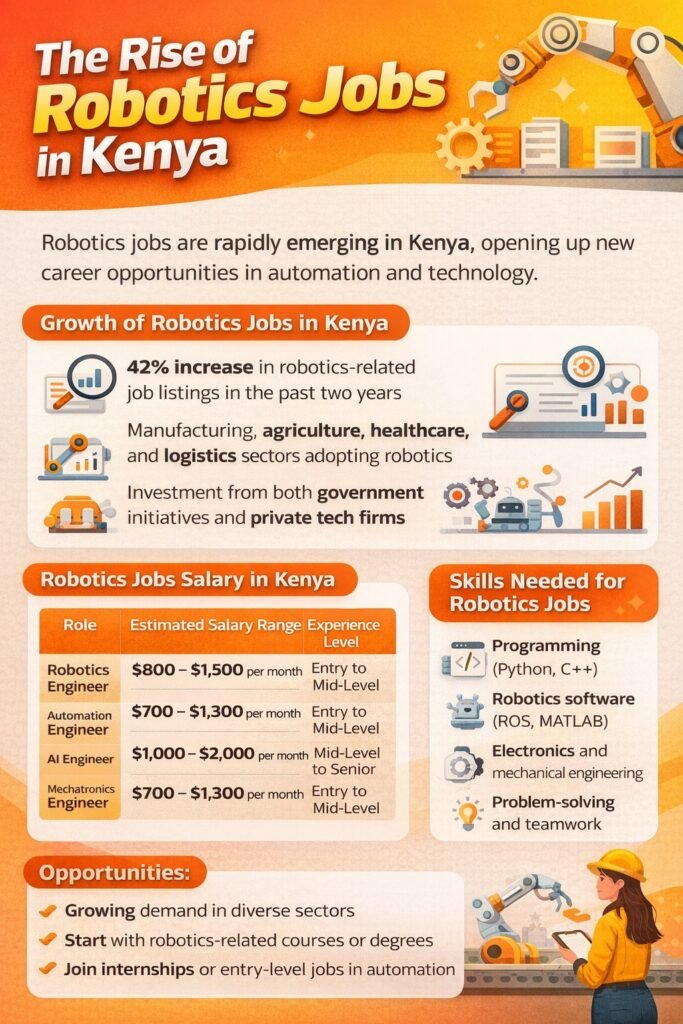
Businesses across Kenya are beginning to advertise robotics and automation roles. Local job boards and industry news show openings for positions such as robotics engineers, mechatronics technicians, RPA (Robotic Process Automation) developers, and related roles.
Major companies are taking notice. For instance, Safaricom recently advertised an RPA developer position responsible for planning and delivering “robotics and intelligent workflows” to automate business processes.
In logistics and manufacturing, firms like DHL report that distribution centers from Nairobi to Mombasa now use warehouse robots and smart conveyor systems to improve speed and precision.
Education institutions are also investing in robotics. Some universities are hiring faculty in robotics and automation, reflecting new academic programs. And training centers are offering courses in robotics for technicians and engineers.
In short, a variety of Kenyan industries – from technology and telecoms to factories and farms – are dipping into robotics, creating demand for skilled workers.
RECOMMENDED FOR YOU:
Top 10 Best Companies to Work for in Kenya (2026) – Salaries & Benefits
Top 26 Careers in AI and Machine Learning: Roles, Salaries, Skills, and 2026 Outlook
Why the Rise in Robotics Jobs Matters Now
This trend matters because Kenya’s economy and workforce are shifting. Globally, robotics is exploding – investment bank Morgan Stanley projects the global robotics market could reach $5 trillion by 2050. Kenya is aligning with that future through policy and private investment.
The government’s AI strategy explicitly aims to make Kenya a regional AI leader and is tied to the Vision 2030 plan and National Digital Master Plan. These strategies highlight technology-driven growth and often cite robotics and automation among key priorities.
At the same time, local industries face new challenges that automation can solve. The e-commerce boom means consumers want same-day delivery, pressuring Kenyan warehouses to adopt automation to keep up.
In agriculture, drones and robotic sensors help increase yields and reduce labor – Kenyan research shows farms using these tools see significant productivity gains. Even service sectors are getting automated: banks and utilities are piloting RPA bots to handle routine tasks.
All this means employers will need engineers and technicians who understand robotics. A Vision 2030 report even emphasizes that counties investing in digital services and automation tend to achieve better outcomes, and it urges tapping Kenya’s large youth population for innovation.
Who Should Care About the Rise of Robotics Jobs in Kenya?
Students, new graduates, and mid-career professionals should take note. For young people, robotics careers offer high-tech, future-oriented paths beyond traditional jobs. For engineering or computer science graduates, this means more specialized roles to aim for.
Mid-career workers in manufacturing, IT, or even business processes can consider pivoting into automation or RPA fields.
With government backing and private-sector interest, skills in robotics and automation are likely to become increasingly valuable in Kenya’s job market.
Key Developments in Robotics Jobs in Kenya
- Industry Adoption: Kenyan manufacturers and logistics firms are beginning pilot projects. In distribution, for example, DHL notes Kenyan companies are “leading the charge” in warehouse automation, deploying autonomous robots and smart storage to boost efficiency. In agriculture, institutions like the Kenya Agricultural and Livestock Research Organization (KALRO) report that drone and sensor systems are raising crop yields on farms that adopt them.
- Digital Economy Growth: As Kenya’s tech sector grows (e.g. in Nairobi’s “Silicon Savannah”), more startups and established firms are exploring robotics. Startups focused on RPA, computer vision, and industrial automation (such as Rapid Automations and AI Wakforce) are emerging.
- Hiring Signals: Job portals show dozens of listings for robotics-related positions. LinkedIn, for example, has dozens of “robotics” or “automation” roles in Kenya, ranging from Field Service Mechatronics Engineer to Automation Technician. Companies like Sidel, Diageo, and Globeleq have recently posted openings in mechatronics and automation, indicating growth in this area.
- Academic Programs: Universities are expanding robotics curricula. For instance, the United States International University – Africa (USIU) advertised an Assistant Professor in Robotics and Systems Automation, signifying investment in training future engineers. Other institutions offer diplomas or short courses in robotics and embedded systems.
Taken together, these developments show an ecosystem forming around robotics and automation. New jobs are appearing, and the pipeline of trained talent is slowly building.
Why Demand for Robotics Jobs Is Rising
Several factors are driving demand for robotics careers in Kenya:
- Automation Trends: Globally, automation boosts productivity and competitiveness. In Kenya, sectors like e-commerce and manufacturing are automating to keep costs down and service levels up. A rapid e-commerce expansion has pushed companies to adopt automation (robots picking orders, AGVs moving goods) to meet same-day delivery expectations.
- Industrial Growth: Kenya is expanding its industrial base under Vision 2030 initiatives. New factories (in automotive, machinery, etc.) increasingly use robotics for assembly and quality control. Manufacturers see robots as key to efficiency. Projects like the special economic zones (e.g. Konza Techno City) include plans for high-tech industries that will use robotics.
- Technology Adoption: Connectivity and digital tech are spreading in Kenya, enabling smarter machines. The National AI Strategy (launched 2025) lays out investments in data infrastructure and research. This creates an environment for AI-enabled robots (in agriculture, healthcare, finance) to be developed locally. For example, robotic monitoring systems in farms, or AI-driven diagnostic tools in clinics, are becoming feasible thanks to better tech infrastructure.
- Government & Private Influence: The Kenyan government is actively promoting tech education and innovation. It recognizes that a “youthful energy” can drive automation-led growth. Private investors and global tech companies are also looking at Africa; Kenya wants to attract that investment by showing it has trained people and policies in place. Demand for robotics skills is partly fueled by this strategic push.
In summary, the convergence of local industry needs, government strategy, and global tech trends is creating a rising demand for robotics and automation expertise in Kenya.
What Robotics Jobs Involve
Robotics roles vary, but they generally combine engineering and computer skills.
A Robotics Engineer might design and build a robot arm or autonomous vehicle. They use programming (often in C++, Python or ROS tools) and work with sensors and actuators. For example, one Kenyan job description notes a robotics engineer “designs and develops robotic systems for industrial applications,” requiring experience with ROS (Robot Operating System) and computer vision. Tasks include writing control algorithms, integrating cameras or LIDAR, and testing mechanical components.
In contrast, a Robotic Process Automation (RPA) Developer focuses on software “robots” that automate office tasks. Such roles involve writing scripts or using platforms like UiPath to replace manual data entry or reporting. A Safaricom job ad describes this role as planning and delivering business automations by “applying existing and new technologies (e.g. robotics and intelligent workflows)”. In other words, they create bots that mimic human actions in software systems to speed up corporate processes.
Other related roles include:
- Automation Engineers who integrate machines and software on production lines
- Mechatronics Engineers who work on embedded systems combining mechanics and electronics
- AI/Machine Learning Engineers who develop the vision and intelligence that power advanced robots
In practice, robotics jobs may involve writing software, building hardware, troubleshooting systems, and collaborating with multi-disciplinary teams. The core is solving real-world problems – from calibrating a robot to pick fruit on a farm, to programming a vision system for quality control on a factory line.
Robotics Jobs Salary in Kenya
In Kenya, robotics and automation roles tend to pay competitive engineering salaries. For example, the average Robotics Engineer earns around KSh 1.8 million per year, with entry-level salaries near KSh 823,900 and experienced roles up to KSh 2.84 million.
One job posting listed a salary of KSh 1.32–2.28 million annually for a robotics position.
Mechatronics Engineers (who work on related automation tasks) typically earn around KSh 138,000–144,000 per month, roughly KSh 1.66–1.73 million per year. Even technicians and junior automation roles can start around KSh 45,000–60,000 per month (KSh 0.54–0.72 million per year) at mid-level experience.
| Role | Estimated Salary Range | Experience Level |
|---|---|---|
| Robotics Engineer | KSh 823,900–2,844,200 per year | Mid to Senior |
| Mechatronics Engineer | KSh 1,656,000–1,728,900 per year | Mid Level |
| Automation/Controls Engineer | KSh 1,320,000–2,280,000 per year | Mid to Senior |
| RPA (Process Automation) Developer | ~KSh 600,000–1,200,000 per year | Entry to Mid |
Skills Required for Robotics Careers
To succeed in robotics, candidates typically need a mix of technical and soft skills:
- Programming & Software: Proficiency in languages like Python, C/C++ or Java. Familiarity with robotics frameworks (e.g. ROS) and tools for simulation and control. For RPA roles, experience with automation platforms (UiPath, Blue Prism) and scripting (Python, VBA) is key.
- Electronics & Hardware: Knowledge of sensors, actuators, microcontrollers, and embedded systems. Understanding of circuit design, motor controllers, and PLCs (Programmable Logic Controllers) used in automation.
- Control Systems & AI: Concepts like feedback loops, PID control, and robotics kinematics. Also, skills in computer vision or machine learning to help robots “see” and make decisions.
- Engineering Fundamentals: Mechanical design and CAD (SolidWorks, AutoCAD) to work on robot structures. Systems integration: combining hardware and software into a working machine.
- Soft Skills: Problem-solving, analytical thinking, and the ability to troubleshoot complex systems. Good communication and teamwork are essential, as robotics projects are often multidisciplinary.
In short, robotics professionals must blend electrical, mechanical, and computer science skills, along with creativity and adaptability.
Related Careers in Robotics
Here are some careers in robotics and automation:
- Robotics Engineer: Designs and builds robots and automated systems for industries like manufacturing, healthcare, and agriculture. Develops algorithms, integrates sensors, and optimizes robot performance.
- Automation/Controls Engineer: Focuses on automating processes (in factories or offices). Works with PLCs, SCADA systems, and industrial networks to make production lines run efficiently.
- AI/Machine Learning Engineer: Develops the “brains” of robots. Specializes in computer vision, natural language, or reinforcement learning to enable robots to perceive and make decisions.
- Mechatronics Engineer: A multidisciplinary engineer who combines mechanical, electronic, and software knowledge. Often works on embedded systems, robotics, drones, and smart devices.
- Robotics Researcher/Academician: Works in universities or R&D centers on cutting-edge robotics technology. Conducts research, publishes papers, and may teach the next generation of engineers.
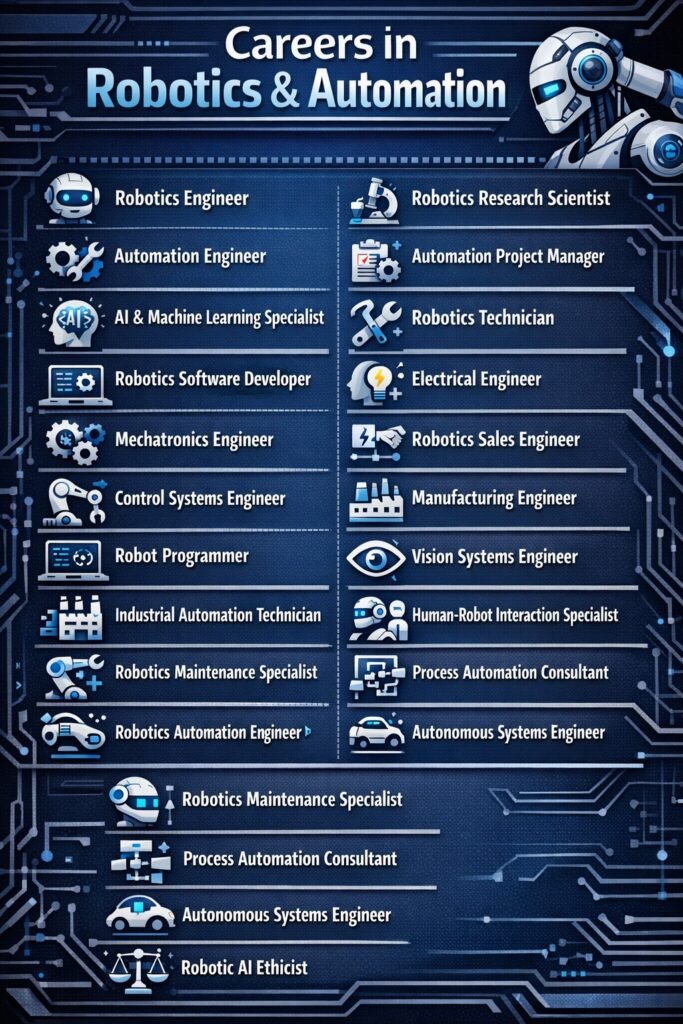
Each of these paths overlaps with robotics, and professionals often collaborate across these roles. For example, a mechatronics engineer might work alongside an AI engineer to add perception capabilities to a production robot.
What This Means for Job Seekers
- Emerging Opportunities: More industries (manufacturing, logistics, agri-tech, healthcare) are hiring for robotics and automation roles. Watch job sites and company postings for titles like “robotics engineer,” “automation technician,” or “RPA developer.” Sectors such as manufacturing and warehousing, as well as tech companies and even government projects, are good places to look.
- Education & Training: Focus on STEM education. A degree in engineering (mechanical, electrical, mechatronics) or computer science is a strong foundation. Supplement with specialized courses or certificates in robotics, control systems, or RPA tools. For example, the Open University of Kenya offers a short course in Robotics & Automation for engineering and technical students. Online platforms and workshops can also build relevant skills.
- Build Practical Experience: Engage in robotics projects to showcase your skills. Join or start a robotics club, participate in competitions (like robotics challenges or hackathons), and work on DIY robot or automation projects. Internships or volunteer work at tech labs or industrial companies can provide hands-on experience. Even working in a related field (e.g. electronics technician, software developer) can be a stepping stone.
- Networking: Connect with Kenya’s tech and engineering community. Attend meetups, webinars, and industry events on robotics and AI. Join online forums or groups where professionals discuss automation trends. Networking can lead to mentorships and job leads in this niche field.
- Focus on In-Demand Skills: Emphasize programming, electronics, and automation tools on your resume. Learn robotics frameworks (ROS), familiar automation hardware (Arduinos, Raspberry Pi, PLCs), and relevant software (simulation tools). Soft skills like adaptability and continuous learning are crucial as technology evolves rapidly.
- Stay Informed: Keep up with Kenyan tech news and policies (like updates to the AI strategy or Vision 2030 initiatives). Understanding local industry needs helps target your career path. For example, if agriculture robotics is growing, learning about agricultural sensors and drones could give you an edge.
With deliberate effort, job seekers in Kenya can tap into the growing robotics field. The combination of formal education and self-driven projects will prepare candidates for these specialized roles.
FAQs on Rise of Robotics Jobs in Kenya
Are robotics jobs in demand in Kenya?
Yes. Demand is rising as Kenyan industries and the government invest in automation and AI. E-commerce growth and policy initiatives mean more companies are creating robotics and automation roles in logistics, manufacturing, finance, and other sectors.
How much do robotics engineers earn in Kenya?
Robotics engineers are generally well-paid by local standards. Data shows the average robotics engineer salary is around KSh1.8M per year, with entry-level around KSh0.8M and senior roles up to KSh2.8M. In monthly terms, that’s roughly KSh68K–237K, depending on experience and employer.
What skills are needed for robotics careers?
Key skills include strong programming (e.g. Python, C/C++), knowledge of control systems, and familiarity with robotics platforms (like ROS). Engineers should also know electronics (sensors, motors), and have problem-solving and teamwork abilities. RPA roles add software automation tools to the mix.
Is robotics a good career in Kenya?
It’s an emerging field with growing support. Kenya’s national AI strategy and tech initiatives highlight robotics as a growth area. The career can be rewarding and future-proof, but it requires commitment to STEM learning. Those with the right skills may find a shortage of competitors as the field is still maturing.
How can I start a career in robotics?
Begin with a strong STEM education. Pursue engineering or computer science, and take extra courses in robotics or automation (for example, OUK’s robotics short course). Build hands-on experience by joining robotics projects or competitions, and seek internships in tech or manufacturing companies. Networking and continuously updating your skills (new tools, AI/ML knowledge) will help you land entry roles in this field.
Conclusion
Robotics and automation are on the rise in Kenya, offering a fresh career frontier. Government strategies and market trends indicate more industries will adopt robots and smart systems.
For job seekers, this means new roles – from hardware-focused robotics engineers to software-driven RPA developers – are increasingly available. The Kenyan youth stands to benefit: a Vision 2030 report notes a “youthful” population ready to drive innovation.
While robotics careers require solid technical preparation, they promise competitive salaries and alignment with Kenya’s push toward a knowledge economy.
In summary, as Kenya embraces automation, well-prepared graduates and professionals can seize these opportunities and help shape the country’s technological future.
CONTINUE READING:
How to Write an ATS-Friendly Cover Letter in 7 Simple Steps (With Examples You Can’t Ignore)
How to Find High-Paying Jobs Without Experience in Kenya — 7 Practical Steps Not to Miss
7 In-Demand Resume Skills to Add Now (and 3 Outdated Ones to Delete)
Join the Career Intelligence Community
Get exclusive data insights, downloadable tools, and mindful career strategies delivered monthly — no fluff, no spam.