Stuck in a career rut? You’re not alone. Today’s workforce is more mobile than ever: 66% of workers have changed or considered changing fields in the past year, and 43% are actively seeking a new career this year.
Many are motivated by remote work, higher pay, or better balance. The key is finding realistic, fast paths into new roles. This guide cuts through the noise to highlight easiest career switches—jobs you can land with short training or certificates, low cost, and high demand.
Contents
What is the easiest career to switch to?
The easiest career switches leverage skills you already have and require little new training. Roles like digital marketing specialist, IT support technician, or sales development representative often fit this profile.
These jobs typically offer entry-level openings, use on-the-job training or short certificates (3–6 months), and rely on transferable skills. For example, a digital marketer or help-desk technician can often transition in under a year with an online course and a strong basic skillset.
What Makes a Career “Easy” to Switch To?
The easiest careers to switch to offer short learning curves, low entry barriers, strong demand, transferable skills, and fast hiring cycles.
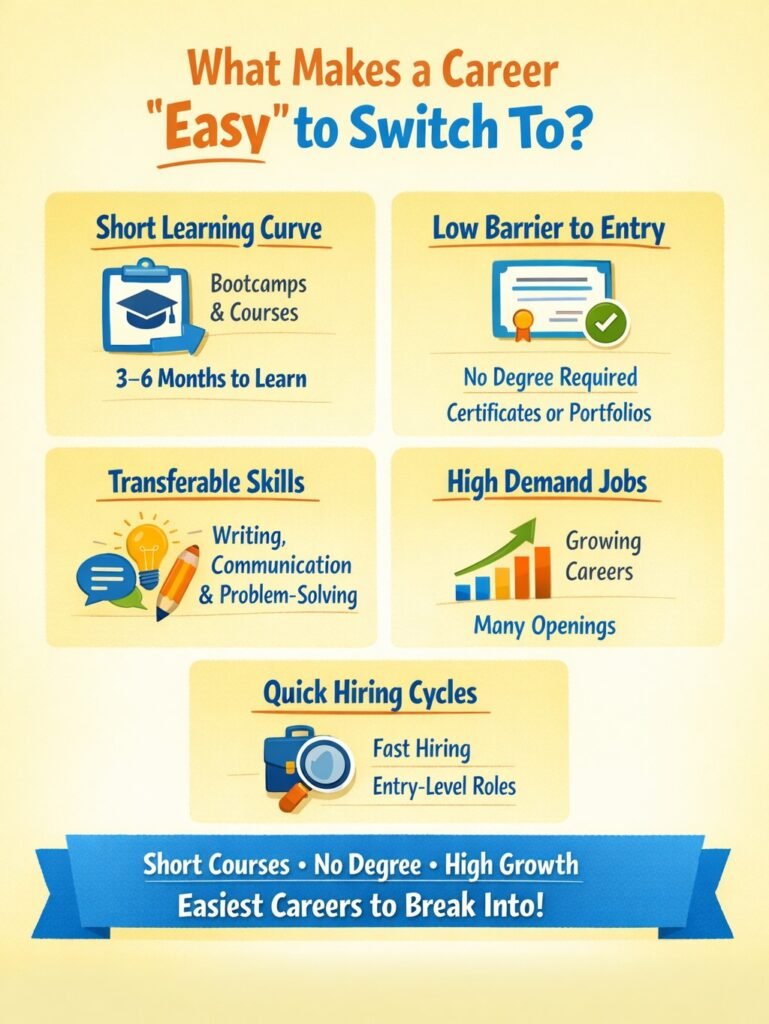
“Easy” career switches share certain traits:
- Short Learning Curve: They have structured training or bootcamps so you can get up to speed in months. For instance, Google’s IT Support and Data Analytics certificates are designed for beginners and take about 3–6 months at 10 hours/week.
- Low Barrier to Entry: Many fast-growing fields don’t require a degree. In fact, Google’s career certificates explicitly target learners with “no experience or degree required”. Entry often hinges on a certificate or portfolio rather than a four-year diploma.
- Transferable Skills: These roles tap broad skills (communication, writing, basic tech savvy) that workers from other fields already have. For example, if you’re good at writing or problem-solving, those skills can map to marketing, technical writing, or support roles.
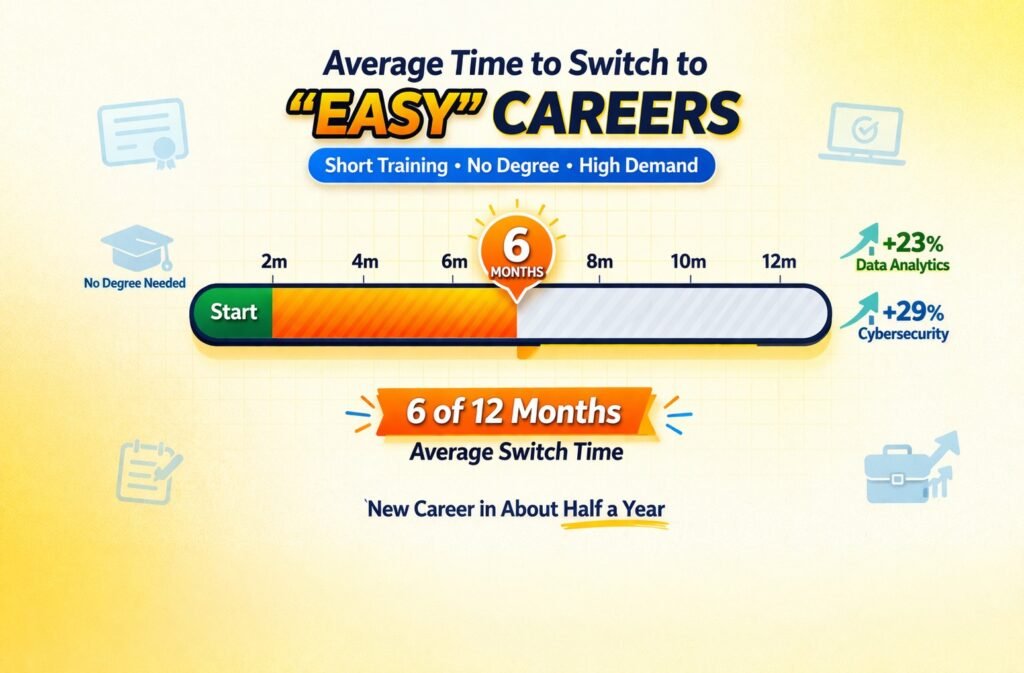
- High Demand/Growth: Easy switches tend to be in fields with many openings. For example, data analytics jobs are growing 23% by 2033 and cybersecurity analysts by 29%. High growth means companies eagerly hire entry-level candidates.
- Quick Hiring Cycles: Employers often hire newbies fast if you show initiative. Research indicates most entry-level transitions happen in “several months” of training and job search. Short timelines and hands-on training (internships or gigs) speed up the switch.
In short, look for roles where training is common and skills transfer across industries. Jobs that check these boxes (short courses, no degree, high demand) are the easiest to break into.
The 10 Easiest Careers to Switch To Now
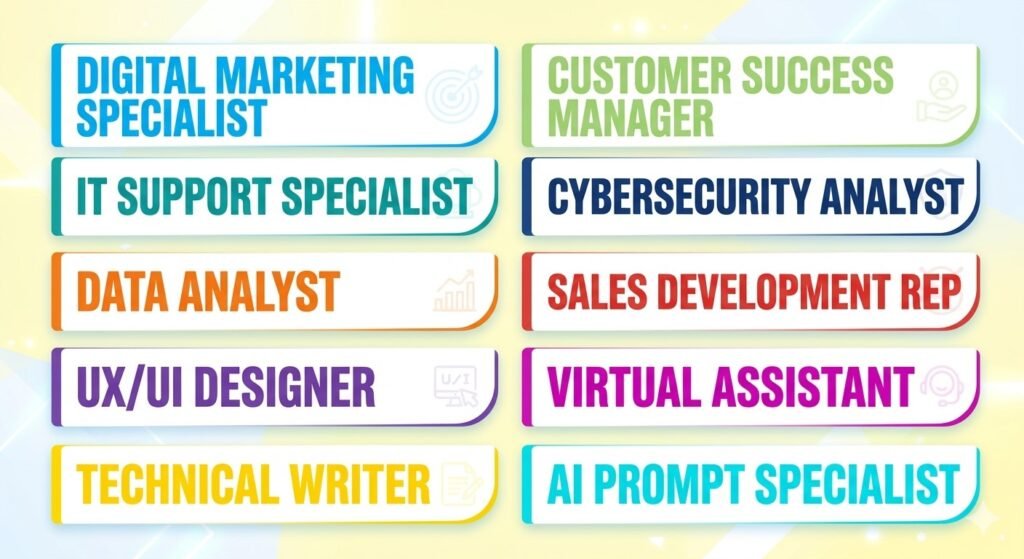
Below are some of the most accessible, high-demand roles for career changers. Each entry explains what the job involves, why it’s beginner-friendly, the key skills/tools, estimated training time, entry pay, and growth outlook.
1. Digital Marketing Specialist

A digital marketing specialist manages online advertising, social media, and SEO to grow a company’s brand. You might create posts, run ad campaigns, and analyze web traffic.
Why it’s easy: You can learn on-the-go with free or low-cost courses (like HubSpot Academy or Google Digital Garage). Most companies hire junior marketers and train them.
Beginner skills: Basic writing and communication, creativity, and comfort with social media and data.
Tools: Google Analytics/Ads, SEO tools (Semrush/Ahrefs), social scheduling (Hootsuite), and email platforms (Mailchimp).
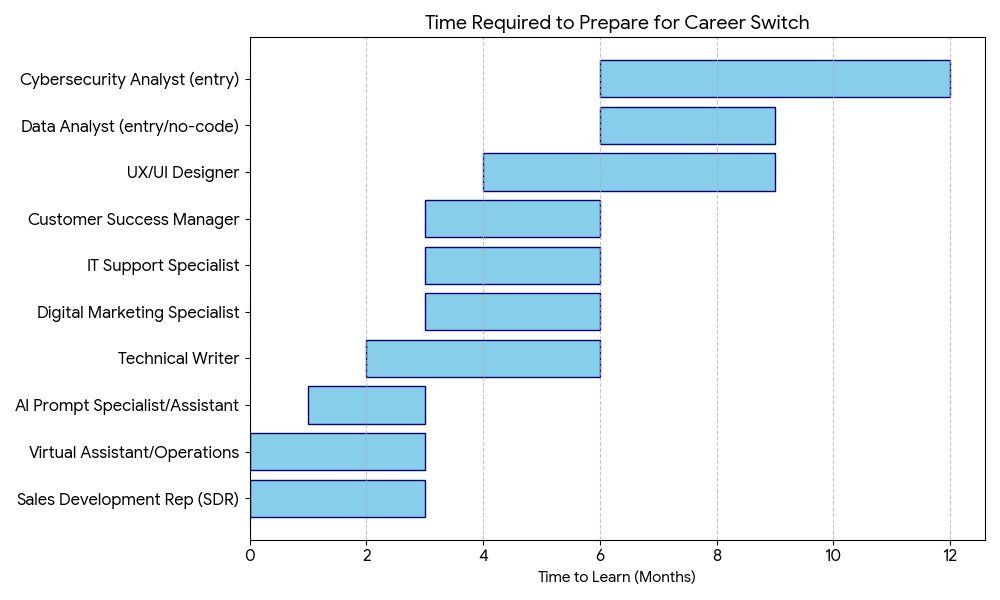
With about 3–6 months of focused learning (e.g. a Google or Coursera certificate), you can build a portfolio (sample ad campaigns or content) and start entry-level. Entry-level digital marketers earn roughly $50K–$65K (ZipRecruiter reports about $65,418/year), rising to a median around $73K with experience.
The field continues growing: marketing specialist roles earn about $77K median pay with ~7% projected growth. Demand is strong as every business wants an online presence.
2. IT Support Specialist
IT (help-desk) support specialists help users with computer or network issues. You’ll troubleshoot hardware/software problems, install programs, and guide users through fixes.
Why it’s easy: Tech support roles have a clear entry path – for example, Google’s IT Support Professional Certificate trains beginners in computer basics in 3 months. You can pivot from personal tech savvy without a degree.
Skills: Troubleshooting, customer service, basic networking.
Tools: Windows/Linux systems, helpdesk software (Zendesk, Jira), remote-support tools (TeamViewer).
Training time: 3–6 months with online courses or certifications (CompTIA A+ is a common path).
Median pay is about $61,550/year. Google notes ~295,000 IT support openings with a $65K median entry salary. While BLS projects a slight decline (–3% by 2034), there are still tens of thousands of hires annually (50K+ openings each year). Many companies continually refresh support staff, and remote help-desk jobs are plentiful.
3. Data Analyst (Entry-Level / No-Code)
Data analysts collect and interpret data to help businesses make decisions. You might clean data sets, create charts, and present findings.
Why it’s easy: Many entry paths let you start without heavy coding. Google’s Data Analytics Certificate takes 6 months at 10 hrs/week and covers tools like Excel, SQL, and Tableau. You can learn basic analytics (pivot tables, dashboards) with a short bootcamp and a few projects.
Skills: Data cleaning, using spreadsheets, simple SQL, and visualizing results.
Tools: Excel/Sheets, SQL (MySQL or BigQuery), and visualization tools (Tableau, Power BI, Google Data Studio).
Time: ~3–6 months to learn core skills and complete a capstone project.
Data analysts earn a median $83,640 (BLS). Even entry-level roles often start in the $60K+ range, thanks to high demand for data skills. BLS predicts 23% growth in data analytics jobs through 2033. With data being “the new oil,” businesses are hiring analysts aggressively. Entry roles abound in tech companies, finance, and consulting, and many are remote-friendly.
Explore how to transition into data analytics without fear
4. UX/UI Designer
A UX (User Experience) or UI (User Interface) designer creates user-friendly app and website designs. You’ll design wireframes, mockups, and user flows to make products intuitive.
Why it’s easy: Many designers come from self-taught backgrounds or short courses. Google’s UX Design Certificate, for example, prepares beginners in ~6 months. If you’re creative and tech-curious, you can learn design tools online and build a portfolio from scratch projects.
Skills: Visual design, basic layout principles, empathy for users, prototyping.
Tools: Figma (very popular), Sketch or Adobe XD, and possibly Photoshop or Illustrator for graphics.
Time: Often 3–9 months of learning (bootcamps or certificates) plus a portfolio of sample designs.
UX designers command a high salary – median around $109K per Glassdoor (entry can be ~$60–70K). BLS lumps them under web developers/digital designers with ~7% growth. The demand is strong as companies invest in user-friendly products. Even if AI can generate design ideas, skilled designers are needed to interpret and implement them. Many UX roles are remote or hybrid, making this a flexible switch.
5. Technical Writer
Technical writers create instruction manuals, how-to guides, and documentation for products or services. They turn complex info into clear text.
Why it’s easy: If you’re a strong writer, you can move into tech writing by learning to use documentation tools. No specialized degree is required – a portfolio of writing samples often suffices.
Skills: Clear, structured writing; ability to understand technical concepts (which you can learn on the job).
Tools: Word processors (MS Word, Google Docs), Markdown editors, Adobe FrameMaker or MadCap Flare, and basic HTML/CMS if needed.
Time: 2–6 months to build a writing portfolio and learn documentation best practices (courses from Society for Technical Communication, etc.).
Technical writers earn a median $62,060 (range $48K–$80K). This field is stable: businesses always need user guides and help docs. Growth is slower (about average), but entry-level opportunities exist in software, manufacturing, and science industries. It’s often fully remote, and strong writing and research skills carry over from other jobs.
6. Customer Success Manager
Customer Success Managers (CSMs) ensure clients use a company’s products effectively. You’ll onboard new customers, provide support, and help increase retention.
Why it’s easy: CSMs often come from customer service or sales roles. Many companies (especially SaaS firms) hire entry-level “CS associates” and train them in product knowledge. No degree is required – communication skills and a problem-solving attitude matter more.
Skills: Communication, relationship-building, active listening, basic sales sense.
Tools: CRM systems (Salesforce, HubSpot), helpdesk software (Zendesk/Intercom), video conferencing (Zoom) and collaboration tools (Slack).
Time: 3–6 months learning product details and account management basics (some companies offer onboarding training or certification programs).
Customer Success roles pay well: the average CSM salary is about $78,500. Entry-level CSMs make around $62K, with bonus/commission often added. Demand is rising because subscription businesses prioritize customer retention. Many CSM jobs are remote and in industries like tech and finance, making this a high-pay entry career without a degree requirement.
7. Cybersecurity Analyst (Entry-Level Path)
Cybersecurity analysts protect companies’ networks and data from attacks. You’d monitor systems, respond to breaches, and implement security measures.
Why it’s easy: While senior roles need experience, entry-level pathways exist through certificates instead of a full degree. For example, certifications like CompTIA Security+ or ISC²’s SSCP can be earned in 6–12 months and open doors. Bootcamps (e.g. Springboard, Udacity) also train beginners.
Skills: Networking basics, familiarity with Linux/Windows systems, and security principles (encryption, firewalls).
Tools: Security software (anti-malware, SIEM like Splunk), intrusion detection tools (Snort), and vulnerability scanners.
Time: About 6–12 months – e.g. spend 3–6 months on CompTIA A+ and Net+ (if needed) plus 3–6 months on Security+.
Cyber roles pay very well: median salary is about $124,910. Entry-level positions start around $60–70K, rising quickly with certs and experience. The need is urgent – BLS projects 29% growth in cybersecurity jobs through 2034 (much faster than average). With so many breaches, organizations are hiring analysts aggressively. Even if AI helps detect threats, human analysts are still crucial to interpret complex incidents and strategy.
8. Sales Development Representative (SDR)
An SDR is an entry-level sales role focused on prospecting. You’ll make calls/emails to potential clients and set up demos for account executives.
Why it’s easy: No degree needed and high turnover means frequent hiring. Companies train new SDRs in about 1–3 months. If you have basic people skills and a positive attitude, you can land an SDR job quickly.
Skills: Communication, persistence, basic understanding of a product.
Tools: CRM (Salesforce, HubSpot), LinkedIn Sales Navigator, email outreach tools (Outreach.io).
Time: 0–3 months ramp-up (many companies pay you while you learn their sales process).
Average entry-level SDR salary (base) is about $63,000 (often plus commission). In some regions or sectors it can be higher. Since every company needs to fuel its sales pipeline, SDR positions are plentiful and often remote. This role builds transferable business and negotiation skills, and is widely considered one of the quickest career changes into tech sales.
9. Virtual Assistant / Operations Support
Virtual assistants (VAs) and operations support professionals handle administrative tasks remotely. You might manage calendars, emails, customer inquiries, or small projects.
Why it’s easy: No formal education is required – organizational and computer skills suffice. Many businesses (especially startups and online entrepreneurs) hire part-time VAs from day one. Training comes from doing: as long as you’re detail-oriented and reliable, you can start with little experience.
Skills: Organization, communication, email etiquette, basic tech (document creation, scheduling).
Tools: Google Workspace or Microsoft Office, Slack, Trello/Asana for task management, and possibly light CRM (e.g. Salesforce basics) or e-commerce platforms (Shopify admin).
Time: 0–3 months to learn key tools and maybe assist a small business or entrepreneur on the side.
Remote VAs earn about $45K–$50K annually (ZipRecruiter lists ~$50,749 average), with top freelancers making more. Demand is growing as remote work expands – many remote job boards list hundreds of VA openings weekly. This role is highly remote-friendly and lets you pivot from any background that’s organized and willing to learn new software.
10. AI Prompt Specialist / AI Content Assistant
An AI prompt specialist (or AI content assistant) uses AI tools (like ChatGPT or DALL·E) to generate or refine content. You might write effective prompts, curate output, and edit it for quality.
Why it’s easy: It requires no formal credentials—just creativity and practice. As generative AI tools become common, even small businesses seek people who can use them well. This role is brand-new but growing: think of it as “the person who talks to AI to get the best answers.”
Skills: Good writing and critical thinking, ability to craft clear prompts, and understanding AI limitations.
Tools: ChatGPT, Claude, or other LLMs; image AIs (Midjourney, DALL·E); and content management tools.
Time: 1–3 months of experimentation – you can start playing with AI tools immediately. (There are online communities and courses on “prompt engineering.”)
Pay ranges are still settling. ZipRecruiter lists “AI Prompt Engineer” jobs averaging $111K (including experienced roles). Entry-level “AI assistant” gigs might start around $50K–$70K depending on employer. Many tech companies are hiring for AI-related support roles. Importantly, this role doesn’t replace human jobs; it’s created by AI’s rise. By specializing in AI tools now, you lock into a future-proof niche that grows with technology.
Discover more top AI and Machine Learning careers that command salaries up to $200K+
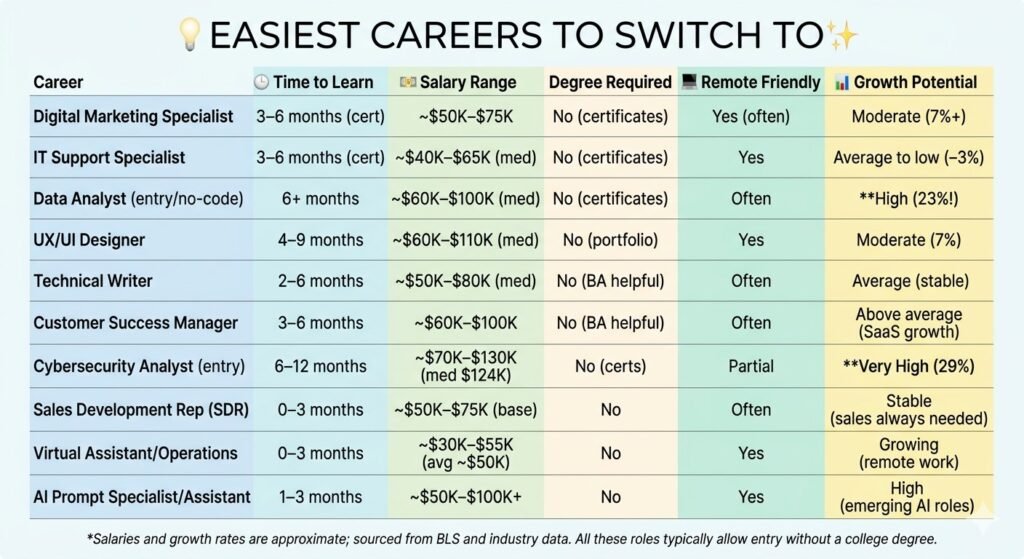
Comparison Table of Easy Entry Careers
Fastest Paths to Career Transition: Your Actionable Roadmap
0–3 Months (Foundation):
- Identify transferable skills. List what you already do well (communication, project management, analysis) and match to target jobs.
- Take introductory courses. Enroll in free/low-cost online courses for your chosen field (e.g. Google Career Certificates, Coursera, Udemy). Focus on one role to avoid spreading yourself thin.
- Learn key tools. Start mastering the main tools (Excel, Google Analytics, Figma, etc.). Many have free tutorials. Even basic hands-on practice builds confidence.
- Build a mini portfolio. Complete small projects to show skill: run a mock ad campaign, create a personal website mockup, write a short technical guide, or analyze a public data set. Even one well-documented project per field can impress recruiters.
- Gather credentials. Obtain relevant badges: e.g. HubSpot’s Digital Marketing, CompTIA A+/Network+, Salesforce Trailhead, or LinkedIn Skill Badges. These signal your dedication.
3–6 Months (Skill-Building):
- Advanced courses or certificate programs. Continue with specialized training (certificate bootcamps, professional programs). Many can be done part-time in 3–4 months. For example, Google IT or UX certificates, or a data analytics bootcamp.
- Internships/volunteering. Gain real-world experience: offer to do pro-bono work or internships. Contribute documentation to open-source projects (for writing/tech roles) or volunteer to manage social media for a local nonprofit. This builds resume experience.
- Networking. Join LinkedIn groups, Slack channels, or meetups for your target field. Ask informational questions to professionals already in the role. Networking can uncover hidden openings.
- Polish your brand. Create or update your LinkedIn and resume to highlight new skills. Use keywords from job listings. Start blogging or posting about your learning journey (this shows enthusiasm and knowledge).
- Certifications. Official certs (Google Ads, AWS Cloud Practitioner, CISSP Associate, etc.) can boost credibility if relevant. Even free credentials (e.g. Google Analytics IQ, Canva design certificate) add shine.
6–12 Months (Landing a Job):
- Apply Strategically. Target entry-level roles and internships explicitly. Emphasize your projects and certifications. Be open to “associate” or “assistant” titles as stepping stones.
- Interview Prep. Practice explaining your transition story clearly: focus on transferable skills and your commitment to the new role. Prepare examples from your portfolio/projects.
- Leverage networks. Reach out to contacts made, ask for referrals. Many hires come through personal recommendations.
- Continuous Learning. Keep updating skills based on interviews (if you notice gaps). Stay active in communities to hear about new opportunities.
- Stay Resilient. Remember that most career changers make progress within a year. Surveys show “entry-level transitions take several months” but succeed with persistence.
Throughout the process, avoid common pitfalls. Don’t chase the latest “hot” job without fitting it to your background; instead align choices with your interests and strengths. Don’t study endlessly without producing – always create projects or real work to show employers.
And don’t undervalue your current skills: emphasize how they transfer to the new career. A few well-chosen projects, a concise resume narrative, and networking often matter more than credentials alone.
Common Mistakes Career Switchers Make
- Choosing on Hype, Not Fit: Jumping into a trendy field (like AI) without passion or skill fit leads to frustration. Instead, prioritize roles that match what you enjoy and where you can leverage what you know (see section “What Makes a Career Easy to Switch To”).
- Overlearning Without Applying: Spending years in classes or courses without real outputs. Employers want proof of capability – even free projects or mock assignments. Pair learning with doing, not just certificates.
- Ignoring Portfolio/Projects: Especially in fields like design, writing, or data, not having a sample portfolio can stall you. Build small but complete projects (UX mockups, blog posts, dashboards) to demonstrate skills.
- Not Leveraging Transferable Skills: Many career-changers forget to highlight what they already know. For example, managerial experience is great for customer success; writing skills help in tech writing. Be explicit about your relevant skills.
How to Choose the Right Career for YOU
Follow this simple framework to pick the best switch:
- Assess Your Skills: Inventory your current skills (e.g. communication, analysis, teaching, organization) and see which roles value them. Your ideal career will reuse what you’re good at.
- Define Income Needs: Know your salary goals. Some entry careers (like marketing or UX) pay high, others (like basic support) pay less. Balance your financial requirements with the role.
- Consider Time Available: How much can you commit? If you can only spare a few hours a week, look for roles with the shortest learning paths (like VA, SDR). If you can immerse yourself full-time, you might tackle data or cybersecurity certifications.
- Interest vs. Practicality: You need motivation to get through training. Pick an area you find interesting (e.g. you enjoy tech gadgets? Try IT support; love storytelling? Try content roles). But also weigh market demand – a role you like and that has job openings.
- Trial First: Test-drive options. Talk to people in those jobs, take a free online lesson, or do a tiny volunteer project. Sometimes a short taste reveals if it fits.
Ultimately, the best switch feels like a smart match between what you know, what you want, and what employers need.
Future-Proof Insight (AI Era Resilience)
You might worry “will AI take this job?” Our list focuses on roles that actually grow with AI. Many tasks in these jobs leverage AI as a tool, not a replacement. For instance, digital marketers use AI to optimize ads, but they still set strategy. Data analysts might use AI for quick charts, but humans interpret insights. UX designers and writers use AI for drafts, then refine for humans. Even roles like AI Prompt Specialists exist because of AI, illustrating that new niches are emerging.
AscendurePro’s 2026 job trends highlight that AI-related roles (AI engineers, consultants, and data annotators) are among the fastest-growing. In other words, as AI reshapes work, humans who know how to collaborate with AI will thrive.
Our suggested careers often require the human elements (communication, creativity, judgment) that AI can’t fully automate. By transitioning into these fields now, you’re building an AI-resilient skill set.
For example, customer success managers and sales reps rely on empathy and relationships; technical writers and UX designers rely on deep understanding of users – qualities where people still outperform machines.
Ready to Take the Next Step?
Changing careers can be transformative—and you don’t have to do it alone. Explore our personalized career transition roadmaps to get expert guidance tailored to your goals.
We will help you pinpoint your best-fit path and build a step-by-step plan (including courses, portfolio projects, and networking) to make your switch smooth and successful. When you’re ready to move, we can help you navigate the transition with confidence.
Begin your journey today and unlock the high-growth, future-proof career waiting for you.
FAQ
What is the fastest career to switch to?
The fastest switches are usually entry-level roles with short training. Jobs like IT support technician, sales representative (SDR), or virtual assistant can often be learned in a few months. These require on-the-job training or short certificates, and companies hire juniors quickly. (For example, Google’s IT Support Certificate can prep you in ~3–6 months.)
Can I switch careers without a degree?
Absolutely. Many high-growth, well-paying jobs don’t require a four-year degree. Roles like digital marketing, data analysis, UX design, and IT support often accept certificates or portfolios instead. As long as you can demonstrate the needed skills (via projects, internships, or certificates), you can land these roles without a degree.
What careers pay well with minimal experience?
Examples include data analysts, UX designers, and cybersecurity analysts, which pay $60K–$100K even at entry. Sales and marketing roles also offer high upside (often with commission). Technical support roles start lower (~$40K), but growth can be fast. In general, tech-adjacent careers (marketing, tech support, data) tend to pay better than generic admin jobs, even at junior levels.
How long does a career change take?
Most career pivots to entry-level roles take several months of preparation. Many people complete a certificate or bootcamp in 3–9 months before landing a job. Others pursue part-time projects alongside a current job and switch after 6–12 months. The exact timeline depends on how quickly you learn and how full-time you can commit, but planning for 3–6 months of training plus job search time is realistic for many of these paths.
CONTINUE READING:
Career Change Success Rate: What the Data Really Says
Top 26 Careers in AI and Machine Learning
How to Transition from Accounting to Data Analytics Without Fear: An Ultimate Step-by-Step Roadmap
Join the Career Intelligence Community
Get exclusive data insights, downloadable tools, and mindful career strategies delivered monthly — no fluff, no spam.