The role of application development is booming globally and in Kenya. An Application Developer (or app developer) is a professional who designs, writes, and maintains software applications for various platforms (web, mobile, desktop, or enterprise).
They take user requirements and turn them into functional programs by writing code, testing features, and fixing bugs.
Contents
What is an Application Developer?
An app developer is a professional who designs, builds, tests, and maintains software applications used by people every day. These applications can run on:
- Mobile phones (Android and iOS apps)
- Web browsers (web applications like online banking or e-commerce)
- Desktop computers (installed software)
- Enterprise systems (large-scale business applications)
At a simple level, an app developer takes an idea and turns it into a working digital product.
They do this by:
- Writing code using programming languages like JavaScript, Python, Java, or C#
- Designing how the application behaves
- Testing features to ensure everything works correctly
- Fixing bugs and improving performance
Think of an application developer as a digital builder. Just like a contractor builds houses from architectural plans, developers build applications from requirements and ideas.
How Application Developers Work
Application developers don’t work in isolation. They collaborate with:
- Designers (to create user-friendly interfaces)
- Product managers (to define features)
- Testers (to ensure quality)
- Other developers (to build large systems)
Their job is to balance:
- User needs (what people want)
- Technical constraints (what is possible)
- Business goals (what creates value)
Imagine a mobile banking app in Kenya. An application developer would:
- Build the interface where users send money
- Connect the app to payment systems
- Ensure transactions are secure
- Fix bugs when users report issues
Every feature you see in an app—from login screens to payment buttons—exists because an application developer built it.
Related Resources:
Top 20 In-Demand Careers in Drone Industry That You Need to Consider Now
Using a Part-Time Job to Make a Career Change (Without Quitting Your Full-Time Job First)
Application Developer vs Other Roles
Many beginners confuse app developers with other tech roles. While there is overlap, each role has a different focus.
Here’s a clear comparison:
| Role | Focus | Typical Tasks | Key Skills |
|---|---|---|---|
| Application Developer | Builds functional applications (web, mobile, desktop, enterprise) | Write code, implement features, test apps, fix bugs | Programming (Java, Python, JavaScript), APIs, debugging |
| Software Engineer | Designs and manages large-scale systems using engineering principles | System architecture, scalability, code quality, technical leadership | Data structures, system design, architecture |
| Full Stack Developer | Builds both frontend and backend of web applications | Create user interfaces + server logic + databases | React/Vue, Node.js, databases |
| Mobile Developer | Specializes in smartphone applications | Build Android/iOS apps, optimize performance, test on devices | Kotlin, Swift, Flutter, React Native |
Key Differences Explained
- Application Developers focus on building working applications based on requirements.
- Software Engineers think more broadly about system design, scalability, and architecture.
- Full Stack Developers handle both front-end and back-end development.
- Mobile Developers specialize in apps for phones and tablets.
In reality, many companies use these titles interchangeably. However, understanding the differences helps you choose your career path.
What Does an Application Developer Do?
An application developer writes, tests, and maintains software applications by turning user requirements into working features using programming languages, tools, and frameworks.
Application Developer Job Description
An application developer’s main responsibility is to turn ideas into functional software.
They do this by:
- Understanding user or business requirements
- Designing how the application will work
- Writing clean and efficient code
- Testing features to ensure reliability
- Fixing bugs and improving performance
- Updating applications over time
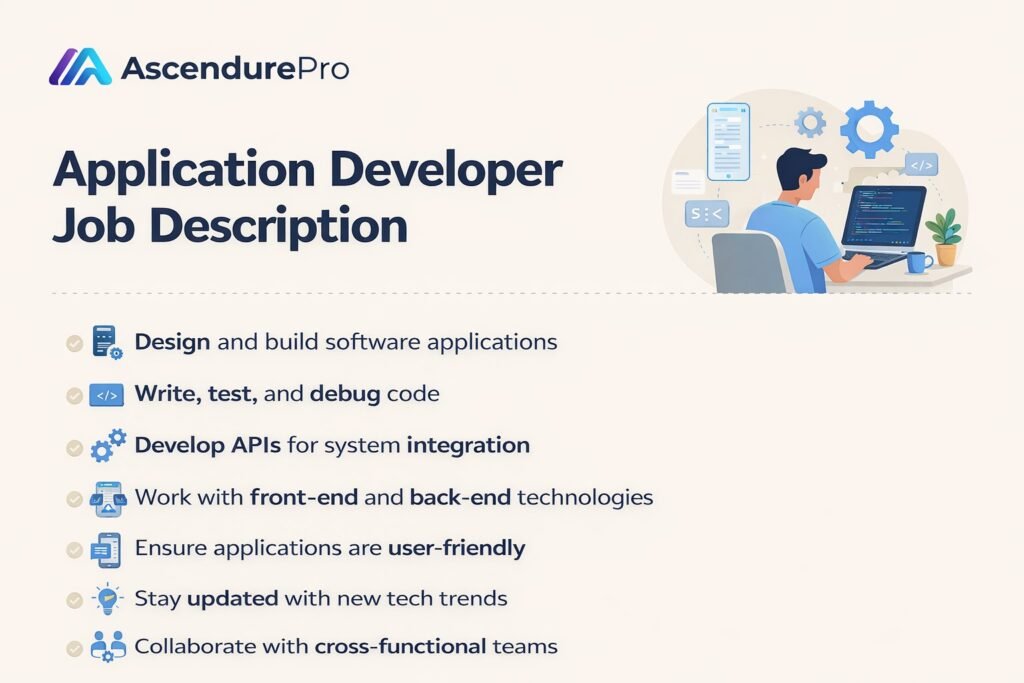
7 Roles of an Application Developer
- Design and build software applications:
Plan, structure, and develop apps based on user or business needs. - Write, test, and debug code:
Create clean code, test functionality, and fix errors to ensure performance. - Develop APIs for system integration:
Build and connect APIs so different systems and applications can communicate. - Work with front-end and back-end technologies:
Handle both user interface (frontend) and server-side logic (backend). - Ensure applications are user-friendly:
Improve usability by applying basic UI/UX principles. - Stay updated with new tech trends:
Learn new tools, frameworks, and best practices regularly. - Collaborate with cross-functional teams:
Work with designers, testers, and managers to deliver complete applications.
Tools Application Developers Use
Developers rely on various tools to do their work efficiently:
- Code editors (e.g., VS Code)
- Version control systems (e.g., GitHub)
- Testing tools (e.g., Postman)
- Frameworks (e.g., React, Django)
- Cloud platforms (e.g., AWS, Azure)
Application Development in Action
Application development is not abstract—it directly impacts industries in Kenya and beyond.
1. Fintech Applications
Kenya is a global leader in mobile finance.
An application developer might:
- Build mobile money integrations
- Create loan management apps
- Develop digital wallets
Example tasks:
- Secure transaction processing
- API integration with payment gateways
- Real-time notifications
2. E-commerce Platforms
ecommerce application development is booming because of the rapid growth of online shopping.
Developers build:
- Product listing systems
- Payment checkout systems
- Inventory management tools
3. EdTech Platforms
Education technology is expanding, especially post-2020.
Developers create:
- Online learning platforms
- Student management systems
- Mobile learning apps
4. HealthTech Systems
Healthcare mobile application development entails:
- Patient record systems
- Telemedicine apps
- Appointment booking platforms
Where Do Application Developers Work?
Application developers have flexible career options. They can work in different environments:
1. Startups
- Fast-paced environment
- Work on multiple features
- High learning opportunity
2. Corporations
- Structured roles
- Focus on large systems
- More stability
3. Freelance
- Work independently
- Choose clients
- Income varies
4. Remote Jobs
- Work for international companies
- Earn in USD or EUR
- Highly competitive
Why Application Developers Are in High Demand Now
1. Digital Transformation
Businesses are moving online faster than ever.
- Banks → mobile apps
- Shops → e-commerce platforms
- Schools → online learning systems
Every business needs applications.
2. Growth of Tech in Africa
Africa’s tech ecosystem is expanding rapidly.
- Kenya is a leading tech hub
- Startups are increasing
- Investment in tech is rising
3. Remote Work Opportunities
Developers can now work globally from Kenya.
- Access to international clients
- Higher earning potential
- Flexible work environments
4. Emerging Technologies
New fields are creating demand for developers:
- Artificial Intelligence
- Cloud computing
- Blockchain
- Internet of Things (IoT)
Key Takeaway
An application developer is the person who turns ideas into real, usable software.
They:
- Write code
- Build features
- Solve problems
- Create tools people rely on every day
From mobile banking apps in Nairobi to global platforms used by millions, application developers are shaping the digital world.
What to Do Next
If you’re considering this career path:
- Explore the different types of application developers to find your niche
- Learn the essential skills you need to succeed
- Follow a clear step-by-step roadmap to becoming a developer
- Understand the salary potential and career growth
At AscendurePro, we help you transition into high-growth tech careers with structured roadmaps, practical training, and career support.
Your journey into application development starts with understanding the role—and now you’re one step ahead.




Start Your Career Transition with AscendurePro
Get clear roadmaps, in-demand skills insights, and proven strategies to help you move into high-growth, future-proof careers — no fluff.