Most job seekers never realize their cover letter failed.
There’s no rejection email.
No feedback.
No indication anything went wrong.
Your application simply disappears.
This is the silent rejection problem—and it’s driven by Applicant Tracking Systems (ATS), not your qualifications.
If you’ve ever wondered “Why don’t I even get interviews?” despite meeting the requirements, this article will explain exactly why most cover letters fail ATS screening and how to fix it fast.
Contents
The Silent Rejection Problem
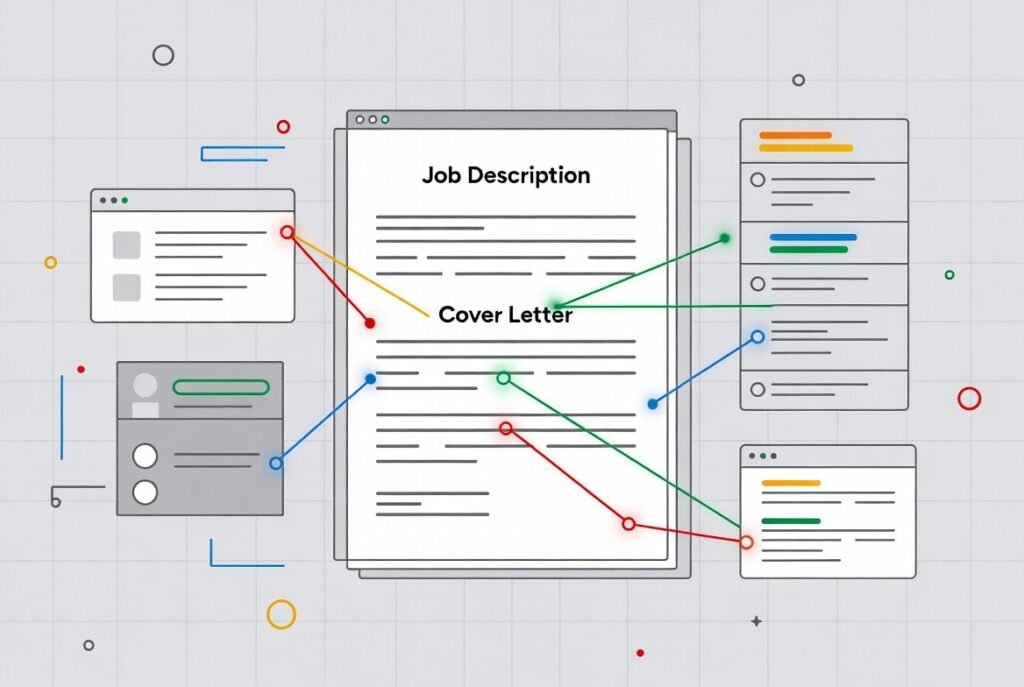
Before a human recruiter reads your cover letter, software scans it.
That software doesn’t care how passionate, creative, or polished your writing sounds. It only checks whether your cover letter is:
- Structured correctly
- Keyword-relevant
- Technically readable
If it fails on any of those, your application may never reach a recruiter’s screen.
This is why:
- Qualified candidates get filtered out
- Entry-level applicants hear nothing back
- Job seekers assume the market is “too competitive”
Often, the problem isn’t competition—it’s ATS incompatibility.
ALSO READ:
How to Find High-Paying Jobs Without Experience in Kenya
7 Reasons Why It is So Hard to Find a Job Right Now
7 In-Demand Resume Skills to Add Now (and 3 Outdated Ones to Delete)
Why “Qualified” Candidates Are Filtered Out
ATS screening is binary at first.
Your cover letter doesn’t compete against other people. It competes against a rule set.
If it doesn’t meet minimum relevance thresholds, it’s:
- Ranked extremely low, or
- Excluded altogether
This happens even if:
- You meet the education requirements
- You have the right experience
- Your resume is strong
A poorly optimized cover letter can quietly drag your entire application down.
Why Most Cover Letters Fail ATS Screening
Let’s break down the exact mistakes ATS systems flag—often instantly.
1. Overdesigned Templates
This is the most common ATS killer.
Job seekers use:
- Canva designs
- Multi-column layouts
- Icons, shapes, logos
- Creative headers
What ATS Sees
- Scrambled text
- Misaligned sections
- Missing information
ATS systems read linearly, not visually. When content is wrapped inside tables or text boxes, critical information is skipped or misread.
📌 Beautiful to humans ≠ readable to ATS.
2. Missing Job-Specific Keywords
ATS does not evaluate effort or writing quality. It checks relevance.
When a system scans your cover letter, it compares the language in your document with the language used in the job description. The closer the match, the higher your application is ranked. When key role terms are missing, the system assumes a skills gap—even if that gap does not actually exist.
For example, a job advert may clearly state requirements such as:
- Data analysis
- Lesson planning
- Financial reporting
If those exact responsibilities never appear in your cover letter, ATS has no way of knowing that you perform them. The software does not infer meaning. It matches text.
This is why many candidates write well-structured, polite cover letters and still get filtered out. The issue is not grammar or tone. The issue is misalignment.
What this looks like in practice
Generic version (low ATS relevance):
I have strong analytical skills and experience supporting organizational goals through effective reporting and planning.
This sounds fine to a human reader. To ATS, it says almost nothing.
ATS-aligned version (higher relevance):
I have experience in data analysis, preparing reports, and supporting decision-making through accurate data interpretation.
The second version works because it uses the same language the system is searching for.
Another example:
Generic version:
I enjoy working with learners and supporting their academic development.
ATS-aligned version:
I have experience in lesson planning, curriculum delivery, and learner assessment at the primary school level.
The difference is not exaggeration. It is specificity.
Why this mistake happens so often
Many applicants try to write one “strong” cover letter and use it everywhere. Unfortunately, ATS is not designed to reward general strength. It rewards contextual fit. A letter that worked for one role can easily fail another if the keywords no longer match.
Good candidates are filtered out not because they lack skills, but because they fail to name those skills using the employer’s language.
The practical fix
Before writing or submitting your cover letter:
- Identify 5–8 repeated terms in the job description
- Use those terms naturally in your letter
- Focus on responsibilities, not personality traits
You are not gaming the system. You are simply making your experience visible in a format the system can understand.
A strong cover letter is not just well written.
It is correctly labeled.
3. Generic Openings
Many cover letters fail before they are fully scanned—simply because the opening paragraph says too little.
Phrases such as:
“I am writing to apply for the above position at your esteemed organization.”
sound polite, but they carry almost no value for an Applicant Tracking System. From the system’s perspective, this type of opening is empty. It does not state the job title, it does not reflect the role requirements, and it does not confirm relevance.
ATS uses the opening paragraph to establish context. If that context is missing, the entire document starts at a disadvantage.
Why generic openings hurt your chances
A weak opening usually lacks three critical elements:
- The exact job title used in the advertisement
- Role-specific terms (keywords) that confirm alignment
- A clear indication of what you actually do (role context)
Without these, ATS cannot confidently associate your cover letter with the role being filled. Even a strong second or third paragraph may not fully recover that lost relevance.
Compare the difference
Generic opening (low ATS value):
I am writing to apply for the above position at your esteemed organization and believe I would be a suitable candidate.
This tells the system nothing.
ATS-aware opening (high relevance):
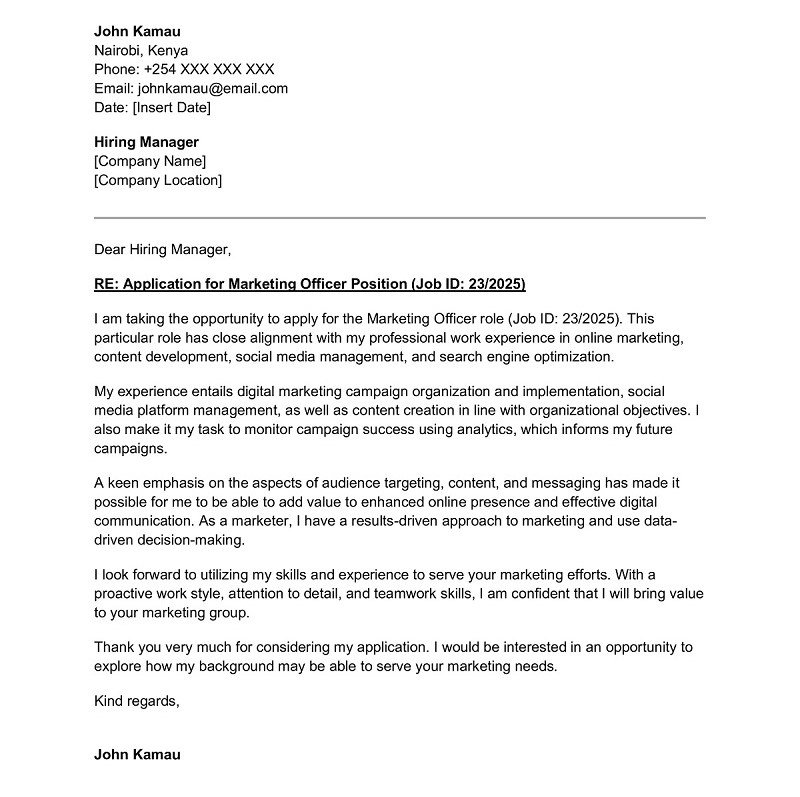
I am applying for the Marketing Officer position, bringing experience in digital marketing, content creation, social media management, and SEO to support brand visibility and growth.
The second version immediately signals:
- The job title
- The core competencies
- The functional area
That single paragraph provides enough information for ATS to classify the application correctly.
Why this matters more than most candidates realize
ATS does not “read” your cover letter the way a recruiter does. It scans, categorizes, and scores. The opening paragraph often receives extra weight because it helps the system decide whether the rest of the document is worth processing in detail.
A strong opening does not need to be clever or dramatic. It needs to be clear, specific, and aligned.
Think of the first paragraph as a label on a file folder.
If the label is vague, the file gets misplaced.
4. Copy-Pasted Content
Using the same cover letter for every role is efficient—but deadly.
ATS compares your content against this specific job description.
If your letter feels generic, relevance scores drop.
Recruiters do the same thing later—and reject it instantly.
5. Incorrect File Formats
Some ATS systems:
- Read
.docxperfectly - Struggle with older
.docfiles - Partially misread PDFs
If the job posting doesn’t explicitly allow PDF, your safest option is .docx.
A strong letter in the wrong format can be functionally unreadable.
6. Keyword Stuffing
In an effort to outsmart ATS, some applicants overload their cover letters with repeated keywords. The intention is understandable, but the result is usually the opposite of what they expect.
A sentence like this is a common example:
“I have project management skills, project management experience, and project management knowledge.”
To a human reader, it sounds awkward. To a modern ATS, it signals poor-quality content.
Today’s systems do more than count words. They assess context, variation, and natural usage.
When the same phrase appears repeatedly without meaningful structure, the system may flag the document as manipulative or low-value. Instead of boosting relevance, excessive repetition can actually lower your score.
Why keyword stuffing backfires
Most ATS platforms now use semantic matching. This means they recognize related terms and evaluate how keywords are used within real sentences. Repetition without explanation adds no new information.
For example, repeating project management several times does not show how you manage projects. It simply shows that you can repeat a phrase.
A better way to signal relevance
Overstuffed version (low quality):
I have project management skills, project management experience, and project management knowledge across multiple projects.
Optimized version (natural and effective):
I have managed cross-functional projects, coordinated timelines and resources, and delivered assignments within agreed budgets and deadlines.
The second version still signals project management, but it does so through actions and outcomes. Both ATS and recruiters respond better to this approach.
The rule to remember
Keywords should support meaning, not replace it.
One well-placed keyword in a relevant sentence carries more weight than the same word repeated multiple times. When your writing sounds natural to a human reader, it is usually structured well enough for ATS too.
Relevance comes from use, not volume.
7. Formatting Elements ATS Can’t Read
Avoid:
- Tables
- Columns
- Headers/footers with content
- Images
- Decorative lines
These elements confuse parsing and break text flow.
How ATS Flags These Mistakes
ATS doesn’t reject you emotionally.
It:
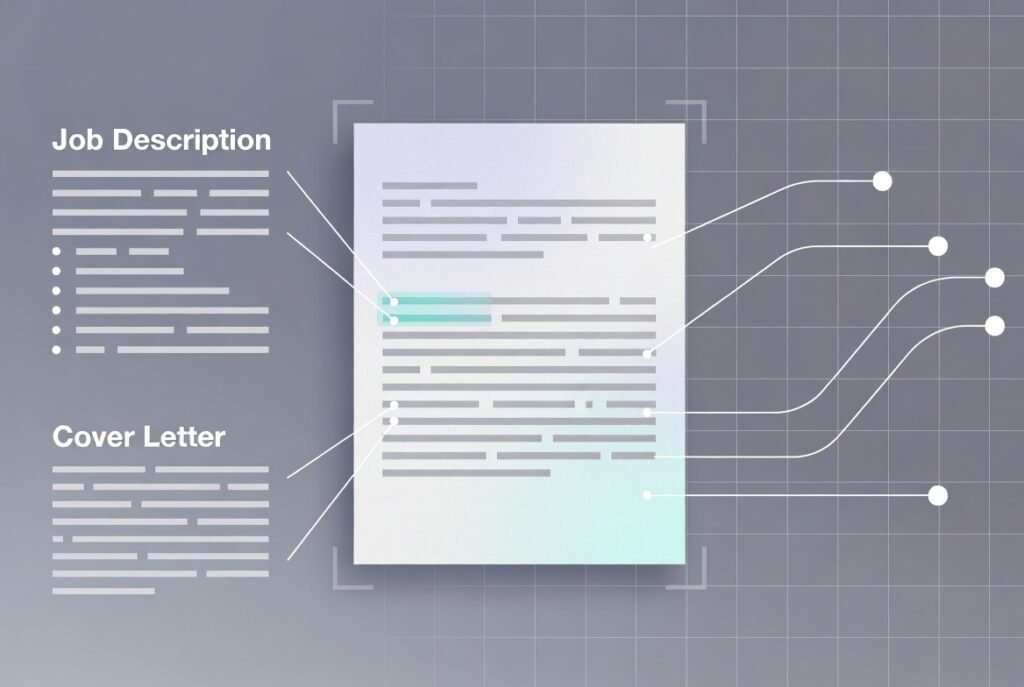
- Parses your document
- Extracts text
- Matches it against keywords
- Assigns a relevance score
What Happens With Poor Content
- Keywords are missed
- Sections are misread
- Context is lost
Your application is either:
- Ranked too low to be seen, or
- Filtered out altogether
Why Recruiters Never See Rejected Letters
Most recruiters:
- Review only top-ranked applications
- Never scroll to the bottom of ATS lists
That means:
- No human rejection
- No feedback
- No chance to explain yourself
The system decides before the recruiter does.
Quick Fixes That Actually Work
You don’t need to rewrite everything.
You need targeted fixes.
✅ Formatting Fixes
- Use a single-column layout
- Left-align text
- Avoid templates with graphics
- Stick to Arial, Calibri, or Times New Roman
- Use font size 10.5–12
✅ Keyword Fixes
- Copy the exact job title into your letter
- Mirror key skills naturally
- Use role-specific terminology
- Align keywords with your resume
📌 Think relevance, not repetition.
✅ Structure Fixes
Use a simple structure:
- Job-specific opening
- Skills + experience paragraph
- Value and fit paragraph
- Clean closing
This structure is:
- ATS-safe
- Recruiter-friendly
- Easy to customize
Case Example: Rejected vs Optimized
❌ Rejected Version
“I am writing to express my interest in the available position. I am hardworking, passionate, and eager to contribute to your organization.”
Problems:
- No job title
- No keywords
- No role alignment
✅ ATS-Optimized Version
“I am applying for the Finance Officer position, bringing experience in financial reporting, budgeting, and audit support to strengthen financial controls.”
Why It Works:
- Job title included
- Keywords matched
- Immediate relevance
Same candidate.
Different outcome.
Conclusion: Rethink Aesthetics, Prioritize Access
A cover letter that never gets read is worse than a simple one that does.
Most candidates fail not because they lack skills—but because they prioritize appearance over accessibility.
If your cover letter can’t survive ATS:
- Your experience doesn’t matter
- Your motivation doesn’t matter
- Your credentials don’t matter
Fixing this takes minutes—but changes outcomes dramatically.
Download the ATS Cover Letter Checklist
Not sure if your cover letter will pass ATS screening?
Use the free printable checklist to audit structure, keywords, formatting, and submission safety before you apply.
👉 Download the ATS-Cover Letter Checklist
Continue Learning (Recommended)
- How to Write an ATS-Friendly Cover Letter in 7 Simple Steps (With Real Examples)
- 10 ATS-Friendly Cover Letter Templates You Can Use Today
- The 5-Minute ATS Resume Checklist to Avoid Costly Parsing Errors and Boost Relevance Scores
Master ATS fundamentals once, and you instantly compete at a higher level than most applicants.
Join the Career Intelligence Community
Get exclusive data insights, downloadable tools, and mindful career strategies delivered monthly — no fluff, no spam.