If you earn KES 50,000 a month and commit to disciplined saving, you can save over 800K (KES 800,000) in five years using realistic SACCO returns and the right saving habits.
Contents
Introduction — Why this matters to Kenyan earners
If you earn KES 50,000 monthly, life feels expensive — rent, transport, food, school fees, family obligations. But building meaningful savings from a single salary is possible. The secret isn’t chasing unpredictable side gigs: it’s structure, compounding, and choosing the right place to save.
This guide shows you a conservative, realistic path to KES 800,000+ in five years using disciplined monthly saving and a familiar Kenyan vehicle — a SACCO. You’ll also see why SACCOs compare favorably against Money Market Funds and Fixed Deposits for many salaried Kenyans.
Quick summary of the plan
- Monthly salary: KES 50,000
- Monthly saving target: KES 10,000 (20%)
- Initial lump sum at start: KES 50,000 (optional but powerful)
- Vehicle: SACCO (we choose Mwalimu National DT SACCO)
- Dividend rate used: 10% p.a. (monthly-weighted method; dividends reinvested)
- Duration: 5 years
- Result: ≈ KES 852,800 (detailed math appears below)
If you don’t have the 50K initial, you can still reach a strong balance — just slower. The math is conservative (10% p.a.) and uses the Mwalimu monthly-weight approach.
Where to save:
Where is the best place to put money for 5 years in Kenya?
For a 5-year horizon, the best option balances:
- Capital safety
- Predictable returns
- Liquidity
- Discipline
- Minimum entry
Here are three realistic options for salaried Kenyans.
1. Money Market Funds (MMFs)
- Pros: Relatively safe, higher returns than bank savings, flexible top-ups and withdrawals, often low minimums.
- Cons: Returns fluctuate with rates and the fund’s yield; not forced — you can withdraw easily (which may erode discipline).
- Who it’s for: People who want near-bank liquidity with better returns and who are disciplined about not touching the money.
2. Bank Fixed Deposits (Term Deposits)
- Pros: Predictable interest and maturity structure.
- Cons: Low flexibility, usually lower returns (unless you lock big sums), higher minimums may be required for attractive rates.
- Who it’s for: People who already have a lump sum and won’t need access for the term.
3. SACCOs (Why many Kenyan salaried earners prefer them)
- Pros: Member-owned, dividends (profit-sharing), often better yields than bank savings for regular savers, forced discipline via monthly savings or salary deductions, access to member loans.
- Cons: Dividends are not fully guaranteed (depend on SACCO performance), some SACCOs have membership requirements and minimum shares.
- Who it’s for: Salaried professionals who want forced discipline, community governance, and competitive returns.
For a disciplined salaried earner wanting both forced savings and attractive compounding, SACCOs are often the best fit — especially if you are already eligible to join a strong SACCO. That is why this guide centers on SACCO saving, while briefly comparing alternatives.
Download the 1-Page Savings Checklist
Struggling with consistency?
This printable checklist helps you stay disciplined month after month — even on a KES 50,000 salary.
Top formidable SACCOs in Kenya
There are many well-run SACCOs in Kenya. A few institutional names commonly mentioned among top performers (for context) include: Stima SACCO, Mwalimu National DT SACCO, and other sector-specific SACCOs. Reputation, governance, loan product quality, dividend history, member services, and share capital requirements matter when selecting one.
For this guide I chose Mwalimu National DT SACCO — a large, education-sector SACCO with deep membership among teachers, lecturers, and education-sector staff.
Mwalimu National DT SACCO: what it is, who can join, how to join, and benefits
What is Mwalimu National DT SACCO?
A member-owned savings and credit cooperative serving education professionals and related families and students. It provides member savings accounts, share capital options, loans, and investment products.
Dividends are declared and credited annually (using monthly-weighted dividend calculation for savings deposited during the year).
Who can join Mwalimu National Sacco?
- Primary members: Teachers and lecturers (public/private), education-sector professionals, and other eligible education workers.
- Family members: Spouses and employed children (18+).
- Students: Those pursuing education-related diploma/degree courses.
- Other employed professionals
How to join Mwalimu National Sacco
- Completed membership application form
- Copy of National ID (both sides)
- Original copy of current payslip (if employed)
- Three recent passport-size photos
- Minimum share capital of KES 30,000
Benefits of Mwalimu National Sacco membership
- BOSA/FOSA accounts for saving and banking
- Dividends on share capital and savings
- Access to member loans (developmental, salary advance, etc.)
- Financial products and member support services
Note for readers: Always confirm current requirements and rates with the SACCO — policies and minimum share capital change periodically.
ALSO READ:
How people land high paying jobs
7 reasons why it is hard to find a job right now
Top ethical side income ideas for teachers
The core maths — how to save over 800K in 5 Years
I’ll show the full transparent computation using Mwalimu’s monthly-weight dividend method and a 10% annual dividend.
Key assumptions
- Initial deposit: KES 50,000 (deposited at month 1)
- Monthly deposit: KES 10,000 (i.e., KES 120,000 per year)
- Dividend rate: 10% p.a. (applied monthly-weighted)
- Duration: 5 years
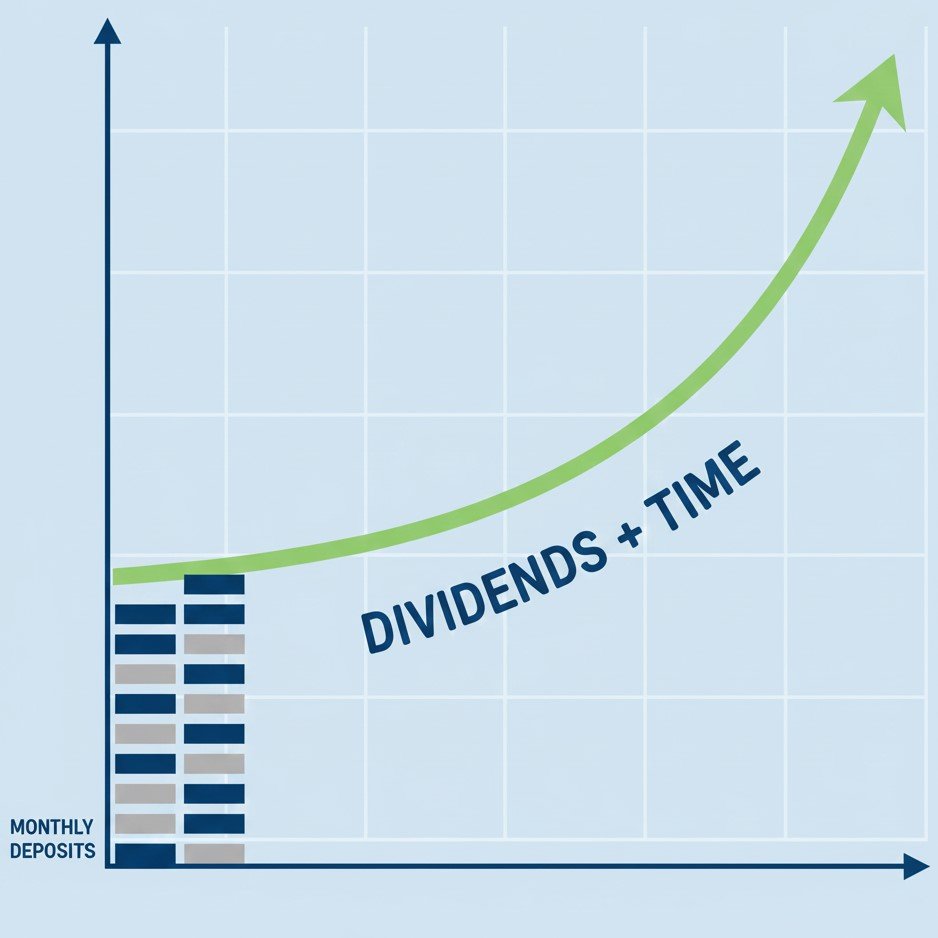
- Dividends credited/rolled over: Yes (dividends for year t credited at start of year t+1 and immediately earn dividends)
- Monthly-weight factor for a full year of monthly deposits: the sum of (n/12) for n=12 down to 0 = 78/12 = 6.5 → this is a standard simplification
Step A: Annual dividend on that year’s monthly savings
For monthly deposits of KES 10,000:
- Annual dividend from that year’s monthly savings = 10,000 × 10% × 6.5 = KES 6,500
This KES 6,500 is the annual dividend attributable to that year’s stream of monthly KES 10,000 deposits.
Step B: Dividend on initial 50K
The initial KES 50,000 deposited in month 1 earns:
- 50,000 × 10% × (12/12) = KES 5,000 (in the first year)
Full year-by-year table
We show opening balance, dividends, new savings, and closing balance.
Year 1
- Opening balance: 0
- Initial deposit: 50,000
- Monthly deposits (sum for year): 120,000
- Dividends earned this year:
- On initial 50K: 5,000
- On monthly deposits (year’s new monthly savings): 6,500
- Dividends declared at year end: 11,500
- Closing balance (start of Year 2) = 50,000 + 120,000 + 11,500 = 181,500
Year 2
- Opening balance: 181,500
- Annual dividend on opening balance (10%): 18,150
- Dividend from this year’s monthly deposits: 6,500
- Dividends declared: 18,150 + 6,500 = 24,650
- New monthly deposits added during year: 120,000
- Closing balance (start of Year 3) = 181,500 + 24,650 + 120,000 = 326,150
Year 3
- Opening balance: 326,150
- Dividend on opening balance (10%): 32,615
- Dividend on new monthly deposits: 6,500
- Dividends declared: 39,115
- New monthly deposits: 120,000
- Closing balance (start of Year 4) = 326,150 + 39,115 + 120,000 = 485,265
Year 4
- Opening balance: 485,265
- Dividend on opening balance (10%): 48,526.50
- Dividend on new monthly deposits: 6,500
- Dividends declared: 55,026.50
- New monthly deposits: 120,000
- Closing balance (start of Year 5) = 485,265 + 55,026.50 + 120,000 = 660,291.50
Year 5
- Opening balance: 660,291.50
- Dividend on opening balance (10%): 66,029.15
- Dividend on new monthly deposits: 6,500
- Dividends declared: 72,529.15
- New monthly deposits: 120,000
- Closing balance (end of Year 5) = 660,291.50 + 72,529.15 + 120,000 = ≈ KES 852,820.65
Rounded and presented earlier as ≈ KES 852,800 for blog-friendly numbers.
Contributions summary
- Personal contributions over 5 years:
- Initial deposit: 50,000
- Monthly deposits: 10,000 × 60 months = 600,000
= Total contributed: KES 650,000
Dividend / yield summary
- Total dividends earned ≈ KES 202,820 (this is total final balance minus contributions: 852,820 − 650,000 = 202,820)
How to save over 800K in numbers
- The monthly-weight factor (6.5) captures the fact that monthly deposits are not all present the whole year; early months earn more months of dividend than later months.
- The opening balance each year is what receives a full 10% for that year.
- Dividends credited at year-end are added to opening balance next year, accelerating compounding.
- Using conservative 10% (with no extra bonuses) keeps the result realistic and defensible.
Practical steps to save over 800K (action checklist for readers)
- Set up an automatic deduction or standing order so KES 10,000 leaves your account on a precise date (payday).
- Open or validate membership in Mwalimu National DT SACCO (or preferred SACCO). Deposit minimum share capital as required.
- Make the first lump-sum deposit (KES 50,000) if possible — it accelerates growth strongly.
- Treat dividends as sacred: opt to have them reinvested into shares/savings (do not withdraw).
- Avoid withdrawing savings unless emergency: withdrawals erode compounding.
- Track monthly contributions and check annual dividend statement; reconcile numbers and ask questions if something seems off.
- If possible, increase the monthly contribution when salary increases. Even a KES 1,000 increase compounds over time.
Behavioural nudges to make this stick (what successful savers actually do)
- Automate before you spend (pay yourself first).
- Keep a separate “emergency buffer” (e.g., 1–2 months’ living costs) in a liquid MMF or savings for true emergencies; avoid using SACCO savings unless necessary.
- Use visual trackers (spreadsheet, printable chart) and celebrate small milestones (KES 100k, 250k, 500k).
- Start saving early in your career
- Do not take expensive loans that will stretch your payslip further
- Explore ethical side income ideas (if your profession allows).
What to do if you can’t start with KES 50,000
Don’t worry. If you start without the initial KES 50K:
- The same structure still works; your final balance will be lower but you’ll still benefit from compounding.
- You can recover ground by increasing monthly contributions later or adding a lump sum later.
Example: if you start with zero initial deposit but still save 10k/month, you’ll reach a strong balance.
When to consider alternatives (MMF, fixed deposit, or switching SACCOs)
- Choose MMF if you need high liquidity and a better short-term return than bank savings.
- Use fixed deposit if you have a large lump sum you will not touch and you can beat the SACCO effective yield.
- Switch SACCOs only if another SACCO clearly offers better governance, consistent higher declared dividends, or better member services. Due diligence matters — check dividend history, audits, governance records, and membership reviews.
Closing: can you save over 800K in 5 years?
Saving KES 10,000 a month is doable — it’s less about income and more about structure. The combination of an initial lump sum, monthly discipline, and the SACCO dividend structure converts modest contributions into a meaningful nest egg. If you’re eligible for Mwalimu National DT SACCO (or another reputable SACCO), the path to KES 800,000+ in five years is real and within reach.
Start today: set up the standing order, join or confirm membership, and commit to the 20% rule — consistency will do the rest.
FAQs
1. Can I really save over 800K from a 50K salary?
Yes — with disciplined saving (KES 10,000/month), an initial lump sum (KES 50,000), and reinvested SACCO dividends at realistic rates (10% p.a. using monthly-weighting), you can exceed KES 800,000 in five years. The math above is transparent and conservative.
2. How do SACCO dividends work in Kenya?
Many SACCOs use a monthly-weighted calculation: money saved earlier in the financial year earns more dividend months than money saved later. Dividends are declared annually and usually credited to members’ accounts at the start of the next financial year — then they begin earning dividends too.
3. Is a SACCO better than a money market fund?
It depends. SACCOs are great for enforced discipline and community governance; MMFs offer liquidity and professional management. For forced monthly saving and competitive yields for salaried workers, SACCOs often win — but compare historical yields and governance before choosing.
4. How do I join Mwalimu National DT SACCO?
Join by filling the membership application, submitting ID, payslip, photos, and paying the minimum share capital (confirm current amount with SACCO). Once a member, set up regular deposits or salary check-off for consistent savings.
5. Do SACCO dividends change year to year?
Yes. Dividends depend on a SACCO’s financial performance (interest income, loan portfolio performance, operating costs). Use conservative assumptions when planning and check a SACCO’s history and governance.
6. What if I miss a contribution month?
Missing months reduces that year’s dividend and slightly slows growth. It doesn’t erase prior gains. Get back on track ASAP and consider a one-time top-up if possible.
7. Are SACCO dividends taxable?
Tax rules may apply depending on jurisdiction and SACCO policy. In Kenya, consult a tax advisor or the SACCO’s finance office to confirm current tax treatments and any withholding obligations.
8. Should I withdraw dividends or reinvest them?
Reinvesting is the fastest way to grow — withdrawals slow compounding. Use dividends for growth unless you need the money for planned, high-return investments (e.g., business seed capital).
9. How much do I need to save to become a millionaire in 5 Years?
A common follow-up question is whether the same strategy can reach KES 1 million in five years.
At a basic level, KES 1,000,000 over 5 years means saving about KES 16,700 per month, assuming no returns. With SACCO dividends in the 8–12% range, the required monthly savings drops slightly — but the key variable remains consistency.
For someone earning KES 50,000, this usually means:
- Increasing monthly savings from 10K to 15K–18K, or
- Extending the timeline slightly beyond five years
The takeaway: KES 1 million in five years is achievable, but it requires either a higher savings rate or a longer horizon.
10. Is it possible to make KES 1 million in 5 years in Kenya?
Yes — but not passively, and not without discipline.
For salaried Kenyans, especially those earning under KES 100,000, reaching KES 1 million in five years typically comes from:
- Structured saving (SACCOs, MMFs)
- Moderate returns (not speculation)
- Early lump-sum contributions
- Avoiding lifestyle inflation
The strategy used in this article is realistic, not aggressive. It prioritizes capital preservation and steady growth, which is why it works for the majority of salaried workers.
11. Which investment has the highest return in Kenya?
There is no single “highest return” investment without corresponding risk.
Historically:
- Equities and land can outperform — but are volatile and illiquid
- SACCOs and MMFs offer moderate, predictable returns
- Government securities provide stability but lower growth
For someone targeting KES 800,000–1,000,000 in 5 years, consistency beats chasing high returns. A stable 8–12% compounded over time often outperforms irregular speculative gains.
12. How much do I need to save to have KES 1 million in 5 years?
Without returns, about KES 16,700 per month.
With SACCO dividends, the required monthly amount may be slightly lower — depending on rate and timing.
13. How to Save Money from Salary in Kenya?
The most effective approach combines:
- Automatic deductions (SACCO, MMF)
- Clear targets (e.g., 800K in 5 years)
- Separating savings from spending accounts
Saving directly from salary removes temptation and builds consistency.
14. How to save over KES 800,000 in 5 years in Kenya?
One realistic approach:
- Save KES 10,000 monthly
- Start with a KES 50,000 lump sum
- Reinvest SACCO dividends
- Stay consistent for five years
This guide walks through the math step by step.
15. Which method is best for saving money in Kenya?
For most salaried Kenyans:
- SACCOs work best for medium-term goals
- MMFs work best for short-term liquidity
- Fixed deposits suit large lump sums
The “best” method depends on time horizon and discipline, not just interest rates.
16. Best place to save money and earn interest in Kenya?
Well-managed SACCOs and reputable MMFs remain the most accessible options for ordinary earners. They offer better real returns than leaving money idle in savings accounts.
17. Can I double my money in 5 years?
To double money in five years, you need roughly 14–15% annual returns, consistently.
This is possible but not guaranteed. The strategy in this article does not assume doubling, which makes it safer and more realistic for most readers.
18. Clever ways to save money in Kenya
Some proven methods include:
- Saving immediately after payday
- Using SACCOs for enforced discipline
- Avoiding lifestyle inflation after salary increments
- Treating bonuses as savings, not spending money
Start Your 5-Year Savings Plan Today
You don’t need a six-figure salary to build meaningful savings.
Start with what you earn, stay consistent, and use the tools in this guide to track your progress — one month at a time.
Join the Career Intelligence Community
Get exclusive data insights, downloadable tools, and mindful career strategies delivered monthly — no fluff, no spam.