
Salary negotiation is not a tertiary step in the hiring process but rather a foundational financial decision with profound, long-term implications. For the modern professional, approaching a job offer without rigorous data and a strategic plan represents a high-cost failure of investment strategy.
Introduction
Economic analysis demonstrates an unequivocal mandate for negotiation: those who negotiate their starting compensation achieve, on average, an 18.83% increase over the initial offer.
This immediate gain is merely the catalyst for the “Compounding Effect,” the primary economic driver that transforms short-term success into massive lifetime earnings disparity. Research indicates that a successful early negotiation can translate into a lifetime earnings difference potentially exceeding $1 million.
Conversely, accepting the first offer—a choice made by a significant portion of job seekers —institutionalizes a lower financial baseline.
The analysis presented in this guide professionalizes the compensation discussion. It shifts the candidate’s mindset from merely “asking for more” to building an evidence-based business case.
The methodology is structured around four pillars: establishing the economic foundation, adopting rigorous market benchmarking, quantifying personal Return on Investment (ROI), and executing the negotiation using principles of behavioral economics to neutralize cognitive and systemic biases.
This guide reframes salary negotiation as a professional, evidence-based business discussion rather than a plea for “more money.” You’ll learn to:
- Build your negotiation case using economic and market data.
- Quantify your personal return on investment (ROI).
- Leverage behavioral science to neutralize biases.
- Use ready-to-go scripts and templates that actually work.
By the end, you’ll not only know how to negotiate confidently — you’ll understand why the right approach can transform your lifetime earnings.
You might consider reviewing verifiable ROI frameworks for human capital arbitrage and career advancement.
Navigation
Part I: The Economic and Social Science Foundation of Compensation
Understanding your job offer begins with the intersection of economics, sociology, and psychology.
Every salary decision you make sets a trajectory — your starting salary is effectively the principal for all future raises, bonuses, and promotions.
1. The Compounding Effect: Modeling Lifetime Earnings Disparity
The most significant quantifiable argument for robust salary negotiation is the concept of the Compounding Effect.
This principle dictates that a starting salary acts as the principal amount upon which all future percentage-based adjustments, bonuses, raises, and competitive offers are calculated. Even assuming a modest 3% annual raise, any deficit established in the first negotiation widens exponentially over a 30 to 40-year career.
Truisac illustrates the magnitude of this effect: a seemingly minor $1,000 difference in starting salary can translate into a loss of $500,000 or more in earnings over the course of a professional career.
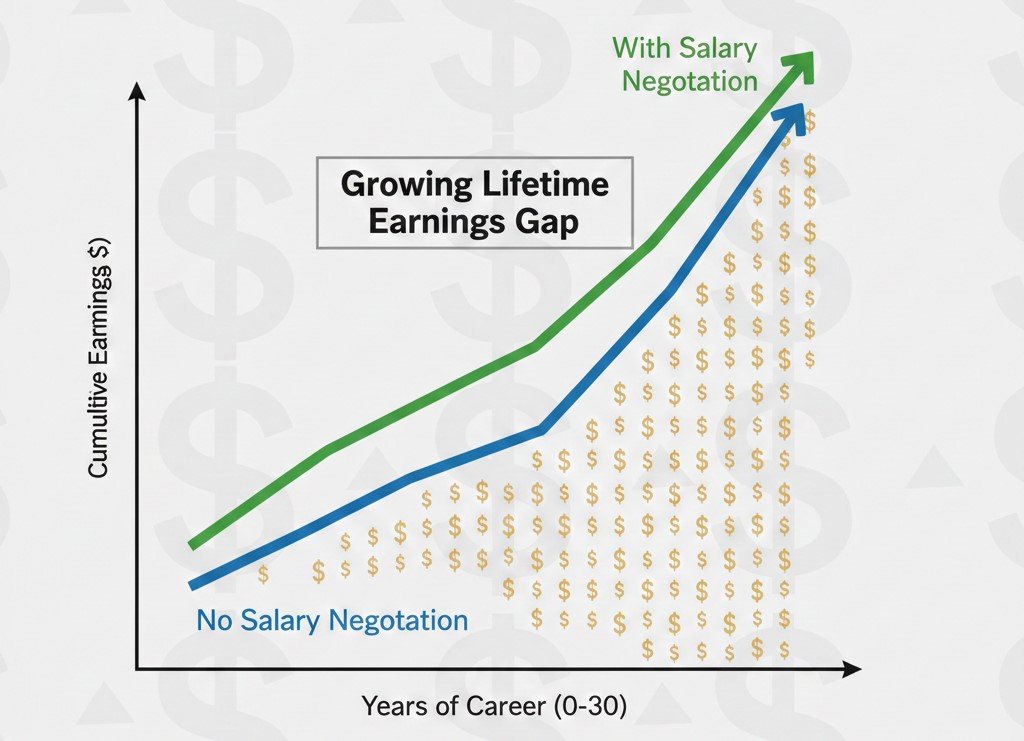
The implication is clear:
Accepting a lower initial offer institutionalizes a permanent, growing financial deficit. This is why negotiating early isn’t just optional — it’s essential.
This effect also disproportionately affects structurally disadvantaged groups. Women, on average, earn 84 cents for every dollar men earn immediately upon entering the workforce, a disparity amplified by compounding over time. This disparity is exacerbated for women of color.
Skilled negotiation is therefore; both a financial optimization and a defense against systemic inequities.
A critical behavioral dimension to address is the fact that 40% of job seekers report accepting the first job offer due to immediate “money worries” — a classic example of short-term anxiety undermining long-term strategy.
This response demonstrates a profound conflict between short-term financial anxiety and long-term strategic investment. When candidates accept a depressed starting salary under pressure, they guarantee a sustained, structural limitation on all future earnings.
Effective preparation, detailed in the following sections, is the only mechanism that provides the financial confidence required to resist the impulse to accept immediately and instead pursue the negotiation necessary for maximizing lifetime value.
2. Fairness Economics and the Reference Transaction Trap
Beyond pure financial accumulation, social science research on labor dynamics confirms that compensation is judged not only by absolute value but also by perceived fairness.
A key factor in this perception, both for the individual worker and the compensating organization, is the establishment of the “reference transaction”.
According to PMC-NIH research on the theory of fairness in labour markets, the compensation package accepted in the initial negotiation sets the worker’s internal baseline—the reference transaction—for what constitutes fair pay in the future.
If a candidate accepts a low offer (Period 1), that depressed figure becomes the point of comparison for all subsequent internal raises and promotions (Period 2). The organization can justify lower pay progression in Period 2 because the initial low base established an unfavorable reference point.
The crucial difference between internal and external compensation progression is difficulty: organizations often find it relatively straightforward to pay a high initial salary to a new hire based on competitive market signals.
However, raising an employee’s salary significantly later on—moving them substantially above the established internal reference transaction—requires overriding established salary bands and addressing complex internal equity concerns, which introduces friction and systemic resistance.
Thus, securing the maximum viable compensation upfront is the single most important step for maintaining favorable pay progression over the entire tenure with a company.
Part II: Methodological Rigor: Data-Driven Benchmarking
The foundation of a successful negotiation is objective, validated data. The candidate must transition from relying on generalized assumptions of “worth” to adopting the structured process utilized by compensation experts. This requires mastering data collection, analysis, and validation.
1. The Structured Process of Compensation Benchmarking
Candidates must emulate the six-step process that HR and compensation teams use to establish internal salary bands.
This alignment ensures the candidate’s request is presented in a language the organization recognizes as authoritative and strategic:
- Role Identification and Categorization: Clearly define the job duties and map the position precisely to standard market equivalents. For complex or hybrid roles, identify all duties and prevent the role from being benchmarked solely against the lowest-value component.
- Market Data Collection: Systematically gather compensation data from multiple reliable sources.
- Internal vs. External Comparison: Analyze where the role falls relative to external market medians and percentiles.
- Data Analysis and Interpretation: Move beyond simple average salaries. High-performing candidates should target the 75th percentile of the market rate, ensuring that the request is justified by skill and market demand.7
- Develop Specific Salary Ranges: Use the data to establish a precise, non-ambiguous target figure, not a vague range, for the negotiation.
- Documentation and Implementation: Ensure the final compensation structure is clearly documented.
Pro Tip: When articulating the negotiation target, professionals should employ metrics familiar to HR leadership. The Compa-ratio (Comparison Ratio) is particularly effective, as it compares the requested salary to the internal midpoint of the company’s pay band for the role.
Requesting a salary that puts you at or above the midpoint signals that you understand the company’s internal structure. Furthermore, it implies you view yourself as a high-value hire deserving of pay that exceeds average internal equity norms.
2. Critiquing Crowd-Sourced Data: Accuracy, Bias, and Limitations
While widely accessible, crowd-sourced salary aggregators must be used with a critical understanding of their inherent data biases and limitations.
According to Ravio, traditional salary surveys conducted by large HR consultancies (e.g., Radford, Willis Towers Watson) offer structured, peer-group data, but they often suffer from data latency, as they are typically updated only once or twice a year.
Conversely, widely used public platforms offer real-time input but carry significant sample bias.
- LinkedIn Salaries: Tends to over-index on active, experienced white-collar professionals (e.g., in tech, finance). While this may lead to slightly higher median figures, the data better represents the senior professional segment compared to other aggregators.
- Glassdoor and Indeed: These platforms benefit from broader inclusion of hourly and junior roles but suffer from lighter verification, leading to more outliers and entries that may lack context regarding equity or complex bonuses.
Best practice: Triangulate data. Compare medians, interquartile ranges (IQR), and specific title mappings across multiple sources. When presenting your figure, contextualize discrepancies:
“While the market median is $X, my research shows that professionals with my skillset command $Y, placing me at the 75th percentile of market compensation.”⁷
This approach positions you as data-driven and credible rather than subjective.
3. Benchmarking Complex Roles: Strategies for Hybrid and Executive Positions
Standard benchmarking often fails when applied to roles that are hybrid, highly specialized, or executive in nature. Effective negotiation in these cases requires granular detail regarding the scope of work and the total compensation breakdown.
For hybrid roles—where an individual performs duties spanning multiple traditional job titles—the candidate must proactively prevent the employer from using the lowest-paid component as the benchmark.
The recommended methodological counter is to insist on the Highest Responsibility Method, which benchmarks compensation against the most senior or complex duty performed. This ensures the package reflects the full required skill set, preventing systemic undervaluation.
In executive compensation (e.g., Director or VP level), the focus must shift heavily toward the nuanced components of total compensation.
Executives must demand clarity on:
- Bonus Calculation: Determine if the bonus is dependent primarily on individual performance or overall company performance. For senior roles, bonuses often become more contingent on company-wide results, which a single executive may have limited direct influence over
- Equity and Vesting: Understand the exact allocation mechanism and vesting schedule. Relying solely on the “Total Compensation” number can be misleading, as large initial signing grants of stock may not be repeated in subsequent years, creating an artificial compensation peak in Year 1.
Part III: Quantifying Value and Personal Return on Investment (ROI)
The strongest negotiation argument moves beyond external market rates and centers on the internal Return on Investment (ROI) the candidate delivers.
The data-driven candidate must frame their salary request not as a cost to be minimized, but as a strategic investment to be maximized.

1. Articulating Value through Business ROI Frameworks
Organizations view hiring as an investment calculated to yield positive Recruitment ROI. To align with this framework, the candidate must adapt common corporate metrics to define their own value proposition.
The analysis can be structured using the standard formula for calculating consultant ROI 17:
Personal ROI (%) = (Quantifiable Benefits Delivered − Total Compensation) ÷ Total Compensation × 100
The candidate’s task is to provide the numerator: the Quantifiable Financial Benefits. Value must be translated into demonstrable business drivers:
- Productivity and Efficiency: Quantify prior achievements in terms of time saved or output increased.
- Cost Savings: Detail projects that resulted in reduced vendor spending or minimized operational waste.
- Risk Mitigation: Highlight expertise in compliance, security, or regulatory frameworks that protect the company against potential financial liabilities.
A highly effective strategic maneuver is to invert the organization’s high Cost Per Hire (CPH) metric. Research indicates the average US company spends approximately $4,000 and 24 days to hire a new employee. The candidate can leverage this by demonstrating superior efficiency and rapid integration.
If a candidate can commit to achieving Key Performance Indicators (KPIs) in 15 days rather than the expected 45, they are quantifying their immediate value by saving the company labor costs, reducing time-to-productivity, and validating a higher compensation request as a prudent investment against high CPH risk.
2. Transforming Career Gaps into Quantifiable Assets
Employment gaps often introduce unconscious bias into the hiring process; based on The Interview Guys publication on how to deal with employment gaps in your resume, 61% of hiring managers view these gaps negatively.
The counter-strategy—as The Interview Guys advise—is not to minimize the gap, but to aggressively reframe it as a period of intentional, quantifiable professional growth that directly translates into organizational value.
The articulation must be data-centric, converting non-traditional activities (volunteer work, independent projects, academic study) into measurable business skills:
- Volunteer Experience: Frame leadership roles or team management within volunteer work as evidence of project execution, team coordination, and stakeholder management.
- Independent Projects: Document academic projects (e.g., mapping projects) or certifications (e.g., Google Data Analytics Certificate) by listing the technical skills used and the measurable deliverables achieved.
Explore our 5-minute ATS resume checklist to avoid costly parsing errors and boost relevance scores.
The following framework illustrates how non-traditional experience can be translated into the language of corporate ROI:
Table: Personal Value Articulation Framework: Translating Skills to Business ROI
| Business Value Driver | Personal Achievement Category | Quantifiable Metric Example |
| Operational Efficiency/Cost Savings | Independent Project Management | Reduced cross-departmental lead time by 30% through implementing a new workflow structure, estimated to save 150 hours annually. |
| Risk Mitigation/Compliance | Specialized Training/Certifications | Completed advanced security certification during career break, proactively identifying and reducing a system vulnerability exposure by 90%. |
| Innovation/Future Growth | Academic/Independent Projects | Developed and executed the Surathkal Beach Mapping Project, utilizing advanced GIS techniques directly applicable to future product R&D. |
3. The Comprehensive Compensation Package: Beyond Base Salary
When the organization asserts that the base salary is inflexible due to established pay bands or internal equity, the negotiation must shift entirely to non-monetary and ancillary benefits. These items often carry a low marginal cost for the employer but provide substantial value to the candidate.
The highest leverage non-salary negotiation is securing an early performance review and compensation adjustment. Instead of waiting the standard 12 months, the candidate should request a documented 6-month review, with clearly outlined performance goals.
This strategy provides two crucial benefits: it demonstrates confidence in the ability to deliver rapid value, and it provides a guaranteed mechanism to raise the “reference transaction” baseline salary much sooner, mitigating the negative effects of the initial salary anchor.
Other high-value components include increased vacation time, professional development funding, sign-on bonuses, and for executives, a careful review of equity vesting schedules and the mechanism for calculating incentive compensation.
Part IV: Behavioral Economics and Negotiation Scripts
Even with data and ROI frameworks, negotiations can fail if you don’t manage human psychology. Behavioral economics helps you navigate cognitive biases and social dynamics to maximize your outcome.
1. The Anchoring Advantage: Setting the Reference Point
Anchoring bias—based on Red Bear Negotiation—means people rely heavily on the first number offered. Your goal: set a high, credible anchor based on your research and personal ROI.

Example Script (Phone/Video Call):
“Thank you for the offer. Based on my research of the 75th percentile for this role and my unique experience, I am targeting $X. This aligns with the value I bring and industry benchmarks.”
Tips:
- Be specific, not vague (“$X–$Y” is weaker than “$X”).
- Support your anchor with ROI evidence and market data.
- If the employer anchors low, reframe immediately with your research.
2. Countering Cognitive Bias in Decision Making
Managers often rely on System 1 thinking — fast, intuitive, and emotional — which can undervalue your request. Force System 2 thinking (slow, analytical) by presenting a documented, data-backed proposal:
- Include percentile market data
- Quantify your ROI
- Compare internal and external benchmarks
This transforms negotiations from a subjective discussion to a strategic business review.
3. Negotiation Strategies to Mitigate Systemic Bias
Research confirms that a “negotiation raise gap” persists, with men achieving an average raise of 19.7% compared to 15% for women.
According to LearnIn on negotiation advice for women, this disparity indicates that structural and gender bias creates a social penalty, where self-advocacy by women and minorities is often negatively perceived as “aggressive” or “intimidating”.
To counteract this penalty, negotiation scripts must incorporate social science-proven strategies that maintain relational warmth while demanding objective value.
Proven Anti-Bias Scripts
- The Power of “We” and Relational Framing: Candidates should use language that embeds their request within the context of shared organizational goals or external professional advice. For instance, attributing the request (“My mentor suggested I structure this request…”) or framing it as a necessity for peak performance (“Securing this compensation ensures I can dedicate 100% of my focus to achieving our shared goals…”) mitigates the social penalty associated with individual self-promotion.
- Specificity is Mandatory: Data shows that individuals, particularly women, who specify a definitive, data-backed numerical amount receive a greater increase in compensation than those who use vague ranges or generalized requests. Confidence and precision are critical in combating assumptions of uncertainty.
- Deflecting Salary History: Historically, asking about a candidate’s previous salary history has been identified as a key mechanism perpetuating the gender pay gap. Candidates must be prepared to respectfully deflect this inquiry. In many U.S. states, based on PON Harvard Edu, this question is now illegal. The recommended deflection focuses the conversation strictly on future value and current external market rates.
4. Ready-to-Use Negotiation Scripts
HR / Recruiter Conversation
“Thank you for the offer. Based on market research and my experience, a salary of $X reflects the 75th percentile for this role. I’m confident this aligns with the value I’ll deliver and allows me to contribute at full capacity.”
Email Counter-Offer
Subject: Discussion of Offer for [Role]
Dear [HR Name],
Thank you for the offer. After reviewing industry benchmarks and evaluating my experience, I am requesting a salary of $X. This reflects my expected contributions, aligns with the market, and ensures I can fully focus on delivering results. I’m excited about the opportunity and look forward to your thoughts.
Best regards,
[Your Name]
Benefits Negotiation
“If the base salary is fixed, I’d like to discuss alternatives: an early 6-month performance review, additional professional development funding, and flexible vacation options. These adjustments ensure I can deliver maximum value efficiently.”
Countering Lowball Offers
“Thank you for sharing the initial figure. According to my research and the value I will bring, I am targeting $X. This aligns with both market standards and expected ROI, ensuring a fair start for both sides.”
The following table provides prescriptive framing for common high-stakes scenarios:
Table: Anti-Bias Negotiation Scripts: Proven Behavioral Strategies
| Bias Challenge | Behavioral Strategy | Recommended Scripting (Data-Backed/Relational) |
| Low Anchor/Lowball Offer | Re-anchor with objective market data (75th percentile), emphasizing unique value. | “Thank you for the initial offer. My comprehensive market analysis for this role, given my specific expertise, shows a 75th percentile range of $X to $Y. I am targeting $Y, which reflects the projected value and ROI detailed in my proposal.” |
| Perception of Aggression | Use relational framing (“The Power of We”) and attribute the request to professional advice or organizational alignment. | “I appreciate the collaboration on this offer. As a key skill I bring to the team, I was advised by my supervisor to ensure this package is fully competitive. I am confident that securing this compensation ensures I can dedicate 100% of my focus to achieving our shared organizational goals.” |
| Salary History Inquiry | Deflect to future value and legal compliance; focus on external market rate. | “I prefer to focus this discussion exclusively on the value I will bring to [Company Name] and the current market rate for this specific leadership role.” |
Job Offer Salary Negotiation in Summary
Negotiation is both an art and a science. Key points for closing effectively:
- Express enthusiasm and appreciation at the start and end.
- Negotiate after the offer, but before acceptance.
- Be ready to walk away if the employer cannot meet justified market rates. Knowing your value empowers you to protect your long-term earnings.
The ultimate leverage comes from combining:
- Data-backed market analysis
- Quantified personal ROI
- Behavioral economics strategies
This synthesis ensures you negotiate confidently, professionally, and with maximal lifetime financial impact.
Don’t just read about read salary negotiation after job offer, also read how to write an ATS-optimized resume, evidence-based professional wellbeing, and optimized professional toolkit.
FAQs
Find quick answers to some questions
Download Full Salary Negotiation Script Pack
Find a comprehensive “150+ ready-to-use negotiation scripts” pack that covers virtually every job offer scenario, including HR calls, recruiter conversations, emails, counteroffers, benefits, hybrid roles, executive roles, diversity-focused situations, remote work, lowball offers, and more.
Download NowJoin the Career Intelligence Community
Get exclusive data insights, downloadable tools, and mindful career strategies delivered monthly — no fluff, no spam.