
Key Summary
- Entry-level openings have shrunk dramatically. In the UK, entry-level and graduate job postings have plunged (graduate roles down ~45% year-over-year); in the US the share of unemployed new workforce entrants hit a 37-year high (13.3%) in 2025.
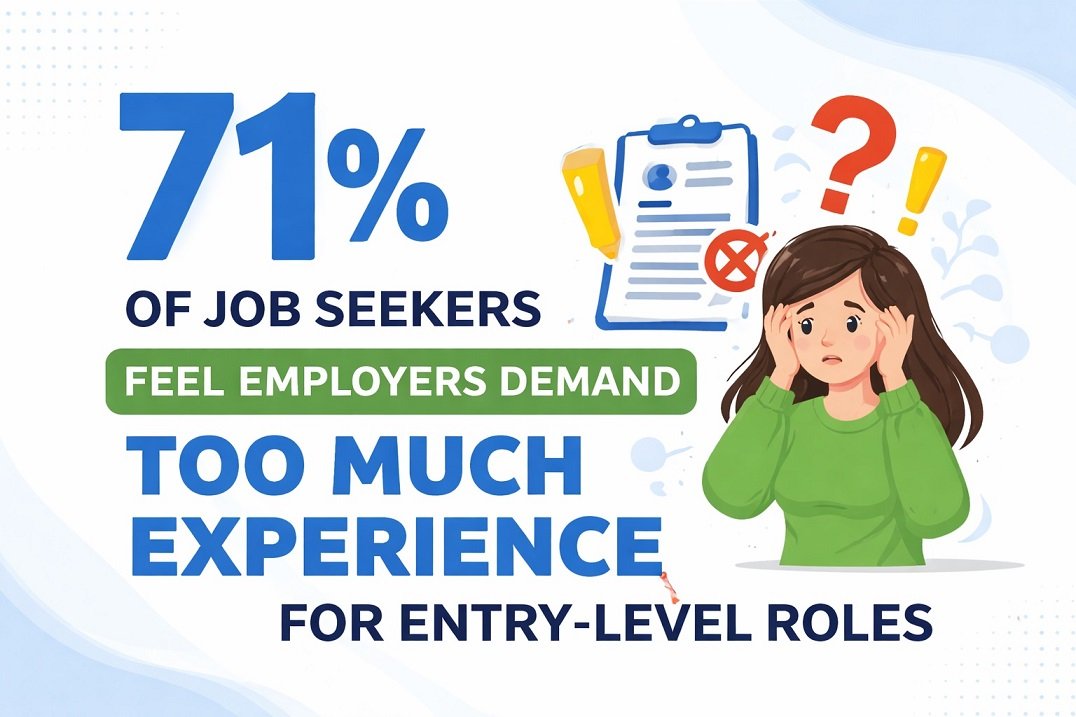
- Experience requirements block beginners. A recent survey found 71% of job seekers feel employers demand “too much experience” for entry-level roles.
- Recruitment has become impersonal and tech-driven. Over 98% of large companies use applicant-tracking or AI systems (ATS/AI) to filter resumes, and more than half (53%) of candidates report being “ghosted” by employers.
- Networking and ATS-optimized applications are now essential.
Contents
Introduction
Graduating with a degree used to signal a ticket to a good job, but today many graduates feel frustrated and confused. Instead of academic credentials guaranteeing interviews, new graduates often face dead-ends.
Crucially, this isn’t a laziness problem – it’s a structural one. Warnings have emerged that our entry-level “rungs on the career ladder are splintering” beneath young people (Fortune).
Recruiters are hiring cautiously in a low-growth economy, preferring to fill vacancies by internal promotion or waiting until someone quits. Meanwhile, technological shifts and hiring practices have raised the bar for newcomers.
In this challenging market, even qualified graduates struggle to get a foot in the door. The good news is there are practical steps to fight back.
In this article we’ll explore the seven core reasons why university graduates can’t find jobs now – from the sheer shortage of entry-level roles to “ghosting” by employers – and for each we’ll offer evidence-based solutions.
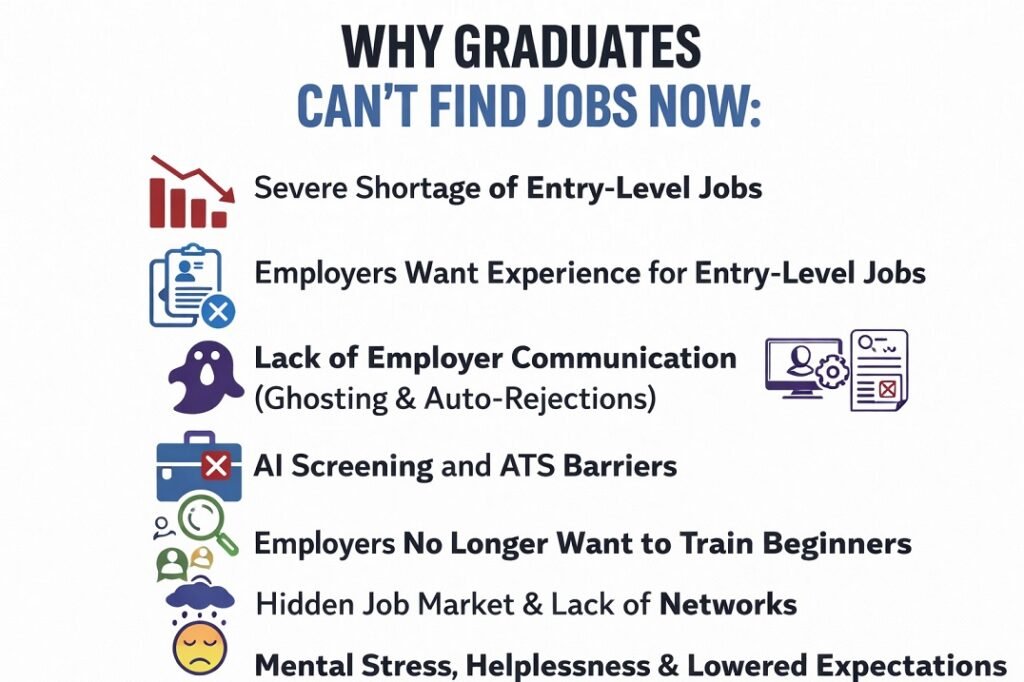
1. Severe Shortage of Entry-Level Jobs
The bottom of the job ladder has been cut away. After post-pandemic hiring booms, many companies slowed or froze entry-level hiring. Economic growth is sluggish, so firms stick with “low-hire, low-fire” staffing strategies. In practice, this means roles only open if someone leaves, rather than creating new positions.
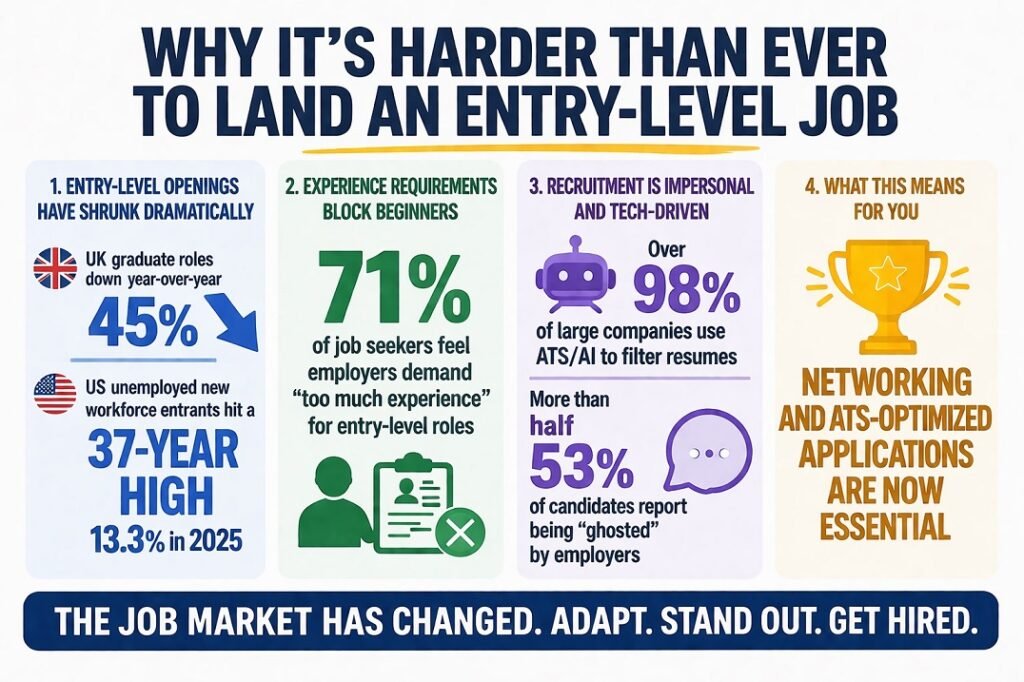
Research shows that when growth slows, “the door closes first on recent graduates and those new to the workforce,” leaving them competing over a tiny number of openings. In the US, only 13.3% of unemployed people in 2025 were new workforce entrants – a share not seen in 37 years.
Globally, countries like the UK are experiencing steep declines: a January 2026 report found UK graduate job ads fell 45% year-over-year, and total entry-level vacancies dropped 4.4%. According to FKE report, youth unemployment in Kenya is extremely high (67% of ages 15–34 are jobless), reflecting how few entry positions are available for new grads.
The result is that even well-qualified grads face lines of candidates for each role. One study found that college graduates no longer have the edge they once did: for the first time, young workers with vocational training (e.g. electricians, mechanics) had slightly better employment rates than those with four-year degrees.
Essentially, good resumes are pitted against dozens or hundreds of others. Many grads report spending hours tailing applications with no response. Beyond frustration, the shortage means extended job searches and financial strain.
In the UK—based on Adzuna, the number of young people not in education, employment or training (NEET) is at record highs. This shortage is felt across sectors: health care and social services had some of the few rising job postings, while finance and information sectors slowed dramatically.
Career Path Finder
Discover careers aligned with your strengths.
How Can We Address the Severe Shortage of Entry-Level Jobs?
1. Apply early and broadly
Start your search months before graduation. Aim to be in front of employers before they stop hiring. Submit applications across different industries and regions.
Don’t just watch your school’s on-campus portal – use general job boards (Indeed, Glassdoor) and niche sites (e.g. Handshake, university career centers, AscendurePro, specialized industry job sites).
2. Target growth areas
Focus on sectors still expanding. For example, healthcare roles (nurses, therapists), education and ed-tech, IT support, logistics/warehousing, and even renewable-energy trades are hiring.
Career experts highlight fields like healthcare, skilled trades (electricians, technicians), transportation and supply chain, and business/sales as areas with steady demand. Aligning your search to these areas increases chances of openings.
3. Speculative applications
Don’t wait for job postings. Identify companies you admire or industries you want, and send a tailored inquiry letter or resume introducing yourself – even if they haven’t advertised a role. Many small firms and nonprofits hire quietly this way.
Find a list of 300+ top employers in Kenya and 10 best companies to work for in Kenya.
4. Gain practical experience via projects
If jobs aren’t coming, build a portfolio or freelance. For instance, a recent grad created a personal website with UX design samples; another wrote for an open-source project.
This demonstrates skills to employers and may lead to contract gigs. In fact, 57% of Gen Z workers now juggle side hustles or gig work for income – view this as building experience rather than a sidetrack.
5. Use alternative pathways
Consider internships (even unpaid), short certificate courses, or micro-project sites (like Parker Dewey’s micro-internships platform). These let you do real work in short bursts, earn reference letters, and make you a stronger candidate.
2. Employers Want Experience for Entry-Level Jobs
Frustratingly, “entry-level” roles often list 1–3 years of prior experience. Employers use experience as a risk filter: they prefer candidates who can hit the ground running with less training.
Recruiters report that many firms include experience requirements to narrow the applicant pool. A survey found 71% of job seekers feel employers demand too much experience for entry-level roles.
In other words, companies are essentially saying “we only want newcomers who’ve somehow already done this job.” The intent is understandable (hiring is costly, and a bad hire hurts), but it shuts out fresh graduates who have the motivation but not the resume line.
This mindset means many grads end up “overqualified” on paper. They lose out on roles not because they lack capability, but because the job posting’s filters exclude them.
At the same time, employers ironically recognize later that some candidates without all boxes checked still excel: in one survey, 60% of applicants who applied to positions above their stated experience actually got hired. Still, those hidden hires are the exception – many graduates just get rejected by the ATS or screened out.
For the candidate, the impact is clear: impressive volunteer leadership or capstone projects may as well not exist if the job ad is programmed to reject applicants with “0 years” experience.
Practical Solutions for Employers Requiring Experience in Entry-Level Jobs
Reframe any experience as relevant
Highlight internships, volunteer roles, or student projects as bona fide work experience. For example, led a campus club? Managed a charity event? Treated these as jobs on your resume (e.g. “Project Coordinator, Student Tech Club – Led a team of 5 to build a functioning app prototype”).
Quantify what you did: “Reduced process time by 20%” or “Coordinated budgets of $5K” turns schoolwork into business outcomes.
Build a skills-first resume
With skill-based hiring on the rise, many employers now emphasize competencies over years-in-role. Adopt a format that foregrounds skills and achievements: group sections by skill (e.g. “Analytical skills”, “Team leadership”). Under each, list short bullet achievements.
The NACE association reports that 70% of employers now use skills-based hiring practices – phrasing your resume around skills can get you past rigid filters.
Pursue micro-internships or apprenticeships
Organizations like Parker Dewey connect students to short paid projects. Even a few weeks of real-world work can be listed as job experience on your resume.
Likewise, look for apprenticeship programs (some countries have formal apprentice tracks for IT, accounting, etc.) or industry bootcamps that provide on-the-job training.
Gain certifications and demonstrable skills
Take relevant online courses (Coursera, Udemy, etc.) and earn certificates (e.g. Google’s digital marketing certificate, CompTIA for IT). Then list those skills prominently. This tells employers you have training even if you lack formal work history.
Be honest but positive in interviews
If asked about experience gaps, focus on what you can do: emphasize your fast learning, recent successes (like coursework), or part-time jobs where you developed related skills. Showing enthusiasm and readiness can outweigh a lack of years on paper.
3. Lack of Employer Communication (Ghosting & Auto-Rejections)
Graduates report applying for jobs and hearing nothing back. Part of this breakdown is simple arithmetic: with massive applicant volumes (especially now that AI tools let anyone customize cover letters at scale), recruiters and HR teams get flooded.
Many use automated rejection emails or silence. Some positions are even “ghost jobs” – dummy postings used to lure applicants or test markets (one survey found 81% of recruiters admitted posting fake job ads).
The result: candidates are left in limbo, often never receiving any reply after submitting hundreds of resumes or doing interviews.
The emotional toll is severe. Recent surveys show more than half of job-seekers (53%) experienced employer ghosting in 2025, up from 38% in 2024. Candidates describe feeling “tired, depressed, desperate” and losing confidence.
This silence breeds uncertainty: Did the recruiter forget me? Was I not qualified? It can lead graduates to question their worth or panic-apply to even more jobs (a vicious cycle). In reality, the problem often lies with the process, not the person.
Fortune reporters note that AI-driven application surges make it nearly impossible for hiring teams to manually reply to every applicant.
Discover Top 8 Degrees That Lead to High-Paying Jobs in Kenya
How to Handle Poor Employer Communication (Ghosting and Automated Rejections)
Track and follow up
Use a spreadsheet or job-tracking app to log every application: position, company, date, and last contact. Set reminders to follow up by email if you haven’t heard in 7–10 days after applying or interviewing.
A polite follow-up (“Reiterating my interest in the [Role] position”) can sometimes bump your resume to a human. Indeed advises always sending a thank-you email after interviews – it shows professionalism and keeps communication open.
Be strategic, not scattershot
Instead of blasting out 100 generic applications, focus on fewer targeted ones. Tailor each resume and cover letter to the role (so it seems more genuine) and research the hiring manager or team.
This increases your odds of a reply (even automated) and reduces burnout. As one expert noted, automation has turned hiring into a numbers game: “As job seekers and hiring managers both use advanced technology, it’s muddying the best way to pick talent.”
Seek feedback when possible
If you do get an interview or rejection email, politely ask if the manager has any advice on your resume or interview performance. Some will reply with tips. Use any feedback to improve for next time.
Keep perspective and momentum
Metrics over moods. Set weekly goals (e.g. “submit 10 tailored applications and reach out to 5 alumni on LinkedIn”). Celebrate small wins (e.g. booking an informational call) rather than fixating on silence.
Remember, 73% of recruiters actively review LinkedIn profiles, so maintain a strong online presence in the meantime. Engage in skill-building (free online courses, volunteer tasks) to feel productive.
4. AI Screening and ATS Barriers
These days, your resume doesn’t even reach a person until it clears an AI gatekeeper. By 2025, virtually every company with hundreds of employees used an Applicant Tracking System (ATS) to pre-screen candidates.
Some major ATS platforms (Workday, iCIMS, etc.) parse hundreds of resumes for keywords and qualifications. Surveys confirm that 99.7% of recruiters use filters in their ATS (checking skills, education, certifications, etc.).
If your resume lacks the exact terms or format it expects, it may never be seen by a human. In effect, graduates are competing in a machine-run sorting contest before being judged on merit.
The ATS hurdle means many qualified grads “disappear” without a trace. Coversentry research finds nearly all Fortune 500 companies (97.8%) use ATS software. A slight misspelling or creative layout (using tables/graphics) can scramble your data. Even a misplaced section title could cause the software to skip your education or skills entirely.
Jobscan data shows 73% of recruiters always or often review a candidate’s LinkedIn, but just 48% report getting candidates from job boards – reflecting how crucial human networks are once the ATS barrier is high.
Ultimately, 44% of job-seekers surveyed got zero interviews, partly due to having their resumes filtered out by these systems.
How to Overcome AI Screening and ATS Barriers
Make your resume ATS-friendly
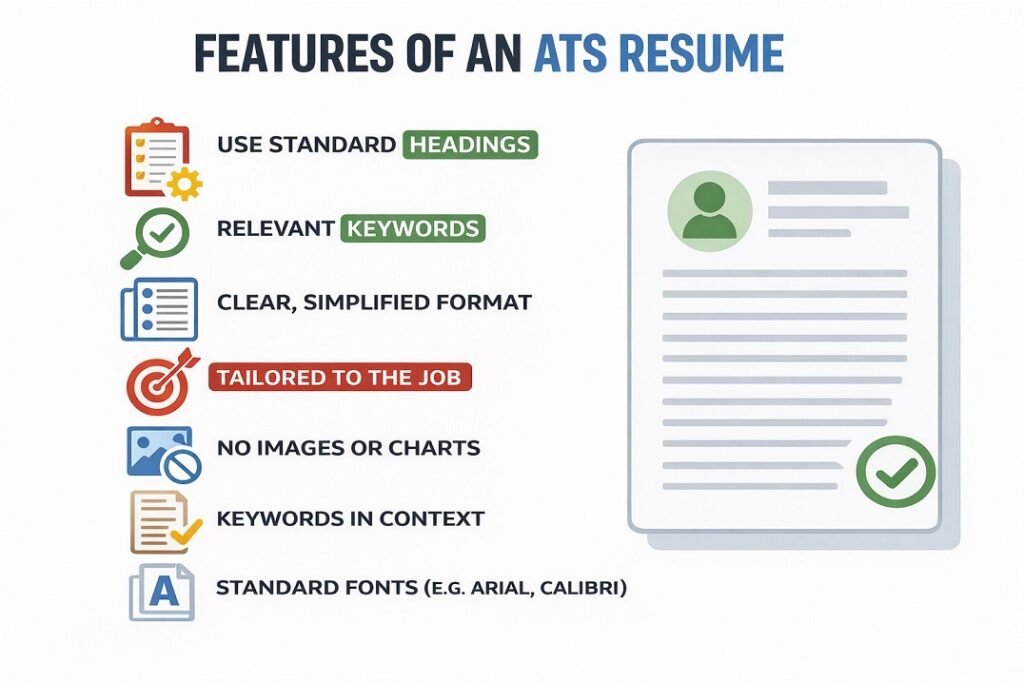
Use a simple one-column layout, standard fonts, and avoid images or tables. USC Charlotte’s career center advises using clear headings (Experience, Education, Skills) and submitting Word or text-based PDFs so systems can parse them.
Tailor your resume to each job by mirroring the language in the posting. For instance, if the ad says “project management” or “Python,” include those exact phrases in your skills and experiences (assuming you legitimately have them).
Use keyword matching strategically
Read the job description and sprinkle key terms naturally. But avoid overstuffing – quality content still matters.
One tip: paste your resume and the job ad into a tool like ChatGPT or Jobscan; it can highlight missing keywords so you know what to add. Also focus on measurable achievements (“increased sales 20%”) which often contain relevant nouns.
Leverage professional tools
Consider using AI resume scanners that simulate ATS screening. They can flag formatting issues and missing keywords specific to the role you want.
Network to bypass ATS
Whenever possible, get a human referral or contact first. Coversentry research shows recruiters source 75% of candidates via LinkedIn search and 60% via employee referrals. If you apply through a connection’s referral link, you often go straight to the hiring manager’s desk, skipping the software.
Build a LinkedIn profile with the same keywords as your resume – 73% of recruiters check LinkedIn profiles, so a well-optimized profile can act as a backup resume.
Resume Optimizer
Turn your CV into an ATS-winning document.
5. Employers No Longer Want to Train Beginners
Gone are the days when companies hired graduates purely as trainees. Many employers now act as if new hires should be “plug-and-play,” ready on day one. Training budgets are tight, and businesses often cut early-career development.
Technology makes it easier to search for seasoned talent, so firms increasingly demand that even newbies already have expertise.
An industry outlook notes that using AI to eliminate entry-level jobs is “short-sighted,” since those roles historically serve as on-ramps for fresh talent. Yet the reality is, companies worry about efficiency and perceive training entry-level employees as costly.
The effect is that many graduates with strong potential are overlooked simply because they haven’t yet been on-the-job. Employers fear taking a risk on a “raw” candidate, so only pick those who have done internships or related jobs.
For grads, this means that talent, motivation and intelligence may not be enough – you have to prove readiness. It also means longer job searches for those who fit well culturally but lack direct experience.
Practical Strategies for Graduates Entering a Job Market Where Employers Are Reluctant to Train Beginners
Show your readiness to learn
In cover letters and interviews, emphasize how fast you pick up new skills. Provide examples from school or personal projects where you self-taught a tool or process. This demonstrates you won’t need hand-holding.
Document self-learning and certifications
Take online courses or earn certificates that signal professional know-how (for example, AWS cloud cert, Google Ads cert, or industry micro-credentials). List these on your resume. They act as proof that you’ve already gone beyond classroom theory.
Provide case-study examples
If you’ve solved problems academically or in clubs, package them as case studies. E.g.: “For my senior project, I developed a 3-step plan to increase website traffic, which improved our local sales by 15%.” This shows you can apply knowledge to real issues.
Internship-to-hire strategy
Even if they call it an “internship” or “contract,” treat it like a trial. Many companies prefer converting interns to full-time hires because the training cost is sunk.
Apply vigorously for any internship or temp role – it often leads to a permanent position, especially if the company can hire without posting publicly.
Emphasize transferable skills
Sell qualities every new hire needs: communication, teamwork, problem-solving, adaptability. For example, highlight how leading a student organization honed your leadership and collaboration skills.
According to NACE, employers increasingly look beyond GPA to competencies. If you lack direct job skills, focus on skills that all jobs require (like learning agility).
6. Hidden Job Market & Lack of Networks
Many job opportunities are never advertised publicly. Instead, roles are filled through referrals, promotions, or informal searches. Companies tend to tap their networks first because referred or known candidates generally perform better and onboard faster.
Research by Jobscan found that 75% of recruiters source candidates via LinkedIn and 69% consider employee referrals very important. In effect, if you don’t have a network in a company or industry, you might not even know the job exists.
This “hidden job market” is especially pronounced in some cultures where internal connections are king.
For graduates who haven’t built professional networks yet, this means many doorways stay invisible. You might apply to the one posted opening and lose out to an internal candidate or referral without ever getting an interview. It also means information on what employers really want can be scarce.
For example, entry-level roles might have unwritten preferences (“we like candidates who volunteered in community service”) that only insiders know.
Without alumni or professional contacts giving a heads-up, fresh graduates are effectively excluded from these channels.
How Can Graduates Navigate the Hidden Job Market and Overcome Limited Networks?
Graduates often face the dual challenge of accessing unadvertised job opportunities and building professional connections from scratch. To navigate the hidden job market effectively, they should focus on developing a proactive and strategic approach:
Build LinkedIn connections from Day 1:
Start with people you know – classmates, alumni from your university (even from other programs), professors, internship supervisors, or family friends in industry. Send polite connection requests with a short note.
Join LinkedIn groups related to your field and participate in discussions. In just six months, a network of 100+ relevant contacts can form, exposing you to referrals and job leads. (Remember: 73% of recruiters check LinkedIn.)
You also need to optimize LinkedIn profile. A well-crafted LinkedIn profile showcasing relevant skills, projects, and achievements can attract recruiters and establish credibility.
Leverage alumni and career centers:
Reach out to your college’s alumni network. Many schools have directories or LinkedIn Alumni pages. Ask alumni in your desired field if you can do an informational interview (a 15–20 minute chat).
People are often happy to talk if asked respectfully. These conversations can yield referrals or tips on unlisted openings.
Attend industry and community events:
Look for networking meetups, webinars, hackathons, or volunteer at conferences. In many emerging markets (e.g. tech hubs in Nairobi, Lagos, or remote meetups) recruiters attend events specifically to scout talent. Even local workshops or job fairs can lead to contacts.
Join online communities:
Platforms like Slack workspaces, Discord servers, Reddit communities, or professional forums in your field can lead to hidden gigs or job mentions. Engage by asking and answering questions. Often, job postings circulate there before they hit mainstream sites.
Ask for referrals explicitly:
When you make friends or acquaintances at companies, let them know you are job hunting and ask if they can refer you to openings or alert you to future roles.
Many companies have referral programs with bonuses, so it’s in employees’ interest to help. Even a short note (“I noticed your company is expanding; I’d appreciate any advice or connections on entry roles”) can open doors.
Leverage Informational Interviews:
Reaching out to professionals for short conversations can provide valuable insights into industries and companies, while organically expanding one’s network.
Engage in Industry Communities:
Participating in professional associations, online forums, or alumni groups helps graduates gain visibility and stay informed about unposted roles.
Showcase Initiative and Value:
Volunteering, freelancing, or contributing to open-source projects demonstrates commitment and allows graduates to build a tangible portfolio.
Collaborate with Career Services and Mentors:
Partnering with university career centers or seeking mentorship can open access to exclusive opportunities and insider advice.
Job Matching
Get AI-matched roles tailored to your profile plus a complete hiring simulation.
7. Mental Stress, Helplessness & Lowered Expectations
Job-hunting in this market can feel like running a marathon without a finish line. Graduates often invest months with little to show. The constant stream of rejections and silence erodes confidence.
Social media doesn’t help: seeing peers land jobs can amplify feelings of failure. Over time, many start to lower their expectations (“I’ll take anything, even underpaying or off-track”) just to end the uncertainty.
This mindset shift – from aiming for a career goal to grabbing “any job” – is common when hope wears thin.
This stress shows up as anxiety, depression, and burnout for many young job seekers. Surveys highlight words like “tired,” “depressed,” and “desperate” in candidates’ own descriptions of their feelings.
Productivity drops, job searches become sporadic, and interviews often go poorly due to low morale. Some grads give up mid-search and either delay career launch (leading to more NEETs) or accept roles far below their skill level.
Overall, the lack of structure and overwhelming uncertainty can drag on mental health and financial stability.
How Graduates Can Overcome Mental Stress, Feelings of Helplessness, and Lowered Expectations
Graduates today often face immense pressure as they transition from academic life to the realities of the professional world. Uncertain job markets, financial strain, and the weight of self-expectations can easily lead to mental stress and discouragement.
However, with the right mindset and practical strategies, it’s possible to navigate this challenging phase with resilience and hope.
1. Acknowledge and Normalize Your Feelings
Recognize that stress and uncertainty are common during major life transitions. Accepting these emotions without judgment is the first step toward managing them effectively.
2. Create a structured weekly plan
Break the job search into manageable tasks. For example: Monday – 3 new applications, Tuesday – update LinkedIn and network, Wednesday – skills training or side project, Thursday – follow-ups, Friday – rest or light activity. A routine provides purpose and reduces anxiety.
3. Set realistic goals, not just outcomes
Avoid comparing your progress to that of others. Set achievable short-term goals—such as improving a skill, applying for a certain number of jobs each week, or building your network. Gradual progress fosters motivation and confidence.
Aim for daily metrics like number of networking emails sent or resume reviews requested. These are in your control, unlike “getting an offer.”
Celebrate small wins: getting an informational interview, learning a new skill, or even writing one effective cover letter are all progress.
4. Lean on peer support
Form (or join) a job-search group with friends or classmates. Meet (even virtually) weekly to share leads, practice interview questions, and hold each other accountable.
Knowing others face similar struggles normalizes the experience and provides mutual encouragement.
5. Consider interim income streams
Taking a short-term part-time job, gig work or freelancing can alleviate financial pressure and boost confidence. It also adds to your experience.
Even temporary retail, tutoring, or ride-share work can be a stepping stone that sustains you while you continue the search.
6. Prioritize Mental Well-being
Establish healthy daily routines, including regular exercise, proper sleep, and mindfulness practices like meditation or journaling. Schedule short breaks during job-search sessions.
View setbacks as data for improvement rather than personal failure. Career experts emphasize “think more positively” and see rejections as learning opportunities.
These habits help reduce anxiety and maintain a balanced mindset.
7. Know when to pivot
If months pass with no success in a chosen field, explore adjacent paths. For instance, a marketing grad might consider sales or customer success roles, or even short-term training for a hot skill like coding or UX design. Keeping options open prevents feeling trapped.
8. Keep Learning and Adapting
Use this period to develop new skills or explore fields that genuinely interest you. Online courses, volunteering, or internships can provide valuable experience and open unexpected opportunities.
9. Redefine Success
Instead of focusing solely on conventional achievements, celebrate personal growth and adaptability. Success is not a fixed destination but a continuous process of learning and self-discovery.
Conclusion
Today’s job market is undeniably challenging, but far from hopeless. The difficulties many graduates encounter stem mostly from systemic changes—such as the reduction of entry-level roles, the rise of AI-based screening, and the increasing emphasis on professional networks—rather than from personal shortcomings.
Key takeaways: focus on sectors experiencing growth, customize each application to align with both role requirements and applicant tracking systems (ATS), gain hands-on experience through projects or short-term contracts, and expand your professional network with clear purpose and consistency.
Maintain both resilience and structure throughout your job search. Track measurable data—like the number of applications submitted or new connections made—to assess progress and stay motivated, rather than relying solely on emotions.
In time, the right opportunity will emerge. With a refined strategy and in-demand skills, you’ll be well prepared to take the next step. Remain persistent, act strategically, and seek guidance when necessary—your first post-graduation position, and the career that follows, are still well within reach.
FAQs on Why University Graduates Can’t Find Jobs Now
Why can’t university graduates find jobs now?
Many structural factors are at play. On one hand, the number of entry-level positions has fallen sharply. For instance, UK graduate job postings dropped 45% year-over-year. In the US, employers are hiring far fewer new workers (hitting a 37-year low for new entrant employment). At the same time, hiring processes have become more competitive and automated. In short, there are more grads and fewer openings, with extra filters like experience and AI screening blocking candidates. It’s an overall slowdown in demand for beginners rather than a shortfall of effort on graduates’ part.
Why do entry-level jobs require experience?
Employers often use experience as a shorthand for “job readiness.” They want new hires to contribute quickly without extensive training. In practice, this leads to many entry-level ads listing 1–3 years required.
Surveys confirm this mismatch: 71% of job seekers say companies demand too much experience for junior roles. Paradoxically, employers do hire some under-experienced candidates (60% who applied beyond the listed experience got hired), but the requirements on paper are still a major hurdle for most.
The solution is to showcase any applicable experience (internships, projects, volunteer work) as “real” experience and to highlight transferable skills.
Is AI replacing graduate jobs?
AI and automation are affecting entry-level positions, especially those involving routine tasks. A Stanford study found a 13% decline in jobs for 22–25 year-olds in AI-exposed fields (like customer service and basic programming) since late 2022.
Tech leaders even warn AI could phase out many junior white-collar roles in coming years. However, not all jobs are being wiped out immediately. Many positions (especially those requiring human creativity, judgment, or personal interaction) still need people.
For now, AI is both a screening tool and a job disrupter – it’s worth gaining AI-related skills or focusing on roles humans must handle (people skills, hands-on trades, etc.) to stay relevant.
Why do graduates get rejected so often?
Besides the lack of jobs, part of it is the filter system. As noted, nearly all large employers use ATS/AI filters. If your resume isn’t packed with the right keywords or is formatted oddly, it might be auto-rejected before a person sees it.
Also, companies often receive hundreds of applications per opening and simply can’t respond to everyone. Many qualified candidates never get feedback, leading to the feeling of being “rejected” silently.
Graduates should tailor each application (resume and cover letter) to include terms from the job posting and try to connect with recruiters via LinkedIn or alumni for a referral.
How long does it take graduates to get a job?
It varies widely, but the reality is many grads don’t land jobs immediately at graduation. A NACE report found only about 60% of Class of 2024 bachelor’s graduates were employed upon graduation. Many need several months of search; starting early helps.
Surveys show Class of 2025 students began job searching 6.4 months before graduation (versus 6 months for 2024), reflecting that longer search.
In practical terms, job searches can easily stretch 3–6+ months in this climate. Persistence, networking, and refining your approach during that time are key.
What industries are hiring graduates now?
Strong areas include healthcare and social services (nursing, therapy, education), skilled trades/technical roles (electricians, technicians, renewable energy), logistics and supply chain, IT support/data roles (cybersecurity, data analysis, QA), and business/sales roles (digital marketing, consulting, customer success).
These fields are hiring because they tie directly to current needs (aging populations, e-commerce, digital transformation). Even if you studied a different field, consider which of these industries align with your skills.
Many companies value cross-functional hires now (e.g. a humanities grad in a tech sales role) if you can show relevant skills and willingness to learn.
What is the hidden job market?
The hidden job market refers to positions filled without ever being posted publicly. Estimates suggest around 60–70% of hires come from referrals or internal promotions, not job boards. These roles are advertised by word-of-mouth or kept within talent pipelines.
To tap into this market, you need networking: connect with professionals, attend industry meetups, and let people know you’re job-hunting. Often a friend-of-a-friend might hear of an opening. Building relationships is the primary way to learn about these “secret” opportunities.
Why are degree holders unemployed?
There are multiple reasons: supply-demand mismatch (more graduates than jobs), skills mismatch (employers need specific skills not taught in all programs), and economic cycles (hiring is down in many economies). Statistics highlight the issue: for example, U.S. data showed roughly 6.3% unemployment for bachelor’s degree holders aged 20–24 in 2025.
In Kenya, overall youth unemployment reaches 67%. In some cases, even career fields like arts or humanities have very few openings. It’s a combination of structural factors – not a lack of effort by graduates.
What should unemployed graduates do now?
Review and improve your strategy. Update your resume and LinkedIn profile (consider using an optimizer to pass ATS).
Build marketable skills through online courses or certifications. Network intentionally: reach out to alumni, mentors, or industry groups. Apply to a wider range of roles and tailor each application. If possible, take on temporary work or volunteer in related fields to build experience and income.
Maintain a weekly job-search routine and set small goals (applications sent, contacts made). Seek feedback and stay persistent. Remember, unemployment today doesn’t last forever.
Related Reads:
How to Write a Cold Email to a Recruiter and Actually Get a Real Reply
Top 20 In-Demand Careers in Drone Industry That You Need to Consider Now
Join Us
Get clear roadmaps, in-demand skills insights, and proven strategies to help you move into high-growth, future-proof careers — no fluff.
