
When interviewers ask “Why do you want to work here as a Finance Manager?”, they want to understand more than your interest in the company. They want to know whether you understand its financial priorities and can help management make better business decisions.
For finance management positions, particularly those focused on financial planning and analysis (FP&A), employers look for commercial awareness, financial modelling, forecasting and strong business partnering skills.
A convincing answer demonstrates that you understand how finance supports business operations. It also connects your experience to the organisation’s financial challenges, growth plans and resource allocation priorities.
Use the Company-Role-Value Formula to structure your response:
- Company: Identify a specific business activity, growth initiative, operational priority or strategic development.
- Role: Explain why the finance management responsibilities interest you.
- Value: Connect your experience in budgeting, forecasting, financial analysis and business partnering to the organisation’s needs.
For example, a Finance Manager applying to a manufacturing or technology company should understand how financial planning supports production targets, capital expenditure, operating costs and contract profitability.
Simply saying you admire the company’s success will not demonstrate that understanding.
Contents
What Interviewers Really Want to Know When They Ask This Question
Behind “Why do you want to work here?” are several concerns that influence hiring decisions.
1. Do You Understand the Company’s Financial Priorities?
Finance Managers must understand how organisations generate revenue, allocate resources and manage operating costs.
A manufacturing business, for example, must balance production capacity, labour costs, inventory, capital investment and customer demand.
A technology company may prioritise product development, infrastructure spending, customer acquisition and recurring revenue.
Interviewers want candidates who understand these commercial realities. They also want evidence that you can translate financial information into useful recommendations.
2. Can You Connect Financial Planning With Business Operations?
A Finance Manager does more than prepare budgets and financial reports.
The position often involves working with operational leaders to understand resource requirements, evaluate spending and assess business performance.
For example, a production department may request additional funding to increase output. The Finance Manager must evaluate the financial implications, expected benefits and available resources.
The goal is not simply to approve or reject spending. It is to help the business make financially sound decisions.

Score up to 2000 resumes in batch analysis
Analyze, grade, and rank up to 2000 resumes in 4 batches. Rent or get a Pro plan.
3. Can You Manage Forecasting, Variance Analysis and Financial Modelling?
Employers want Finance Managers who can explain why actual financial performance differs from expectations.
This requires more than comparing budget figures against actual expenditure.
You should be able to identify underlying cost drivers, investigate unexpected movements, assess financial risks and recommend corrective actions.
The Association for Financial Professionals’ FP&A framework identifies planning, forecasting, performance management and financial analysis as central FP&A functions.
4. Can You Influence Decisions Across Different Departments?
Finance Managers regularly work with engineering, procurement, production, sales, accounting and executive management.
They must communicate financial findings to people who may not have formal finance backgrounds.
For example, explaining why production costs increased requires understanding operational circumstances, not simply presenting unfavourable budget variances.
Employers value professionals who can challenge assumptions constructively and support decisions with reliable financial evidence.
5. Can You Improve Financial Processes and Reporting?
Growing organisations often need better financial reporting, forecasting and expenditure controls.
Finance Managers may identify opportunities to automate reporting, improve financial models, strengthen spending visibility and integrate operational data.
Experience with ERP systems, SQL and advanced Excel can be particularly valuable.
Employers want someone who can use technology to improve the quality and speed of financial decision-making.
Pre-Interview Research Checklist for Finance Manager Positions
Before answering this question, research the organisation and identify its financial priorities.
1. Understand the Business Model
Find out how the company generates revenue, manages costs and allocates capital.
Pay particular attention to:
- Revenue sources and major customer segments.
- Main operating expenses and cost drivers.
- Capital-intensive business activities.
- Production capacity and operational efficiency.
- Contract profitability and commercial obligations.
- Growth initiatives and investment priorities.
For manufacturing and technology companies, understand how operational performance affects financial results.
2. Research the Company’s Financial Performance
If financial information is publicly available, review the latest annual report, quarterly results and investor presentations.
Look for:
- Revenue growth and profitability.
- Operating expenses and margins.
- Cash flow and working capital.
- Capital expenditure.
- Business segment performance.
- Significant investments and expansion plans.
For private companies, examine available announcements, leadership interviews, funding information and industry developments.
3. Study the Finance Manager Job Description
Identify the responsibilities that appear most frequently and the competencies the employer emphasises.
Common requirements include:
- Financial planning and analysis (FP&A).
- Annual budgeting and periodic forecasting.
- Financial modelling and scenario analysis.
- Departmental spending and variance analysis.
- Contract and business profitability.
- Capital expenditure tracking.
- Cash flow forecasting.
- Operational KPI analysis.
- Executive reporting and presentations.
- ERP systems, SQL and advanced Excel.
Do not assume every Finance Manager position requires all these competencies. Focus on the actual vacancy.
4. Understand the Industry’s Financial Challenges
Industry knowledge can help distinguish your answer from generic responses.
For example:
| Industry | Financial priorities |
|---|---|
| Manufacturing | Production costs, capacity utilisation, inventory and capital expenditure |
| Technology | Product development, infrastructure spending, recurring revenue and profitability |
| Aerospace | Programme costs, production efficiency, equipment investment and contract profitability |
| Retail | Gross margins, inventory turnover, working capital and operating expenses |
| Financial services | Regulatory capital, liquidity, risk exposure and profitability |
5. Prepare Evidence of Your Financial Leadership
Identify examples demonstrating how your work influenced financial or operational decisions.
Prepare examples involving:
- Improving forecast accuracy.
- Identifying unnecessary expenditure.
- Managing departmental budgets.
- Evaluating capital investment proposals.
- Improving financial reporting.
- Identifying profitability risks.
- Supporting operational efficiency.
- Presenting financial recommendations to senior management.
Where possible, quantify your contributions using verifiable figures.
Pro Tip: Compare your resume against the Finance Manager job description using AscendurePro’s Resume Check and AI Tailoring tools. Identify gaps in your financial modelling, forecasting and business partnering experience before the interview.
4 Sample Answers for Finance Manager Interviews
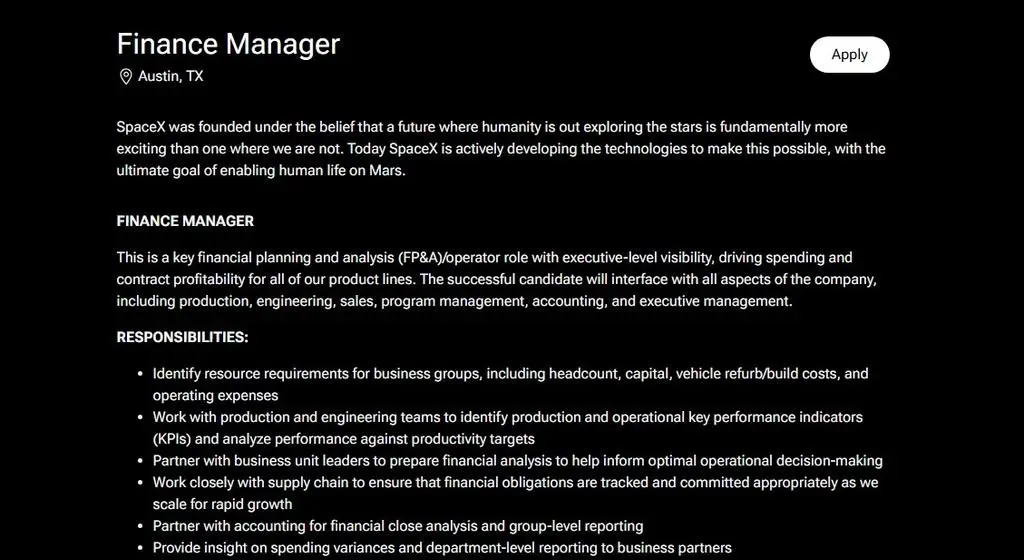
These examples address different professional backgrounds. The SpaceX references reflect the operational FP&A requirements of the position used for this article.
Company details and candidate achievements in the responses are illustrative. Replace them with verified research and your actual professional experience.
1. Best for an Experienced Finance Manager (FP&A and Corporate Finance)
“I want to work here because the position aligns closely with my experience in financial planning, forecasting and business performance analysis. I am particularly interested in how your finance team supports operational decisions and resource allocation across different business units. In my current role, I oversee departmental budgets, coordinate monthly forecasts and investigate spending variances. I have also developed financial models that help management evaluate investment decisions and identify cost-saving opportunities. I enjoy working closely with operational leaders because it allows finance to contribute beyond reporting historical results. I believe my experience would help strengthen financial visibility, improve resource planning and support the organisation’s business objectives.”
Why this works: It demonstrates that the candidate understands the strategic and operational responsibilities of a Finance Manager. It also establishes relevant experience in FP&A and business partnering.
2. Best for a Finance Manager in a Manufacturing or Technology Company
“I am interested in working here because I find the financial challenges of scaling complex operations particularly interesting. Your business requires careful resource planning, spending oversight and financial coordination across different operational functions. These are areas where I have developed practical experience. In my previous role, I supported production budgeting, monitored operating expenditure and analysed performance against operational targets. I also worked with procurement and operations teams to improve spending visibility and strengthen financial forecasts. I would welcome the opportunity to apply these skills in an environment where financial analysis directly supports production efficiency, investment decisions and long-term business growth.”
Why this works: It connects financial management with operational performance. This is particularly relevant to manufacturing, engineering, aerospace and technology businesses.
3. Best for a Finance Manager Transitioning from Accounting or Financial Analysis
“I want to work here because this position offers an opportunity to apply my financial reporting and analytical experience more broadly to business planning and decision-making. My background in accounting and financial analysis has given me a strong understanding of financial statements, reconciliations, budgeting and variance analysis. I have also worked with departmental managers to explain financial performance and investigate unexpected costs. I am particularly interested in taking on greater responsibility for forecasting, resource allocation and financial strategy. I believe my technical foundation, combined with my experience working across finance functions, would allow me to contribute effectively to your organisation.”
Why this works: It presents the career progression as a logical development. The candidate connects accounting or analytical experience to the wider responsibilities of financial management.
4. Best for a Finance Manager Targeting a High-Growth Business
“I want to work here because I am interested in helping growing businesses maintain financial discipline while pursuing ambitious expansion plans. Rapid growth creates important financial management challenges, particularly around resource allocation, operating expenditure, cash forecasting and investment decisions. In my previous position, I managed departmental budgets, prepared rolling forecasts and presented financial performance reports to senior management. I also worked with business leaders to evaluate spending priorities and identify emerging financial risks. I would like to bring this experience into an organisation where finance plays an active role in shaping operational decisions and supporting sustainable growth.”
Why this works: It demonstrates an understanding of the financial pressures associated with business expansion. It also positions the candidate as someone who can balance growth ambitions with financial discipline.
Weak vs. Strong Answers: What Makes the Difference?
| Weak and generic answer | Strong and relevant answer |
|---|---|
| “I want to work here because you are a successful company with excellent growth opportunities.” | “Your expansion in advanced manufacturing interests me because it creates opportunities to contribute to resource planning, capital allocation and production cost management.” |
| “I want to use my financial management skills and develop my career.” | “The position aligns with my experience in budgeting, forecasting and departmental performance analysis. I am particularly interested in supporting operational decision-making.” |
| “I enjoy working with numbers and managing budgets.” | “I have experience analysing spending variances, identifying cost drivers and presenting financial recommendations to operational managers.” |
| “I want to work with a reputable organisation.” | “I am interested in how your finance function connects operational KPIs with financial performance to guide investment and resource allocation decisions.” |
Why the weak answers fail: They focus on personal interests and generic company attributes. They provide little evidence of commercial understanding or professional suitability.
Why the strong answers work: They connect the organisation’s activities to relevant financial management responsibilities. They also demonstrate how the candidate can contribute to business performance.
2-Minute Fill-in-the-Blank Script Builder
Use this framework to develop your own personalised response.
The Company-Role-Value Formula
1. COMPANY
“I have been following [Company Name]’s developments in [industry/business activity], and I am particularly interested in [specific expansion, investment, operational priority or business initiative].”
2. ROLE
“What attracted me to this Finance Manager position is its focus on [budgeting, forecasting, financial modelling, resource planning or business partnering].”
3. VALUE
“In my previous role, I [specific financial management achievement] by using [financial models, forecasting methods, ERP systems or analytical tools].”
4. MOTIVATION
“I am excited about bringing my experience in [core competencies] to support your [specific business objective] and contribute to better financial and operational decisions.”
Example of a Completed Answer
“I have been following your expansion in advanced manufacturing, and I am particularly interested in how your finance team supports operational growth. What attracted me to this Finance Manager position is its focus on financial planning, expenditure analysis and resource allocation. In my previous role, I managed departmental budgets, prepared rolling forecasts and worked with operational managers to investigate spending variances. I also developed financial models to support investment decisions. I would welcome the opportunity to bring this experience to your organisation and help improve financial visibility, spending discipline and operational decision-making.”
The example is illustrative. Replace the achievements and company research with your own verifiable information.
How long should your answer be?
Aim for 60–90 seconds, or approximately 120–160 words. Avoid memorising the entire response. Remember the four components and communicate them naturally.
Likely Follow-Up Questions to Prepare For
Your response may prompt the interviewer to investigate your financial management experience and commercial judgement.
Prepare for these questions:
1. “How do you approach budgeting and forecasting?”
Explain how you gather historical financial information, identify operational drivers, consult departmental managers and develop realistic financial projections.
Discuss how you monitor actual performance and update forecasts when business conditions change.
2. “Tell me about a time you identified significant spending variances.”
Use a genuine example. Explain the original budget expectations, the actual results, your investigation and the corrective action you recommended.
Demonstrate that you understand the difference between identifying a variance and explaining its underlying cause.
3. “How do you evaluate capital expenditure proposals?”
Discuss expected returns, initial investment, operating costs, cash flow implications and financial risks.
Depending on the investment, explain how you use net present value (NPV), internal rate of return (IRR) and payback period.
4. “How do you communicate financial information to non-financial managers?”
Explain how you simplify financial reports, focus on relevant business drivers and translate financial findings into practical recommendations.
Give an example of influencing an operational decision through financial analysis.
5. “How would you improve our financial planning and reporting processes?”
Discuss opportunities to standardise reporting, automate repetitive tasks, improve data quality and integrate operational information into financial models.
Explain how you would preserve appropriate review and approval controls.
6. “How proficient are you with Excel, SQL and ERP systems?”
Discuss your practical experience rather than simply listing software.
For Excel, mention financial modelling, PivotTables, Power Query and scenario analysis where applicable. For SQL, discuss querying databases and analysing structured financial information if you have performed these tasks.
7. “How do you balance cost control with business growth?”
Explain how you evaluate spending against expected business benefits. Discuss prioritising investments, monitoring financial performance and identifying opportunities to improve efficiency without undermining essential operations.
Frequently Asked Questions (FAQs)
1. How long should my answer to “Why do you want to work here?” be in a Finance Manager interview?
Aim for 60–90 seconds. Explain why the company interests you, how the position aligns with your experience and what you can contribute. Leave room for follow-up questions.
2. Should I mention salary, bonuses or career advancement?
These are legitimate employment considerations, but they should not dominate your answer. Focus on the responsibilities, business challenges and opportunities to contribute to financial performance.
3. How do I answer if I have never worked in a manufacturing or technology company?
Emphasise transferable experience in budgeting, forecasting, financial modelling, cost analysis and business partnering. Explain how you would apply these competencies to the new industry’s operational requirements.
4. What if the company has limited publicly available financial information?
Research its products, services, customers, operating model and industry developments. Review leadership interviews, company announcements and available market research. Do not invent financial performance figures.
5. Should I mention financial software and analytical tools?
Yes, when relevant to the vacancy. Examples include SAP, Oracle, NetSuite, Microsoft Dynamics, advanced Excel and SQL. Explain how you have used these tools to improve financial analysis, reporting or forecasting.
6. How should I answer this question when interviewing at SpaceX?
Research its different business activities, including Starlink, Starship, Falcon and Dragon. Understand how production, engineering, supply chain and capital investment influence financial performance.
Connect your experience to resource planning, contract profitability, operational KPIs, spending analysis and cash forecasting.
The advertised position also requires six or more years of experience in finance, business or operations. Advanced Excel modelling is preferred, alongside ERP and SQL experience. Candidates should also understand the stated onsite and US export-control eligibility requirements.
7. What should I avoid when answering this interview question?
Avoid generic statements about company reputation, salary and career advancement. Do not repeat the company’s mission without explaining its relevance to your professional interests.
Never exaggerate your financial management experience or claim responsibility for results you cannot substantiate.
Further Preparation: Finance Manager Interview Resources
Finance Manager interviews often combine behavioural questions with practical assessments of financial modelling, budgeting, forecasting and commercial judgement.
Prepare for both.
Useful resources include:
- AscendurePro Interview Preparation Tools – Explore tools for practising interview questions and improving answer delivery.
- AscendurePro Career Launchpad – Prepare your resume, tailor applications and practise interviews.
- AFP: Financial Planning and Analysis – Understand the core responsibilities of FP&A professionals.
- AFP: Finance Business Partnering – Explore how finance professionals support operational and strategic decisions.
Related article in this Finance interview series: How to Answer “Why Do You Want to Work Here as an Accountant?“.
Ready to practise? Use AscendurePro Interview Practice to rehearse your response and likely follow-up questions. Focus on demonstrating financial judgement, commercial awareness and your ability to influence business decisions.
Editorial reference: The SpaceX Finance Manager vacancy informed the role-specific responsibilities and examples. The article reflects the advertised emphasis on FP&A, resource planning, production KPIs, spending and contract profitability, capital expenditure and cash forecasting. It does not claim to reproduce SpaceX’s actual interview questions.