
“Why do you want to work here?” is not simply a test of enthusiasm. It helps employers understand whether you have researched the organisation, understand the position, and can explain your professional motivation.
For a recruiter, the answer needs an additional layer. You must demonstrate that you understand how recruitment supports business performance.
In high-volume manufacturing, hiring delays can affect staffing levels and production plans. Recruiters must therefore balance speed with candidate quality, communication, and sound hiring decisions.
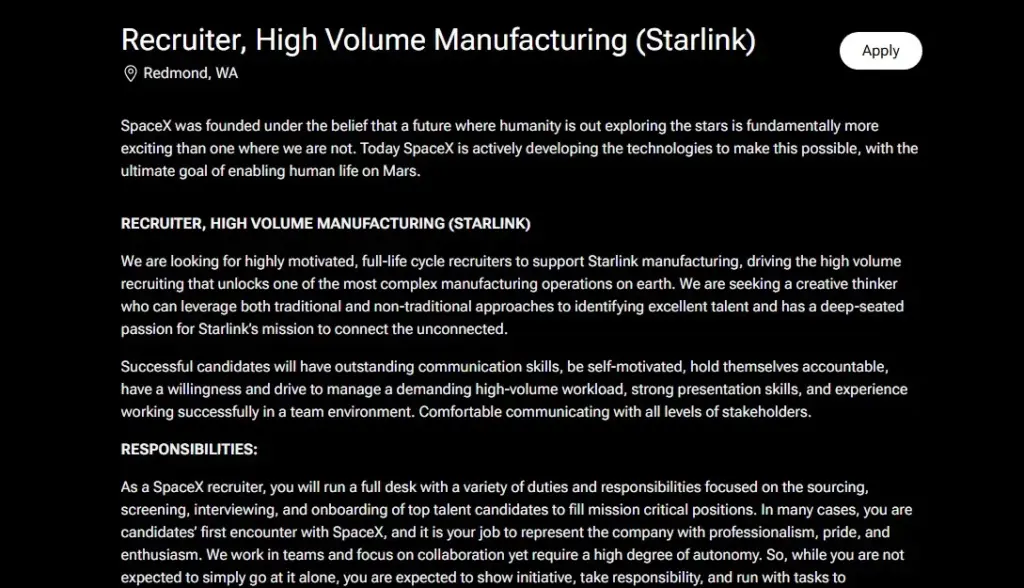
This guide uses the SpaceX Recruiter, High Volume Manufacturing (Starlink) vacancy as its role-specific reference. It is not a generic talent acquisition article.
The listing describes a full-cycle recruiting role supporting high-volume Starlink manufacturing in Bastrop, Texas. It combines sourcing, screening, interviewing, stakeholder partnership, candidate communication, and onboarding. It also expects recruiters to build passive-talent pipelines and manage multiple requisitions. Greenhouse
That distinction matters. A convincing answer should show that you understand recruiting as a business function. You must connect talent needs with operational priorities, not simply say you enjoy working with people.
SpaceX’s 2025 Starlink progress report describes expanded manufacturing capacity at its Bastrop facility. It reports more than 1,300 local jobs and production capacity exceeding 170,000 Starlink kits weekly across the United States. These figures provide useful public context for understanding the scale of the manufacturing operation. Starlink
Key Takeaways
- Explain why the company’s mission and operations genuinely interest you.
- Connect your experience to full-cycle and high-volume recruitment.
- Demonstrate that you understand sourcing, screening, stakeholder management, and candidate experience.
- Show how you balance hiring speed with candidate quality.
- Use measurable recruitment achievements where you have reliable figures.
- Research the role’s practical conditions, including location, working arrangements, and eligibility requirements.
Contents
What Interviewers Really Want to Know
A recruiter applying for another recruitment position must demonstrate more than an ability to communicate. Employers need someone who can manage hiring priorities, assess talent, influence stakeholders, and deliver results.
The SpaceX vacancy highlights several competencies.
1. Can You Manage Full-Cycle Recruitment?
The advertised role covers sourcing, screening, interviewing, and onboarding. It also involves reviewing applications and conducting passive candidate searches. Greenhouse
This means the recruiter must manage the hiring process from initial candidate identification through to the final stages.
Your answer should show that you understand the complete recruitment lifecycle. If you have experience closing candidates and coordinating onboarding, mention it.
2. Can You Recruit at High Volume Without Sacrificing Quality?
High-volume recruitment involves managing several vacancies and candidate pipelines simultaneously.
However, filling positions quickly is not the only objective. Recruiters must still assess qualifications, suitability, and relevant experience.
The SpaceX listing specifically prefers candidates with at least two years of high-volume recruiting experience. Manufacturing experience is desirable. Greenhouse
Prepare an example showing how you managed competing requisitions while maintaining appropriate screening standards.
3. Can You Source Candidates Beyond Traditional Job Boards?
The vacancy places considerable emphasis on passive candidate sourcing and non-standard recruitment methods.
These include cold calling, networking events, targeted sourcing campaigns, and identifying industry experts. Greenhouse
This is important when recruiting skilled tradespeople. Qualified technicians, electricians, and facilities professionals may not be actively applying for advertised vacancies.
A strong candidate should explain how they identify, approach, and engage suitable professionals.
4. Can You Partner With Hiring Managers?
Recruiters must understand the positions they are filling. They should also help hiring managers make informed decisions.
The SpaceX listing expects recruiters to work directly with technical leaders, including directors and vice presidents. It also emphasizes the ability to present candidates accurately without overselling them. Greenhouse
Your answer should demonstrate that you can challenge unclear requirements professionally. You should also communicate candidate strengths and limitations honestly.
5. Can You Use Recruitment Data to Improve Decisions?
Recruitment data helps teams understand pipeline performance and identify bottlenecks.
Relevant measures may include:
- Time to fill and time to hire.
- Qualified candidates per requisition.
- Sourcing channel effectiveness.
- Interview-to-offer conversion.
- Offer acceptance rate.
- Candidate withdrawal rates.
- Hiring manager satisfaction.
- Quality of hire, where measurable.
The SpaceX listing specifically mentions reviewing, evaluating, and reporting recruiting data. Greenhouse
SHRM’s 2025 recruiting benchmarking analysis also highlights the importance of balancing recruitment speed, cost, and talent availability.
How to Research the Company Before Your Interview
Avoid relying only on SpaceX’s reputation or its mission statement. Research the business and connect that information to the actual recruitment responsibilities.
1. Understand SpaceX and Starlink
SpaceX develops launch vehicles, spacecraft, and satellite technology. Starlink provides satellite internet services.
The Starlink manufacturing operation in Bastrop supports the production of consumer hardware. Its growth creates a substantial need for manufacturing talent.
Read the Starlink 2025 progress report. Pay attention to its discussion of manufacturing expansion, production capacity, and employment.
You can then explain why supporting recruitment in a growing manufacturing environment interests you.
2. Study the Job Description Carefully
Identify the responsibilities that define this particular position:
- Reviewing internal and external applications.
- Conducting passive candidate searches.
- Screening and interviewing candidates.
- Building and maintaining talent pipelines.
- Managing multiple clients and requisitions.
- Advising hiring managers on talent decisions.
- Engaging candidates through creative outreach.
- Maintaining clear candidate and stakeholder communication.
These responsibilities should shape your answer. Greenhouse
3. Understand Manufacturing Recruitment
Manufacturing recruitment differs from recruiting exclusively for office-based roles.
Depending on the vacancy, recruiters may need to understand shift patterns, technical certifications, equipment experience, safety requirements, and practical job conditions.
For example, recruiting an electrician requires a different assessment approach from recruiting an administrative assistant.
Research the common skills and qualifications associated with the manufacturing positions you may support.
4. Prepare Evidence From Your Recruitment Experience
Identify examples that demonstrate your ability to:
- Fill multiple vacancies under tight deadlines.
- Source candidates who were not actively job hunting.
- Recruit technicians or other skilled tradespeople.
- Build relationships with hiring managers.
- Improve candidate engagement or offer acceptance.
- Use recruitment data to identify bottlenecks.
- Manage difficult stakeholder expectations.
- Maintain candidate communication during busy hiring periods.
Use genuine results. If you reduced time to fill, state the actual improvement and explain how you measured it.
The Company–Role–Value Formula
A useful way to structure your response is the Company–Role–Value formula.
Step 1: Company
Explain why the organisation interests you.
Identify a specific business activity, mission, product, or development that genuinely attracts you.
Step 2: Role
Connect your interest to the recruitment responsibilities.
Mention full-cycle recruitment, high-volume hiring, manufacturing talent, sourcing, or stakeholder partnership.
Step 3: Value
Show what you can contribute.
Connect your experience with measurable hiring outcomes, stronger pipelines, candidate engagement, and recruitment efficiency.
Your answer should sound like one connected explanation. Avoid presenting the three elements as a memorized checklist.
Four Sample Answers for Different Recruiter Candidates
These examples are illustrative. Adapt them to your actual experience and the employer’s requirements.
1. Experienced High-Volume Recruiter
“I want to work here because the scale and pace of Starlink manufacturing create an interesting recruitment environment. Supporting a business that is expanding its manufacturing capabilities requires recruiters who understand both talent sourcing and operational priorities.
My experience in high-volume recruitment has involved managing multiple requisitions, screening candidates, coordinating interviews, and maintaining hiring manager relationships. I have also worked with recruitment data to monitor pipeline progress and address delays.
I am particularly interested in applying these skills within a manufacturing environment. I believe I can contribute through disciplined recruitment execution, proactive sourcing, and consistent candidate communication.”
Why this works: It connects the company’s manufacturing operations with relevant recruitment experience. It also emphasizes delivery without making unsupported claims about SpaceX’s internal hiring results.
2. In-House Recruiter Moving to a Larger Manufacturing Environment
“I am interested in this opportunity because it combines in-house recruitment with the demands of a large manufacturing operation. I enjoy working closely with business teams and understanding the people requirements behind their operational goals.
In my current recruitment experience, I have partnered with hiring managers to clarify role requirements, identify suitable candidates, and manage recruitment processes. I have also learned the importance of maintaining strong relationships with candidates throughout the hiring journey.
The opportunity to support Starlink manufacturing appeals to me because it requires both structured recruitment and creative sourcing. I would welcome the chance to contribute my stakeholder management skills while developing further experience in high-volume manufacturing recruitment.”
Why this works: It demonstrates an understanding of internal recruitment. It also explains why manufacturing recruitment is a meaningful next step.
3. Agency Recruiter Transitioning Into Corporate Recruitment
“I want to work here because I am interested in moving closer to the business and contributing to its long-term talent strategy. Agency recruitment has given me experience identifying candidates, building talent networks, managing client expectations, and working towards demanding placement targets.
I am particularly interested in applying those skills within an in-house environment. The role’s focus on passive sourcing, candidate engagement, and close collaboration with hiring managers matches the areas of recruitment I find most rewarding.
I would bring commercial awareness, strong candidate relationships, and a proactive approach to sourcing. I also understand that internal recruitment requires balancing immediate hiring needs with consistent candidate experience.”
Why this works: It presents agency experience as transferable. It also recognizes that in-house recruiters must understand the employer’s broader workforce needs.
4. Recruiter With Technical or Skilled-Trades Sourcing Experience
“What attracts me to this position is the opportunity to support recruitment for a technically demanding manufacturing environment. I understand that finding suitable technicians and skilled tradespeople requires more than advertising vacancies and reviewing applications.
My experience sourcing technical candidates has taught me to understand role requirements, identify relevant professional backgrounds, and approach passive candidates effectively. I have also worked with hiring managers to clarify technical expectations and present candidates accurately.
I would like to apply that experience to Starlink manufacturing. The combination of targeted sourcing, high-volume recruitment, and stakeholder partnership makes this a particularly interesting opportunity for me.”
Why this works: It focuses on the specialised sourcing requirements. It also shows that the candidate understands the difference between recruiting technical talent and simply processing applications.
Weak vs. Strong Answers
| Weak answer | Stronger answer |
|---|---|
| “SpaceX is a famous company, and I want to be part of it.” | “Starlink’s manufacturing expansion makes this an interesting opportunity to support recruitment at operational scale.” |
| “I enjoy meeting and working with people.” | “I enjoy building candidate relationships and helping hiring managers identify talent that meets specific business needs.” |
| “I am good at filling vacancies quickly.” | “I manage competing requisitions while monitoring candidate quality, pipeline progress, and hiring deadlines.” |
| “I can recruit any type of employee.” | “I understand that skilled-trades recruitment requires targeted sourcing and careful assessment of practical experience.” |
| “I am a hardworking recruiter.” | “I use proactive sourcing, consistent follow-up, and recruitment data to keep hiring processes moving.” |
The stronger answers provide evidence of how a recruiter works. They replace general claims with relevant professional capabilities.
Build Your Own Answer With This Script
Use this template to prepare a response that reflects your background.
Company
“I am interested in working here because [specific company activity, mission, product, or business development].”
Role
“The Recruiter position particularly interests me because it involves [high-volume recruitment, manufacturing talent, passive sourcing, or stakeholder partnership].”
Value
“My experience in [recruitment skills or relevant sector] has prepared me to contribute through [specific achievement or capability]. I would welcome the opportunity to apply these strengths while supporting the organisation’s hiring priorities.”
Example of a completed answer:
“I am interested in working here because Starlink’s manufacturing operations support an ambitious global connectivity business. The Recruiter position appeals to me because it combines high-volume hiring, proactive sourcing, and close collaboration with technical leaders.
My experience managing multiple vacancies and building candidate pipelines has prepared me to support demanding recruitment requirements. I would welcome the opportunity to contribute through effective sourcing, clear communication, and consistent recruitment delivery.”
Use this example only if it accurately reflects your experience.
Follow-Up Questions You Should Prepare For
A strong motivation answer may lead to questions about your recruitment methods and results.
| Possible follow-up question | What your response should demonstrate |
|---|---|
| How do you manage multiple requisitions? | Prioritization, organization, and communication. |
| How do you source passive candidates? | Research, targeted outreach, and relationship building. |
| How do you recruit skilled tradespeople? | Understanding of technical requirements and relevant talent pools. |
| How do you assess candidate quality? | Job-related screening and evidence-based evaluation. |
| How do you handle a demanding hiring manager? | Consultation, influence, and professional judgment. |
| Which recruitment metrics do you track? | Understanding of pipeline performance and hiring outcomes. |
| How do you improve candidate experience? | Clear communication, timely feedback, and realistic expectations. |
| How do you handle unsuccessful candidates? | Professionalism, fairness, and respectful communication. |
You should also prepare examples using the STAR method: Situation, Task, Action, and Result.
For recruitment roles, structured assessment matters. The US Office of Personnel Management explains that structured interviews use consistent questions and evaluation standards to assess job-related competencies. Its structured interview guidance is useful preparation for discussing fair and consistent candidate assessment. U.S. Office of Personnel Management+1
Important Details About the SpaceX Vacancy
The advertised position includes practical conditions that candidates should understand before applying.
- Location: Bastrop, Texas, in the Austin area.
- Work arrangement: Full-time onsite. Hybrid and remote arrangements are not offered in the listing.
- Working hours: Extended hours and weekends may be required.
- Basic qualifications: A bachelor’s degree and at least one year of recruiting experience; or an associate degree and at least two years of experience; or at least three years of professional recruiter experience in lieu of a degree.
- Preferred experience: Two or more years of high-volume recruitment, ideally in manufacturing.
- Additional advantages: In-house recruiting, skilled-trades recruitment, full-cycle recruitment, recruiting data analysis, and non-standard sourcing methods.
- ITAR eligibility: The listing specifies US citizenship or national status, lawful permanent residency, qualifying refugee or asylee status, or eligibility to obtain the required US government authorization. Greenhouse
These are details from the advertised position, not universal requirements for every Recruiter role. Candidates should review the current listing before applying.
Frequently Asked Questions
1. How do you answer “Why do you want to work here?” as a Recruiter?
Explain what interests you about the organisation, connect that interest to its recruitment needs, and show how your experience can contribute. Use specific examples rather than generic compliments.
2. What should a Recruiter say when applying to SpaceX?
Discuss your interest in supporting Starlink manufacturing and connect it to high-volume recruitment, passive sourcing, full-cycle hiring, and stakeholder partnership. Mention only the skills and experience you genuinely possess.
3. What skills are important for a high-volume Recruiter?
Important skills include candidate sourcing, pipeline management, screening, stakeholder communication, prioritization, recruitment analytics, and candidate relationship management. Manufacturing recruitment may also require familiarity with skilled trades and technical roles.

A personal page that shows your work
A personal page that shows your work. Share one link with employers. 12 polished templates to choose from. You just need a Standard plan to get started.
4. How can a Recruiter demonstrate measurable value?
Use credible recruitment outcomes. Examples include vacancies filled, time-to-fill improvements, offer acceptance rates, qualified candidates sourced, or reduced process delays. Explain your contribution and the measurement period.
5. Is manufacturing recruitment different from general recruitment?
Yes. Manufacturing recruitment may involve shift-based roles, technical qualifications, skilled trades, safety requirements, and production-related staffing priorities. Recruiters need to understand these requirements before sourcing candidates.
6. Does the advertised SpaceX Recruiter position require a degree?
The listing provides alternative qualification routes. These include a bachelor’s degree with one year of recruiting experience, an associate degree with two years, or three years of professional recruiter experience in lieu of a degree. Greenhouse
7. How long should your answer be?
Aim for approximately 45–90 seconds. Explain your motivation, connect it to the position, and provide one or two relevant strengths. Save detailed career examples for follow-up questions.
Conclusion
A strong answer to “Why do you want to work here?” should show that you understand recruitment beyond filling vacancies.
For this SpaceX Recruiter position, the strongest themes are high-volume hiring, manufacturing talent, proactive sourcing, stakeholder partnership, and candidate communication.
Your response should connect those priorities with your own experience. Explain why the organisation interests you, why the role fits your professional direction, and what you can contribute.
Avoid memorized speeches and unsupported claims. Prepare genuine examples that demonstrate how you source, assess, engage, and hire talent.
For further preparation, explore AscendurePro’s interview preparation tools and career coaching services. You may also find our guide on how to write a cold email to a recruiter useful for understanding candidate outreach from the recruiter’s perspective.
Editorial note: The SpaceX vacancy informed the responsibilities, qualifications, and working conditions discussed here. The sample answers are illustrative. They are not actual SpaceX interview responses, and the article does not claim to know the company’s interview questions.
Related interview-question guides
- How to Answer “Why Do You Want to Work Here as an Accountant?”
- How to Answer Why Company Question: 15 Sample Responses
- How to Answer “Why Do You Want to Work Here as a Finance Manager?”
- How to Answer “Why Do You Want to Work Here as a Tax Analyst?”