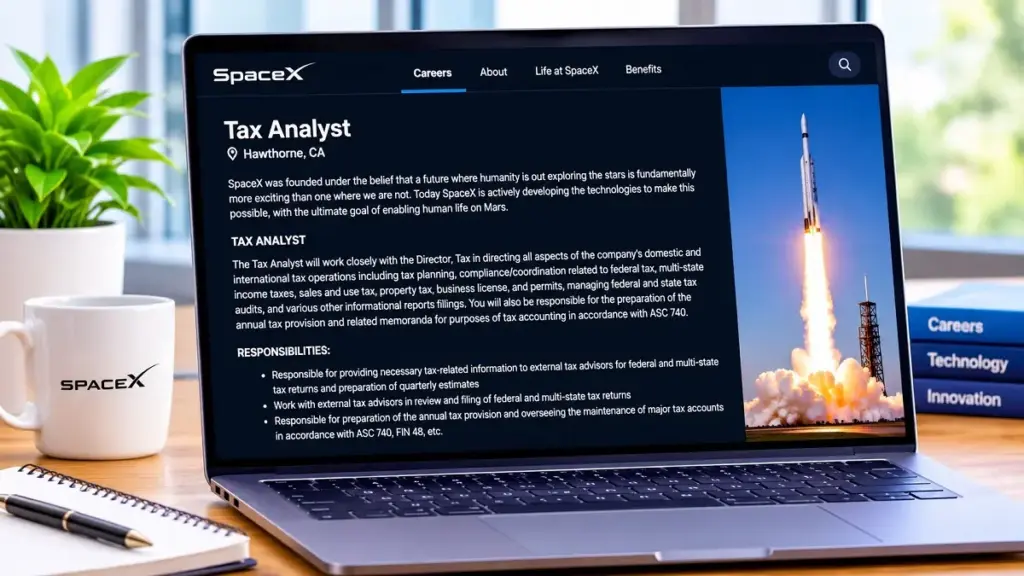
This article will focus on the Tax Analyst role, using SpaceX’s advertised position to ground the technical requirements. The title follows your outcome-driven and mistake-prevention recommendations while retaining the exact search phrase.
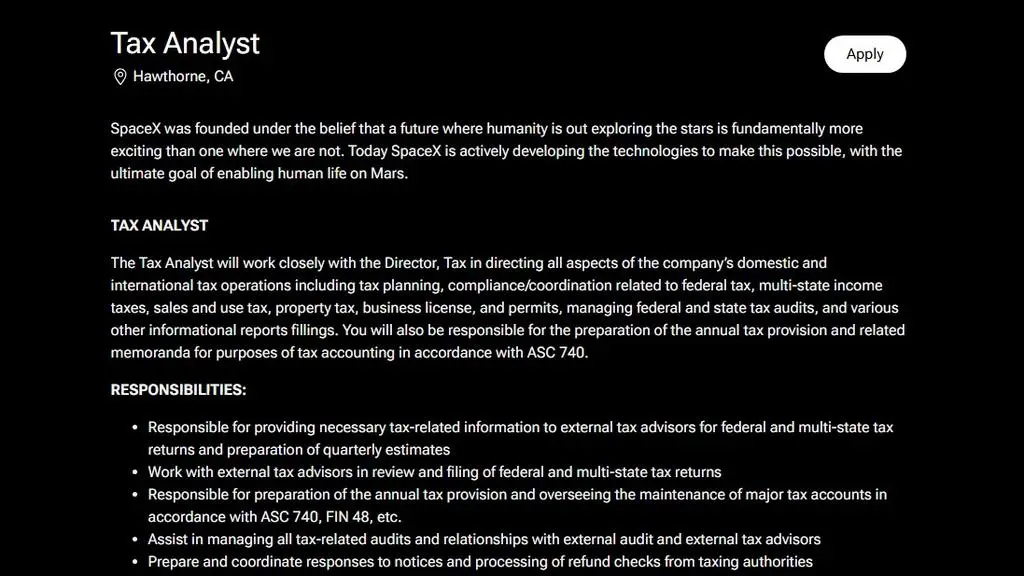
The vacancy places particular weight on corporate income tax, federal and multi-state compliance, ASC 740 tax provisions, tax audits, external tax advisers, and explaining tax implications to other business teams. It also mentions process improvements involving fixed-asset depreciation systems. Greenhouse
The examples below distinguish three different preparation routes: public-accounting experience, corporate tax experience, and transferable accounting experience.
The SpaceX vacancy asks for at least two years of combined public-accounting tax experience and ASC 740 tax accounting. It lists a bachelor’s degree in accounting, tax, or business as a basic qualification. A CPA and Big Four experience are preferred, not mandatory. Greenhouse
One important distinction: the vacancy is not an entry-level role simply because its title says “Analyst.” Candidates without the stated experience should treat the entry-level example as a broader preparation model, not evidence that they meet this specific posting’s requirements.
Contents
Introduction
“Why do you want to work here as a tax analyst?” sounds straightforward. Yet many candidates answer it poorly.
They talk about wanting career growth, working for a respected company, or joining an exciting industry. Those motivations may be genuine, but they rarely demonstrate professional value.
A stronger answer connects three things:
- What interests you about the company.
- Why the Tax Analyst role matches your technical experience.
- What value you can contribute to its tax function.
For a company with complex operations, tax work extends beyond preparing returns. It involves compliance, financial reporting, tax risk, business decisions, and coordination across departments.
Your answer should show that you understand this broader responsibility.
Key Takeaways
- Use a simple Company–Role–Value formula to structure your response.
- Research the employer’s business model and tax-related challenges.
- Connect your experience to corporate tax, ASC 740, compliance, and tax reporting.
- Demonstrate how you communicate tax implications to non-tax colleagues.
- Avoid generic statements about prestige, innovation, or career growth.
- Prepare examples that show accuracy, judgment, collaboration, and process improvement.
What Interviewers Really Want to Know
The interviewer is assessing more than your interest in the company. They want to understand whether you appreciate the demands of its tax function.
For the advertised SpaceX Tax Analyst position, several areas deserve particular attention.
1. Your Understanding of Corporate Tax Responsibilities
Corporate tax analysts support tax compliance and reporting across different jurisdictions.
Their work may involve federal income tax, state and local taxes, sales and use tax, property tax, and business registrations. They may also coordinate tax returns and estimated payments with external advisers.
The SpaceX vacancy specifically identifies these responsibilities. It also includes audit coordination, tax notices, and informational filings. Greenhouse
Your answer should demonstrate awareness of these responsibilities. Avoid describing the position as simply preparing tax returns.
2. Your Knowledge of ASC 740
ASC 740 governs the financial accounting and reporting of income taxes under US GAAP.
It addresses current income taxes and the future tax consequences of transactions. These include deferred tax assets, deferred tax liabilities, and valuation allowances.
The standard also addresses uncertain tax positions. Understanding these concepts matters when preparing and reviewing a company’s income tax provision.
Deloitte’s ASC 740 income taxes overview explains the distinction between current and deferred tax expense.
The advertised role explicitly requires experience with ASC 740 and related tax accounting. Deloitte+1
3. Your Ability to Manage Tax Compliance and Risk
Tax compliance requires more than knowing applicable tax rules.
A Tax Analyst must work with accurate financial information, monitor filing obligations, maintain supporting documentation, and respond to tax authority inquiries.
For federal corporate income tax, the IRS provides filing requirements and guidance through its Form 1120 instructions.
Candidates should understand how compliance, payment deadlines, documentation, and audit readiness connect. Internal Revenue Service+1
4. Your Ability to Work Across Departments
Tax decisions can affect procurement, finance, accounting, operations, and business planning.
A Tax Analyst must explain these effects clearly. Technical knowledge matters, but so does the ability to communicate recommendations.
The SpaceX listing specifically mentions explaining tax implications of business strategies to other business groups. Greenhouse
5. Your Approach to Improving Tax Processes
Tax functions handle substantial volumes of financial information and recurring deadlines.
Manual processes can create delays, inconsistencies, and avoidable errors. Employers therefore value people who can identify process weaknesses and support better systems.
The vacancy mentions improving tax processes, including a fixed-asset depreciation system. Greenhouse
A strong answer should show that you can contribute beyond routine compliance work.
How to Research the Company Before Your Interview
Avoid researching only the company’s mission and public reputation. Focus on information that helps you explain why the role makes sense.
Use this checklist before preparing your final answer.
1. Understand the Business Model
For SpaceX, research its launch services, spacecraft, satellite internet business, and broader commercial operations.
Understand how its different business activities may create varied financial and tax considerations.
Do not assume you know the company’s confidential tax arrangements. Focus on publicly available business information and the implications of operating across different activities.
2. Study the Job Description
Identify the responsibilities that appear repeatedly or carry significant technical weight.
For this vacancy, prioritize:
- Federal and multi-state corporate income tax.
- Quarterly estimated tax calculations and payments.
- Annual tax provision preparation.
- ASC 740 and uncertain tax positions.
- Sales and use tax and property tax.
- Tax audits and external adviser coordination.
- Tax authority notices and refund processing.
- Fixed-asset depreciation processes.
- Tax planning and communication with other departments.
These responsibilities provide a much stronger foundation than generic company research. Greenhouse
3. Review Relevant Tax and Accounting Guidance
Refresh your understanding of the technical areas likely to arise in the role.
Useful resources include:
- IRS corporate income tax guidance for Form 1120 filing requirements.
- IRS business tax guidance for major business tax categories.
- Deloitte’s ASC 740 overview for current and deferred tax accounting.
- PwC’s deferred tax accounting guide for deferred tax assets and valuation allowances.
You do not need to recite technical guidance during your answer. Use your research to demonstrate informed interest.
4. Identify Your Strongest Evidence
Prepare two or three examples from your experience.
Consider situations where you:
- Prepared or reviewed corporate tax returns.
- Supported quarterly tax provisions.
- Identified a tax exposure or reporting error.
- Responded to an audit request.
- Worked with external tax advisers.
- Improved a tax reconciliation or reporting process.
- Explained a tax issue to a non-tax colleague.
Where possible, quantify the results accurately. Never invent savings, percentages, or achievements.
The 3-Step Formula for Answering the Question
A practical structure is the Company–Role–Value formula.
Step 1
Company: Explain what attracts you to the business
Mention a specific business activity, strategic direction, or operational challenge that genuinely interests you.
Step 2
Role: Connect the opportunity to your technical strengths
Identify relevant responsibilities, such as tax compliance, ASC 740, tax provisions, or multi-state taxation.
Step 3
Value: Explain what you can contribute
Show how your experience can support accurate reporting, effective compliance, tax risk management, or process improvement.
The three steps should form one coherent answer. Avoid delivering them as separate statements that sound rehearsed.
Four Sample Answers for Different Tax Analyst Candidates
These examples are starting points, not scripts to memorize. Adapt them to your actual experience and the employer’s requirements.
1. Experienced Corporate Tax Analyst
“I want to work here because the complexity of the business creates an interesting tax environment. SpaceX operates across several business activities, making accurate tax reporting and compliance particularly important.
The position also matches my experience in corporate income tax, tax provisions, and multi-state compliance. I have worked with tax advisers, supported reporting deadlines, and reviewed tax balances for accuracy.
I would welcome the opportunity to apply that experience to a demanding tax function. I am particularly interested in contributing to reliable tax reporting, stronger processes, and effective coordination across departments.”
Why this works: It connects the company’s operations with relevant technical experience. It also identifies practical contributions without making unsupported claims about SpaceX’s internal tax arrangements.
2. Public Accounting Professional Moving into Industry
“My interest in this opportunity comes from the chance to apply my public accounting experience within a company’s internal tax function.
Working with different clients has helped me develop experience in tax compliance, technical research, documentation, and managing reporting deadlines. I have also learned the importance of communicating tax issues clearly to clients and colleagues.
I am particularly interested in the position’s combination of tax accounting, compliance, and business support. I would like to bring my technical foundation into an environment where I can understand the business more deeply and contribute to its ongoing tax processes.”
Why this works: It presents public accounting experience as a foundation for corporate tax work. It also explains why the candidate wants to move into industry.
3. Candidate with Strong ASC 740 and Tax Provision Experience
“What attracts me to this role is its emphasis on both tax compliance and financial reporting. I enjoy work that requires technical accuracy, careful judgment, and an understanding of how tax affects financial statements.
My experience with ASC 740, current and deferred tax calculations, and tax account reconciliations aligns closely with the responsibilities described. I have also worked with supporting schedules and documentation needed for tax reviews.
I see an opportunity to contribute through reliable tax provision preparation, sound technical analysis, and effective collaboration with external advisers. I would also be interested in supporting improvements to tax reporting processes.”
Why this works: It places ASC 740 at the centre of the answer. This is particularly relevant to a position that specifically requests income tax provision experience.
4. Accounting Professional Transitioning into Corporate Tax
“My interest in this role comes from the opportunity to build on my accounting background and specialize further in corporate taxation.
My experience in financial reporting, reconciliations, and working with financial records has given me a strong appreciation for accuracy and internal controls. I understand that corporate tax work requires connecting accounting information with applicable tax rules.
I am particularly interested in developing further expertise in tax provisions, compliance, and multi-state tax matters. I believe my accounting foundation would help me contribute to accurate reporting while continuing to strengthen my technical tax capabilities.”
Why this works: It connects transferable accounting skills with tax responsibilities. However, candidates should not use this answer to imply they meet the SpaceX vacancy’s two-year tax experience requirement if they do not.
Weak vs. Strong Answers: What Makes the Difference?
| Weak answer | Stronger answer |
|---|---|
| “SpaceX is a famous company, and I want to work there.” | “The company’s diverse operations make its tax compliance and reporting responsibilities particularly interesting to me.” |
| “I want to grow my career in taxation.” | “I want to deepen my corporate tax experience, particularly in tax provisions and multi-state compliance.” |
| “I am good with numbers and tax returns.” | “My experience in tax reconciliations and provision support has strengthened my attention to detail and technical judgment.” |
| “I want to work with talented people.” | “The role’s collaboration with finance teams and external tax advisers matches the way I approach tax work.” |
| “I believe I can do the job.” | “My experience in corporate tax reporting and compliance would help me support accurate filings and timely reporting.” |
The difference is specificity. Strong answers connect genuine motivation with evidence of professional capability.
Build Your Own Answer: A Customizable Script
Use the following template to create an answer that reflects your background.
Company
“I am interested in working here because [specific business activity, company direction, or operational challenge].”
Role
“The Tax Analyst position particularly interests me because it involves [relevant responsibilities, such as ASC 740, tax compliance, or multi-state taxation].”
Value
“My experience in [relevant technical skills] has prepared me to contribute through [specific contribution or achievement]. I would welcome the opportunity to apply those strengths while developing further within the company’s tax function.”
Example of a completed answer:
“I am interested in working here because SpaceX operates in technically demanding markets with complex business activities. The Tax Analyst position appeals to me because it combines corporate tax compliance, ASC 740 reporting, and collaboration with other business teams.
My experience in tax provisions, account reconciliations, and compliance has prepared me to support accurate reporting and effective tax processes. I would welcome the opportunity to contribute those skills while developing a deeper understanding of the company’s operations.”
Only use the technical experience in this example if it accurately reflects your background.
Follow-Up Questions You Should Prepare For
Your answer may lead to more detailed questions. Prepare for these possibilities:
| Possible follow-up | What your response should demonstrate |
|---|---|
| Why are you interested in corporate taxation? | Genuine motivation and understanding of the work. |
| What is your experience with ASC 740? | Knowledge of current and deferred taxes, tax provisions, and relevant judgments. |
| How do you approach a tax audit? | Organization, documentation, technical accuracy, and communication. |
| How do you manage multiple filing deadlines? | Prioritization, planning, and attention to detail. |
| How would you handle a tax authority notice? | Careful review, supporting evidence, and appropriate escalation. |
| How do you identify tax process improvements? | Ability to assess workflows, controls, and recurring errors. |
| How do you explain tax implications to non-tax teams? | Clear communication and practical business understanding. |
For technical preparation, revisit the tax provision process, deferred tax calculations, uncertain tax positions, and the relationship between book income and taxable income.
Common Mistakes to Avoid
1. Focusing Only on the Company’s Reputation
A company’s reputation is not a sufficient reason to hire you. Explain why its business and the role genuinely interest you.
2. Giving a Generic Career-Growth Answer
Career development is a valid motivation. However, explain what you want to develop and how the role supports that direction.
3. Overstating Your Technical Experience
Do not claim ASC 740 expertise if you have only encountered it briefly. Explain your actual exposure and the areas you are developing.

A personal page that shows your work
A personal page that shows your work. Share one link with employers. 12 polished templates to choose from. You just need a Standard plan to get started.
4. Treating Tax Compliance as the Entire Job
The advertised position includes reporting, audits, tax planning, business communication, and process improvement. Show that you understand the wider responsibilities.
5. Memorizing an Answer Word for Word
A rehearsed response can sound unnatural. Understand the structure and prepare evidence you can explain confidently.
Frequently Asked Questions
1. How do you answer “Why do you want to work here?” as a Tax Analyst?
Connect your interest in the company with the position’s tax responsibilities. Then explain how your experience can contribute to compliance, tax reporting, and process improvement.
2. What should a Tax Analyst say when applying to SpaceX?
Focus on the company’s business activities and the vacancy’s emphasis on corporate taxation, ASC 740, multi-state compliance, tax audits, and process improvements. Support your motivation with relevant experience.
3. Is ASC 740 important for a Tax Analyst interview?
It can be especially important for corporate tax roles involving income tax provisions and financial reporting. Understand current and deferred taxes, temporary differences, valuation allowances, and uncertain tax positions.
4. How much tax experience does the advertised SpaceX role require?
The listing states at least two years of combined tax experience in public accounting, including tax accounting under ASC 740. It also requires a bachelor’s degree in accounting, tax, or business. Greenhouse
5. Is a CPA required for the SpaceX Tax Analyst position?
The listing identifies a CPA as a preferred qualification, not a basic requirement. Big Four experience is also preferred. Candidates should distinguish preferred qualifications from mandatory ones. Greenhouse
6. How long should your answer be?
Aim for approximately 45–90 seconds. Give enough detail to demonstrate genuine interest and relevant experience without turning your answer into a career history.
7. Can I use the same answer for every Tax Analyst interview?
Use the same basic structure, but change the company research, role priorities, and examples. A response tailored to the employer will usually be more convincing than a memorized generic answer.
Conclusion
A convincing answer to “Why do you want to work here?” should connect your motivation with your professional value.
For a Tax Analyst position, that means demonstrating an understanding of corporate tax responsibilities. It also means connecting your experience with compliance, ASC 740, tax reporting, audit support, and business collaboration.
The strongest candidates do not rely on impressive company names or generic career ambitions. They explain why the opportunity makes sense and what they can contribute.
Before your interview, rehearse your answer aloud and prepare evidence for every technical strength you mention.
For more structured practice, explore AscendurePro’s interview preparation tools and career coaching services.
Editorial note: The SpaceX vacancy informed the role-specific responsibilities and qualifications discussed in this article. The sample answers are illustrative, not actual SpaceX interview responses. The vacancy’s requirements and conditions may change.
Related articles in this Finance and Accounting interview series