Finding a job is no longer just about submitting applications and waiting for employers to respond. Professional relationships, industry visibility, and online reputation increasingly influence career opportunities.
Professional networking sites make it easier to connect with recruiters, hiring managers, industry leaders, and potential colleagues. They also help job seekers discover vacancies, learn about companies, demonstrate their expertise, and access opportunities that may never reach traditional job boards.
However, not every professional networking platform serves the same purpose. LinkedIn offers broad professional exposure, while Wellfound focuses on startup careers. GitHub helps developers demonstrate technical skills, and Behance connects creative professionals with potential clients and employers.
Choosing the right platforms can make your job search more focused and productive.
This guide examines 15 of the best professional networking sites for jobs. It compares their features, strengths, limitations, and suitability for different professionals. It also explains how to use professional networks to build meaningful connections and improve your employment prospects.
Key Takeaways
- LinkedIn is the best general-purpose professional networking platform for most job seekers.
- Wellfound is particularly useful for professionals targeting startups and technology companies.
- XING is worth considering when pursuing opportunities in Germany, Austria, and Switzerland.
- GitHub, Behance, and Dribbble help professionals demonstrate practical skills through portfolios and projects.
- Handshake is particularly valuable for university students, graduates, and early-career professionals.
- Meetup helps job seekers establish relationships through professional events and industry communities.
- ResearchGate supports academic networking and research-related career opportunities.
- Using two or three complementary platforms is usually more productive than maintaining profiles everywhere.
Contents
What Are Professional Networking Sites?
Professional networking sites are online platforms that help people establish and maintain relationships related to their careers, industries, and professional interests.
Unlike conventional social networking platforms, professional networks emphasize employment, business relationships, knowledge sharing, and career development.
Depending on the platform, members can:
- Create professional profiles highlighting their qualifications and experience.
- Connect with recruiters, employers, colleagues, and industry specialists.
- Discover job vacancies and recruitment opportunities.
- Participate in industry discussions and professional communities.
- Share projects, portfolios, publications, and professional achievements.
- Receive career advice and recommendations from experienced professionals.
- Build relationships that may lead to employee referrals.
- Discover internships, freelance assignments, and consulting opportunities.
Professional networking has become an important part of modern job searching. An iHire 2026 recruiting report found that 50.2% of surveyed job seekers used professional networking sites.
Additionally, 30.5% reported using referrals, networking, or word of mouth when searching for opportunities. These findings illustrate why online networking deserves attention alongside traditional job applications.
Importantly, professional networking sites are not all job boards. Some primarily facilitate relationships, while others combine networking with recruitment, portfolio hosting, and professional discussions.
Top 15 Professional Networking Sites for Jobs in 2026
The following platforms were selected based on their professional networking capabilities, employment opportunities, industry relevance, accessibility, and usefulness to different career stages.
Some offer dedicated job-search features. Others help professionals become discoverable through their work, expertise, and industry relationships.
1. LinkedIn – Best Overall Professional Networking Site
Best overall
Website: linkedin.com
Best for: Professionals across industries, job seekers, recruiters, and employers.
Cost: Free basic membership; optional paid subscriptions.
LinkedIn is arguably the most versatile professional networking platform for job seekers. It combines professional profiles, recruitment tools, industry discussions, and employment listings.
Members can create detailed profiles showcasing their education, work experience, skills, certifications, and professional achievements. They can also connect with recruiters, hiring managers, former colleagues, and professionals in their industries.
Its job-search functionality allows users to discover vacancies, save opportunities, create job alerts, and apply directly or through external employer websites. LinkedIn also offers the Open to Work feature, which helps communicate availability to recruiters.
Another important feature is LinkedIn Groups. These communities allow professionals to participate in discussions, exchange knowledge, and establish relationships around shared interests.
LinkedIn is particularly useful for professionals who want to build a recognizable professional brand. Regularly sharing relevant insights, commenting on industry discussions, and showcasing completed projects can improve visibility.
The platform has also introduced AI-powered job search. Users can describe their preferred opportunities conversationally rather than relying exclusively on exact job titles.
Potential limitation: Competition is substantial. A complete profile alone does not guarantee recruiter attention or employment.
Our recommendation: Maintain an updated LinkedIn profile regardless of your industry. Connect with relevant professionals and engage with organizations you genuinely want to work for.
ALSO READ: Best Job Websites in the USA
2. Wellfound – Best for Startup and Technology Jobs
Best for startups
Website: wellfound.com
Best for: Technology professionals, startup enthusiasts, engineers, designers, and entrepreneurs.
Cost: Free for job seekers.
Wellfound, formerly known as AngelList Talent, is a recruitment platform focused on startups and technology companies.
It connects job seekers with emerging businesses, established technology companies, founders, and hiring managers. Its specialization makes it particularly useful for professionals interested in innovative companies and fast-growing organizations.
Unlike general-purpose job boards, Wellfound provides startup-focused opportunities across software engineering, product management, marketing, sales, operations, and design.
The platform also emphasizes direct connections between candidates and startup hiring teams. Job seekers can create profiles, showcase their experience, and apply for relevant opportunities.
One particularly useful feature is compensation transparency. Many listings display salary ranges and equity information before candidates apply. This helps applicants assess opportunities more effectively.
Wellfound also provides filters for remote work, company stage, industry, and job category.
Potential limitation: Its strongest opportunities are concentrated in startups and technology-related businesses. Professionals targeting traditional government, manufacturing, or public-sector positions may find fewer relevant vacancies.
Our recommendation: Use Wellfound if you want to work for startups, technology companies, or innovative businesses offering remote opportunities.
3. XING – Best for European Professional Networking
Website: xing.com
Best for: Professionals targeting Germany, Austria, and Switzerland.
Cost: Free basic account; optional premium services.
XING is a professional networking platform with a particularly strong presence in German-speaking Europe.
It helps professionals connect with employers, recruiters, colleagues, and business communities. Members can create professional profiles, develop networks, and explore employment opportunities.
For international job seekers interested in European careers, XING offers another channel for establishing professional visibility.
Its regional orientation is particularly valuable. Some employers and recruiters in Germany, Austria, and Switzerland use regional professional networks to identify potential candidates.
Job seekers can use XING to follow companies, identify industry professionals, and establish connections with people working in their target organizations.
Potential limitation: Its usefulness decreases outside its core German-speaking markets. Professionals primarily targeting North American, African, or Asian employers may benefit more from LinkedIn.
Our recommendation: Consider XING when targeting employers in Germany, Austria, or Switzerland. A professional profile written in German can also improve your accessibility to local employers.
4. Handshake – Best for Students and Recent Graduates
Website: joinhandshake.com
Best for: University students, recent graduates, and early-career professionals.
Cost: Free for eligible students and job seekers.
Handshake connects students and recent graduates with employers, universities, and career opportunities.
The platform is particularly useful for people entering the employment market without extensive professional experience.
Students can discover internships, graduate programmes, entry-level positions, and employer recruitment events. They can also explore organizations recruiting from their universities and connect with potential employers.
Another advantage is its relationship with educational institutions. Universities can use Handshake to connect students with employers and communicate career-development opportunities.
This creates a structured environment for discovering internships and graduate employment opportunities.
Potential limitation: Access and employer coverage depend on participating educational institutions and the platform’s supported markets. Its usefulness may be limited for experienced professionals who have already established their careers.
Our recommendation: Students should check whether their university participates in Handshake. If available, complete your profile before internship and graduate recruitment seasons begin.
5. GitHub – Best for Software Developers
Website: github.com
Best for: Software developers, programmers, engineers, and technical professionals.
Cost: Free for basic use; optional paid plans.
GitHub is primarily a software development and collaboration platform. However, it also serves as an important professional networking resource for developers.
Professionals use GitHub to publish code, contribute to open-source projects, collaborate with other developers, and demonstrate technical abilities.
For job seekers, these activities can provide practical evidence of expertise beyond traditional resumes.
A well-maintained GitHub profile can demonstrate programming languages, development experience, problem-solving abilities, and familiarity with collaborative workflows.
Developers can also establish professional relationships through open-source contributions. Participating in projects exposes them to experienced engineers, technical communities, and organizations seeking contributors.
Employers may review public repositories when evaluating technical candidates. However, a GitHub profile should complement, rather than replace, a conventional resume.
Potential limitation: GitHub is not a comprehensive traditional job board. Its networking value depends heavily on the quality and relevance of your contributions.
Our recommendation: Developers should publish meaningful projects, write useful documentation, contribute to open-source repositories, and maintain an organized profile.
6. Behance – Best for Creative Professionals
Website: behance.net
Best for: Graphic designers, illustrators, photographers, creative directors, and visual artists.
Cost: Free basic membership; optional paid features.
Behance is a creative portfolio platform that allows professionals to showcase projects and connect with people in the creative industry.
Unlike conventional professional networking sites, Behance places greater emphasis on visual work than employment histories.
Members can publish detailed creative projects, organize portfolios, follow other professionals, and receive feedback from the creative community.
This makes the platform particularly valuable for graphic designers, photographers, illustrators, animators, and other visual professionals.
Recruiters and potential clients can explore portfolios to assess a candidate’s creative abilities and working style. Professionals can also use their portfolios when approaching agencies and prospective employers.
A strong Behance portfolio should contain carefully selected projects, clear descriptions, and examples of the creative process.
Potential limitation: Behance is not equally valuable across all professions. Accountants, lawyers, and administrative professionals are unlikely to gain much from maintaining extensive visual portfolios.
Our recommendation: Creative professionals should use Behance to showcase their strongest work. Include project descriptions explaining your contribution, tools, and results.
7. Dribbble – Best for Designers and UI/UX Professionals
Website: dribbble.com
Best for: UI/UX designers, product designers, web designers, and digital creatives.
Cost: Free basic membership; paid services available.
Dribbble is another specialized professional networking platform for creative professionals.
It allows designers to showcase visual projects, discover design inspiration, and connect with other people working in digital design.
The platform is especially relevant to UI/UX designers, product designers, illustrators, and web designers.
Members can publish design samples, follow creative professionals, and explore opportunities through its hiring and freelance features.
For job seekers, Dribbble provides an opportunity to demonstrate design capabilities through actual work. This can be particularly useful when employers prioritize practical design skills over academic qualifications.
Potential limitation: Dribbble’s professional audience is relatively specialized. Its networking value is considerably lower for people outside creative and digital design fields.
Our recommendation: Use Dribbble alongside a conventional professional profile. Keep your portfolio current and include complete case studies where possible.
8. ResearchGate – Best for Researchers and Academics
Website: researchgate.net
Best for: Researchers, academics, scientists, and postgraduate professionals.
Cost: Free basic membership.
ResearchGate is a professional networking platform designed primarily for the academic and scientific community.
It allows researchers to create profiles, share publications, follow research developments, and interact with other professionals in their fields.
For academics, the platform can help increase the visibility of research and establish connections with specialists working on related subjects.
These relationships may lead to research collaborations, conference invitations, academic discussions, and awareness of career opportunities.
ResearchGate is particularly relevant to people pursuing careers in universities, research institutions, laboratories, and scientific organizations.
However, it should not be mistaken for a conventional recruitment platform. Its primary purpose is academic networking and research communication.
Potential limitation: It has limited relevance for professionals outside academia and scientific research. Job seekers should also monitor university career pages and specialist academic recruitment platforms.
Our recommendation: Researchers should maintain accurate publication records, describe their research interests, and connect with professionals working in related disciplines.
9. Meetup – Best for In-Person Professional Networking
Website: meetup.com
Best for: Professionals seeking industry connections, local events, and professional communities.
Cost: Free to join many groups; event and organizer costs may apply.
Meetup connects people through shared interests, activities, and organized events.
Although it is not exclusively a professional networking platform, it offers valuable opportunities for career-related networking.
Users can discover professional associations, technology communities, entrepreneurship groups, business events, and industry meetups.
Attending these events allows job seekers to interact with professionals beyond online conversations.
For example, a software developer can join a local programming community. A marketing professional can attend digital marketing events. An entrepreneur can connect with business owners and potential partners.
Meetup can be particularly useful when building professional relationships in a new city.
Its relevance is not limited to international markets. For example, Meetup lists professional networking groups in Nairobi, including startup and technology communities. Meetup
Potential limitation: The quality and availability of groups vary by location. Some communities are more socially oriented than professionally focused.
Our recommendation: Join groups aligned with your career interests. Attend regularly and contribute to discussions rather than treating every event as a recruitment opportunity.
10. Fishbowl – Best for Industry Discussions
Website: fishbowlapp.com
Best for: Corporate professionals, consultants, and industry specialists.
Cost: Free basic access, subject to platform eligibility and availability.
Fishbowl is a professional community platform centered on workplace discussions and industry conversations.
It provides spaces where professionals can discuss career experiences, workplace challenges, compensation, management, and industry developments.
The platform is useful for people who want perspectives from professionals working in similar roles or organizations.
Job seekers can learn about workplace cultures, industry expectations, career progression, and potential employers.
Its discussion-based environment can also help users identify professionals with shared interests and establish connections.
Potential limitation: Fishbowl is not primarily a job-search platform. Discussions may include unverified opinions, and some communities may have limited activity.
Our recommendation: Use Fishbowl to research industries and understand workplace experiences. Verify important employment information through employers and other reliable sources.
11. Blind – Best for Workplace Insights and Salary Discussions
Website: teamblind.com
Best for: Technology employees, corporate professionals, and people researching employers.
Cost: Free basic membership.
Blind is a professional community platform that facilitates workplace conversations through anonymous or pseudonymous participation.
It is particularly popular among technology professionals and employees discussing their experiences at major companies.
Members can discuss compensation, workplace culture, recruitment processes, management practices, and career progression.
For job seekers, these discussions may provide additional context when evaluating prospective employers.
For example, candidates preparing for interviews can look for discussions about interview experiences, technical assessments, and recruitment processes.
However, anonymous discussions should be interpreted carefully. Individual experiences do not necessarily represent an entire organization.
Potential limitation: Its usefulness varies by industry and geographic market. Some discussions can be speculative, subjective, or unnecessarily negative.
Our recommendation: Use Blind as a supplementary research resource. Never rely on anonymous posts alone when evaluating an employer or negotiating compensation.

A personal page that shows your work
A personal page that shows your work. Share one link with employers. 12 polished templates to choose from. You just need a Standard plan to get started.
12. Reddit – Best for Niche Professional Communities
Website: reddit.com
Best for: Job seekers, career changers, freelancers, and professionals in specialized industries.
Cost: Free basic membership.
Reddit is a discussion-based social platform organized around communities known as subreddits.
Although it is not a traditional professional networking site, several communities provide useful career advice, industry knowledge, and employment discussions.
Examples include:
- r/jobs – General employment discussions and job-search experiences.
- r/careerguidance – Career development and professional advice.
- r/resumes – Resume feedback and improvement.
- r/cscareerquestions – Software development careers.
- r/consulting – Consulting industry discussions.
Job seekers can use these communities to ask questions, learn from other professionals, and understand industry expectations.
Some communities also share recruitment announcements, referrals, freelance opportunities, and employer insights.
The greatest value comes from participating in relevant discussions and providing useful contributions.
Potential limitation: Reddit is not a verified recruitment marketplace. Job advertisements and career advice require independent verification.
Our recommendation: Identify two or three communities relevant to your profession. Contribute meaningfully and avoid sending unsolicited messages to members.
13. The Dots – Best for Creative Industry Careers
Website: the-dots.com
Best for: Creative professionals, marketers, photographers, designers, and media specialists.
Cost: Free basic membership; additional services may vary.
The Dots is a professional networking platform focused on the creative industries.
It brings together creative professionals, companies, freelancers, and organizations working across design, advertising, marketing, media, and related fields.
Members can showcase their work, discover creative opportunities, and connect with other people in the industry.
The platform is particularly relevant to professionals whose careers depend on creative collaboration and portfolio-based evaluation.
For example, a photographer can showcase completed projects while connecting with agencies. A marketing professional can discover creative organizations and potential collaborators.
The Dots can also help freelancers establish professional visibility beyond conventional job applications.
Potential limitation: Its strongest relevance is within creative industries. Professionals targeting unrelated occupations may find more useful opportunities elsewhere.
Our recommendation: Build a portfolio that communicates your specialization. Include your best work and clearly explain your contribution to collaborative projects.
14. Alignable – Best for Entrepreneurs and Small Business Professionals
Website: alignable.com
Best for: Entrepreneurs, small business owners, consultants, and independent professionals.
Cost: Free basic membership; optional paid features.
Alignable is a business networking platform designed primarily for small businesses and local professional communities.
It helps entrepreneurs establish relationships with other business owners, service providers, and potential customers.
Although it is not a conventional employment platform, it can create professional opportunities through referrals, partnerships, and business relationships.
Independent consultants, freelancers, and professionals offering specialized services may find it particularly useful.
For example, a freelance accountant can connect with local business owners. A marketing consultant can establish relationships with agencies and entrepreneurs.
These connections may eventually lead to contract work, consulting assignments, or full-time employment opportunities.
Potential limitation: Alignable is more relevant to business development than traditional recruitment. Its value also depends on activity within your local business community.
Our recommendation: Consider Alignable if you are self-employed, provide professional services, or want to build relationships with small businesses.
15. Slack and Discord – Best for Specialized Professional Communities
Websites: slack.com and discord.com
Best for: Developers, designers, marketers, remote workers, and industry communities.
Cost: Free entry-level options; paid plans vary.
Slack and Discord are communication platforms that also support professional networking through organized communities.
Many industries maintain dedicated Slack workspaces and Discord servers. These communities bring together professionals interested in particular technologies, occupations, or business sectors.
Members can exchange ideas, ask questions, collaborate on projects, and share employment opportunities.
For example, software developers can join open-source communities. Digital marketers can participate in specialist groups. Designers can connect with other creatives and exchange feedback.
These platforms are particularly useful for developing relationships through regular participation rather than relying exclusively on connection requests.
However, access to professional communities may require invitations, membership applications, or participation in related organizations.
Potential limitation: Neither platform is a comprehensive job-search website. Community quality, moderation, and recruitment activity differ considerably.
Our recommendation: Find established communities with active discussions and clear moderation. Contribute useful information before approaching members about employment opportunities.
Comparison of the 15 Best Professional Networking Sites
The following table summarizes the platforms and their primary career applications.
| Platform | Best suited for | Main networking advantage |
|---|---|---|
| All professionals | Recruiters and professional connections | |
| Wellfound | Startup professionals | Direct startup recruitment |
| European professionals | German-speaking business network | |
| Handshake | Students and graduates | University-to-employer connections |
| GitHub | Developers | Technical portfolio and collaboration |
| Behance | Creative professionals | Visual portfolios and discovery |
| Dribbble | Digital designers | Design portfolios and hiring |
| ResearchGate | Academics | Research collaboration |
| Meetup | All professionals | Events and local connections |
| Fishbowl | Corporate professionals | Workplace discussions |
| Blind | Technology professionals | Anonymous workplace insights |
| Specialized professionals | Niche communities and advice | |
| The Dots | Creative professionals | Creative industry connections |
| Alignable | Entrepreneurs | Business referrals and relationships |
| Slack and Discord | Specialist communities | Direct community participation |
Note: Free membership does not necessarily mean every feature is free. Some platforms also restrict access by geography, institution, or professional eligibility.
How to Choose the Best Professional Networking Sites for Your Career
Having accounts on several professional networking platforms does not automatically improve your employment prospects. The important consideration is whether a platform connects you with relevant people and opportunities.
Your industry, experience, career objectives, and preferred employment market should influence your choice.
Here are several factors worth considering.
1. Consider Your Industry and Profession
Different professional networking sites attract different audiences.
A software developer may benefit from LinkedIn, GitHub, and specialist technology communities. A graphic designer may find Behance and Dribbble more useful.
Similarly, an academic researcher may benefit more from ResearchGate than from a general business networking platform.
Identify where professionals in your target industry interact. Prioritize platforms where employers and recruiters actively search for candidates.
2. Identify Your Employment Objectives
Your preferred type of employment should also influence your decision.
Consider the following distinctions:
- Full-time employment: LinkedIn and relevant industry communities.
- Startup employment: Wellfound and LinkedIn.
- Graduate opportunities: Handshake and university career networks.
- Remote employment: LinkedIn, Wellfound, and specialist remote-work communities.
- Freelance opportunities: Behance, Dribbble, and creative communities.
- Academic employment: ResearchGate and university networks.
- European employment: XING and LinkedIn.
Remember that some of these platforms facilitate networking rather than directly advertising vacancies.
3. Evaluate the Platform’s Geographic Reach
A professional networking platform can have millions of members without being particularly useful in your target employment market.
For example, XING is especially relevant to German-speaking Europe. Handshake has strong university recruitment connections in its supported markets.
If you are seeking employment internationally, prioritize platforms with employers recruiting in your preferred countries.
Also check whether vacancies accept international applicants. A remote job does not automatically mean an employer can hire someone in every country.
4. Examine the Networking Features
The best professional networking platforms should offer meaningful ways to establish relationships.
Look for features such as:
- Professional profiles and portfolios.
- Direct messaging and connection requests.
- Industry-specific groups and communities.
- Employer and recruiter discovery.
- Professional events and discussions.
- Project sharing and collaboration.
- Job alerts and employment listings.
A platform with active professional discussions may be more valuable than one with impressive membership figures but limited engagement.
5. Consider Accessibility and Cost
Most platforms offer free entry-level membership. However, certain networking, recruitment, and visibility features may require subscriptions.
Before paying for premium services, determine whether the additional features support your objectives.
A free, well-maintained LinkedIn profile may provide more value than an expensive subscription to a platform with limited relevance to your industry.
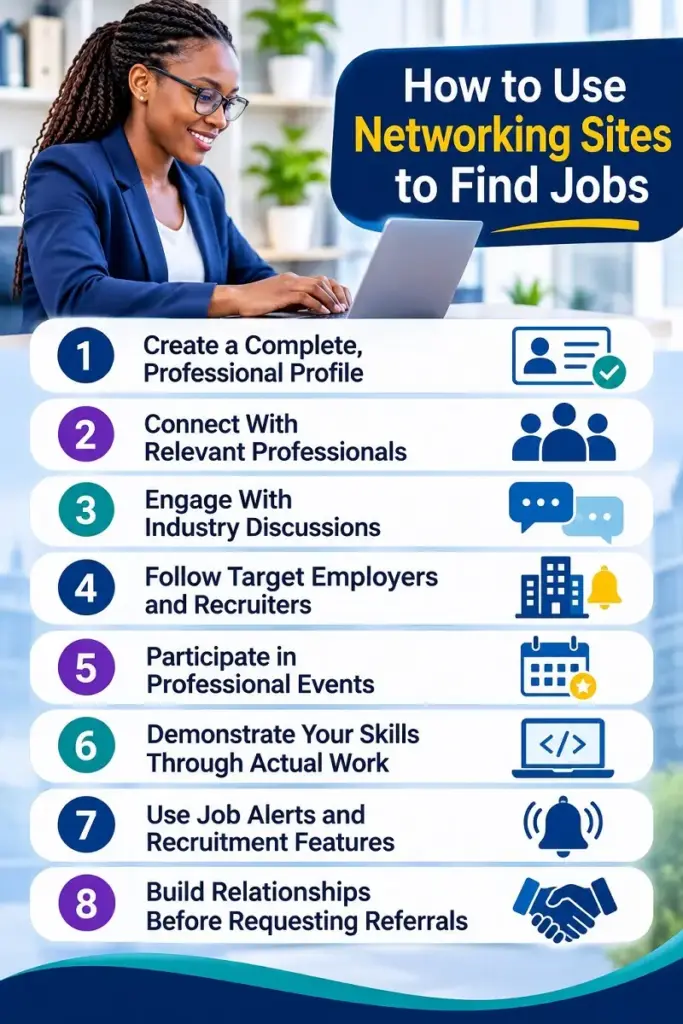
How to Use Professional Networking Sites to Find Jobs
Creating a professional networking account is only the beginning. Your results depend on how effectively you use the platform.
The following strategies can help you develop meaningful professional relationships and discover employment opportunities.
1. Create a Complete and Professional Profile
Your profile is often the first impression potential employers and professional connections receive.
Treat it as an extension of your resume. Clearly communicate your expertise, experience, qualifications, and career interests.
Include the following:
- A professional photograph where appropriate.
- A clear professional headline.
- A concise career summary.
- Relevant employment history.
- Educational qualifications.
- Industry-specific skills.
- Professional certifications.
- Portfolio links or project examples.
- Contact information where appropriate.
Avoid vague descriptions such as “hardworking individual seeking opportunities.”
Instead, communicate your professional specialization and the value you bring to employers.
For example:
Financial Analyst | Financial Modelling | Budgeting and Forecasting | Financial Reporting
This headline communicates a professional identity more effectively than a generic job-seeking statement.
If you need help presenting your qualifications, explore the AscendurePro resume-building and career preparation tools.
2. Connect With Relevant Professionals
Professional networking is about building relationships, not collecting hundreds of connections.
Identify people working in your target organizations, industries, and occupations.
These may include:
- Recruiters and talent acquisition specialists.
- Hiring managers.
- Department heads.
- Professionals in your target occupation.
- Former colleagues and classmates.
- University alumni.
- Industry association members.
Send personalized connection requests rather than generic messages.
For example:
Hello [Name],
I came across your profile while researching professionals working in [industry/company]. I am particularly interested in your experience in [specific area].
I would appreciate connecting and following your professional insights.
Best regards,
[Your Name]
A personalized message establishes context and gives the recipient a reason to accept your request.
3. Engage With Industry Discussions
Professional visibility improves when people can see your knowledge and contributions.
Participate in relevant discussions on LinkedIn, Reddit, Fishbowl, and specialist communities.
You can:
- Share useful industry insights.
- Comment thoughtfully on professional discussions.
- Discuss relevant industry developments.
- Publish lessons from completed projects.
- Answer questions within your area of expertise.
- Share professional achievements and certifications.
Avoid posting simply to remain visible. Focus on providing information that helps other professionals.
Consistent, relevant participation can gradually establish your professional reputation.
4. Follow Target Employers and Recruiters
Identify organizations that match your career interests.
Follow their official pages and monitor recruitment announcements. Pay attention to company developments, new projects, expansion plans, and departmental changes.
You can also follow recruiters specializing in your occupation.
This approach helps you understand employer requirements and discover vacancies earlier.
However, following a company does not guarantee that its recruiters will notice your profile. Maintain direct engagement and apply through official recruitment channels.
5. Participate in Professional Events
Online networking should not replace opportunities for meaningful conversations.
Attend industry conferences, webinars, career fairs, professional association meetings, and local networking events.
Meetup can help identify relevant professional communities. LinkedIn can also help you discover industry events and participants.
Before attending, research the speakers and organizations involved.
Prepare a short introduction explaining your professional background and interests. Ask thoughtful questions and follow up with relevant connections afterward.
For professionals building networks in new markets, these interactions can be particularly valuable.
6. Demonstrate Your Skills Through Actual Work
Professional qualifications are important, but employers also want evidence of practical capabilities.
Use platforms that allow you to demonstrate your work.
For example:
- Developers can publish projects on GitHub.
- Designers can showcase portfolios on Behance.
- UI/UX professionals can share design work on Dribbble.
- Researchers can publish their academic work on ResearchGate.
- Consultants can showcase case studies and professional insights.
Whenever possible, explain the problem, your contribution, the approach, and the outcome.
This makes your professional profile more informative and credible.
7. Use Job Alerts and Recruitment Features
Many professional networking sites offer employment discovery features.
LinkedIn, for example, supports job alerts and allows candidates to save opportunities. Wellfound offers startup-focused job recommendations and candidate profiles.
Use these features to monitor relevant vacancies.
Set alerts around specific job titles, locations, industries, and experience levels.
Do not rely exclusively on automated recommendations. Search manually and explore company career pages to identify additional opportunities.
8. Build Relationships Before Requesting Referrals
Employee referrals can help candidates access recruitment opportunities. However, requesting referrals immediately after connecting can appear transactional.
Start by establishing genuine professional relationships.
Engage with the person’s contributions, ask relevant questions, and learn about their experience.
If a suitable vacancy appears, explain why you are interested and how your qualifications match the position.
A referral request should be specific, respectful, and easy for the other person to decline.
9. Maintain a Consistent Networking Routine
Professional networking becomes more effective when approached consistently.
You do not need to spend several hours every day maintaining your profiles.
A manageable weekly routine could include:
- Updating your professional profiles.
- Researching potential employers.
- Connecting with relevant professionals.
- Participating in industry discussions.
- Reviewing job alerts.
- Attending professional events.
- Following up with existing connections.
Keep track of important conversations and opportunities. This prevents useful connections from disappearing into your message history.
Common Mistakes to Avoid When Using Professional Networking Sites
Even experienced professionals can undermine their networking efforts through avoidable mistakes.
Watch out for the following:
1. Creating incomplete profiles: Missing employment information, outdated skills, and vague descriptions can weaken your professional presentation.
2. Sending generic connection requests: Unpersonalized messages provide little reason for professionals to engage.
3. Asking for jobs immediately: Approaching strangers exclusively for employment favors can damage potential relationships.
4. Maintaining too many inactive accounts: Managing numerous profiles without meaningful engagement wastes time.
5. Sharing unprofessional content: Offensive comments, misleading achievements, and inappropriate public discussions can damage your reputation.
6. Applying without researching employers: Always investigate the organization, vacancy, and recruitment process before submitting personal information.
7. Treating networking as a substitute for applications: Professional relationships can generate opportunities, but they do not replace formal applications and interview preparation.
8. Ignoring follow-ups: Professional relationships require ongoing communication. Follow up respectfully when appropriate.
9. Trusting every job advertisement: Fraudulent recruiters and employment scams operate across social networking platforms. Verify employers and recruitment channels before sharing sensitive information or paying fees.
Are Professional Networking Sites Better Than Traditional Job Boards?
Professional networking sites and traditional job boards serve related but different purposes.
Job boards primarily help candidates discover and apply for advertised vacancies. Professional networking platforms also facilitate relationships, professional visibility, and direct engagement with employers.
| Comparison | Professional networking sites | Traditional job boards |
|---|---|---|
| Main purpose | Building professional relationships and discovering opportunities | Advertising and finding vacancies |
| Professional profiles | Usually central to the experience | Varies by platform |
| Recruiter connections | Often available | Usually more limited |
| Industry discussions | Common on community-based platforms | Generally limited |
| Employee referrals | Can facilitate relationships leading to referrals | Not usually a central feature |
| Portfolio sharing | Available on specialized platforms | Varies |
| Direct applications | Available on some platforms | Usually a core feature |
Neither approach is universally better.
The strongest job-search strategy combines professional networking, targeted applications, employer research, and career preparation.
For example, a candidate can discover a vacancy on LinkedIn, research the employer through professional discussions, connect with relevant employees, and submit an application through the company’s official careers page.
This creates several opportunities to demonstrate interest and suitability.
Conclusion
Professional networking sites have become valuable resources for discovering employment opportunities, developing industry relationships, and building professional visibility.
However, the best platform depends on your career objectives. LinkedIn provides broad professional exposure, while Wellfound serves startup professionals. GitHub, Behance, and Dribbble help candidates demonstrate practical abilities.
Students can benefit from Handshake, while academics can use ResearchGate to establish research connections. Meetup, Reddit, Slack, and Discord offer additional opportunities to participate in professional communities.
Rather than joining every available platform, select two or three that align with your profession and target employment market.
Build complete profiles, demonstrate your expertise, engage with relevant professionals, and maintain meaningful relationships.
Most importantly, combine networking with targeted job applications and proper interview preparation. Professional relationships can open doors, but your qualifications, experience, and ability to demonstrate your value remain essential.
Frequently Asked Questions (FAQs)
1. What is the best professional networking site for finding jobs?
LinkedIn is the best general-purpose professional networking site for most job seekers. It combines employment listings, recruiter connections, professional profiles, and industry communities.
However, specialized platforms such as Wellfound, Handshake, and XING may be more useful for particular industries and employment markets.
2. Are professional networking sites free to use?
Most professional networking sites offer free basic membership. LinkedIn, GitHub, Behance, ResearchGate, and Reddit allow users to establish basic profiles without paying.
However, some platforms charge for premium features, enhanced visibility, or advanced recruitment services.
3. Which professional networking sites are best for international job seekers?
LinkedIn is a strong starting point for international job seekers because of its broad professional reach.
Wellfound is useful for startup and technology opportunities, while XING is relevant to German-speaking Europe. Handshake can help eligible students access international employers recruiting through participating institutions.
Always check individual vacancy eligibility and work authorization requirements.
4. Can professional networking sites help recent graduates find jobs?
Yes. Professional networking sites help graduates connect with recruiters, alumni, employers, and experienced professionals.
Handshake is particularly useful for students and recent graduates in supported markets. LinkedIn is another valuable platform for building professional visibility and discovering entry-level opportunities.
Graduates should also showcase internships, academic projects, volunteering, and relevant technical skills.
5. How many professional networking sites should I join?
There is no fixed number, but two or three relevant platforms are a practical starting point.
Consider combining a general professional network with a specialized platform. For example, developers can use LinkedIn and GitHub, while designers can combine LinkedIn with Behance or Dribbble.
Focus on maintaining quality profiles and building meaningful relationships.
6. Do recruiters actually use professional networking sites?
Yes. Recruiters use professional networking platforms to discover candidates, review professional backgrounds, communicate with potential applicants, and advertise vacancies.
LinkedIn is particularly relevant for professional recruitment. Other platforms serve specialized audiences, including technology startups, creative industries, and academic research.
However, recruiter activity varies by industry, employer, and geographic market.
7. Can I find a job through professional networking without applying directly?
Yes, it is possible. Professional relationships can lead to employee referrals, recruiter introductions, freelance assignments, and direct employment discussions.
Some employers also approach candidates whose profiles match their recruitment requirements.
Nevertheless, networking does not guarantee employment. Continue submitting targeted applications and preparing for formal recruitment processes.
Further reading on AscendurePro
- 20 Top Interview Preparation Tools for Job Seekers and Professionals – Explore tools for improving interview performance.
- Career Launchpad – Build and tailor your resume, prepare for interviews, and manage job applications.
- Why are highly educated job seekers struggling to find work?
- 260+ Legitimate Websites to Find Side Jobs, Freelance Work and Remote Gigs
- The 20 Best Countries to Work in for English Speakers