You earned the degree. You built the experience. Then you sent dozens of applications and received automated rejections or silence.
Highly educated job seekers now hit this wall in many countries. The cause is rarely a lack of ability. Application volumes are at record highs, hiring is slow, and software sorts much of the first round.
This guide covers what the data shows about educated job seekers struggling to find work. It explains what triggers automated rejections and what does not. It ends with a plan you can start this week.
Key Takeaways
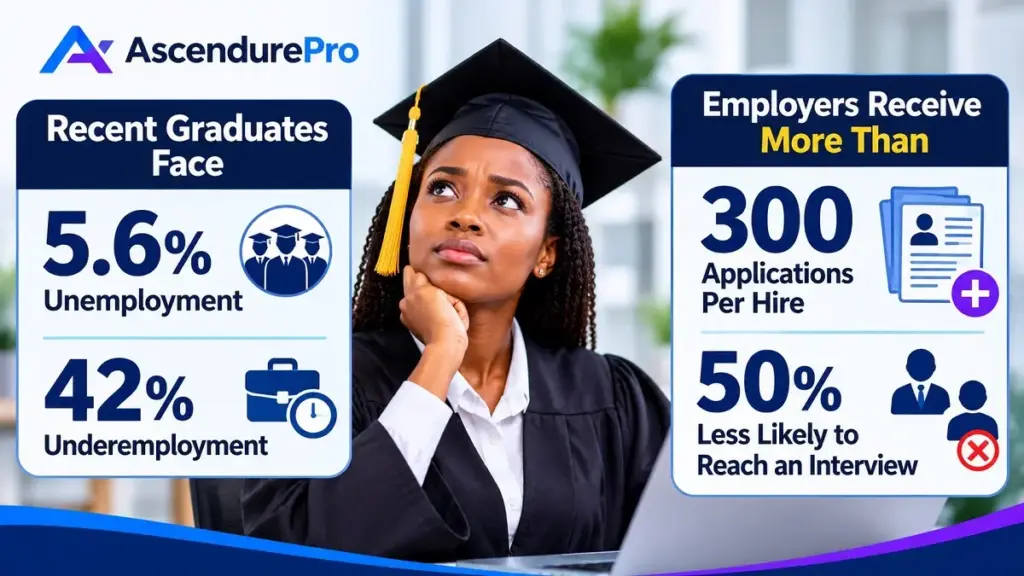
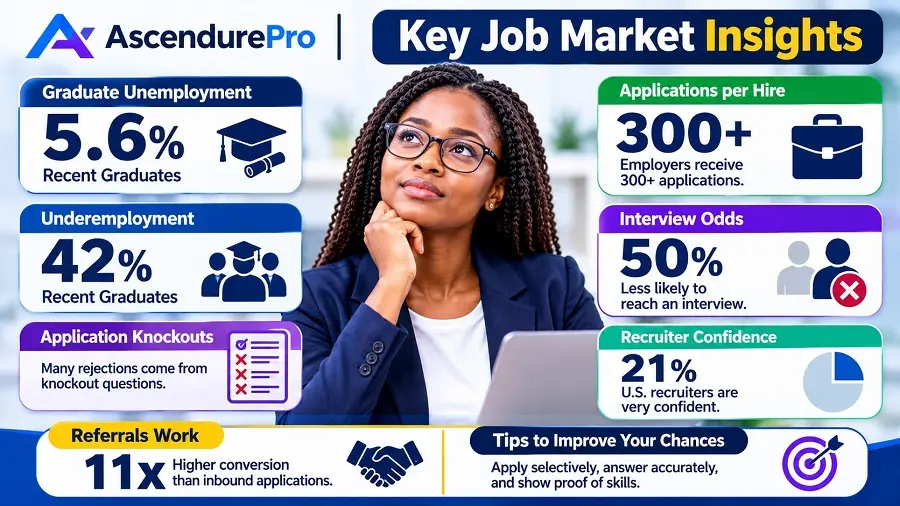
- Highly educated job seekers still post lower unemployment than other groups, but recent graduates face 5.6% unemployment and 42% underemployment.
- Employers now see more than 300 applications per hire, and candidates are about 50% less likely to reach an interview.
- Many instant rejections trace to knockout questions on application forms, not a secret resume score.
- Only 21% of U.S. recruiters are very confident their screening tools do not reject qualified candidates.
- Referrals convert at 11 times the rate of inbound applications, so direct contact beats volume.
- Fewer, tailored applications, accurate answers, and visible proof of skill improve your odds.
Contents
Free Listing
Are Highly Educated Job Seekers Really Struggling to Find Work?
Yes, but the struggle sits in specific places. Overall unemployment among degree holders is low. In April 2026, the U.S. rate was 2.8% for people with a bachelor’s degree or higher. High school graduates faced 4.7%.
Advanced degrees show a similar pattern. Adults aged 25 and older with a master’s degree or higher had a 2.1% rate in May 2026. Those rates measure joblessness, not how long a search takes or how many applications it needs.
Recent graduates face a harder market. The New York Fed reports 5.6% unemployment and 42% underemployment among recent graduates in the second quarter of 2026. These graduates are aged 22 to 27. Underemployment means working in a job that usually does not require a degree, and the measure includes people with graduate degrees.
Long Searches Are Becoming More Common
Hiring has slowed without mass layoffs. The hires rate was 3.4% in September 2026, with 7.5 million openings. Economists call this a low-hire, low-fire market.
Long-term unemployment, meaning 27 weeks or more, made up 25.4% of unemployed people in March 2026. College graduates are a growing part of that group. In 2025, about one-third of the long-term unemployed held a degree, up from roughly one-fifth a decade earlier. Our review of how long it takes to find a job after college compares search durations across 20 countries.
The Same Pattern Appears Outside the United States
UK graduate employers received 141 applications per graduate position in 2025-26, and London roles drew 172. Graduate recruitment had already fallen 8% in 2024-25. In Kenya, the economy created 822,100 jobs in 2025, and nearly nine in ten were informal.
Educated job seekers in both markets face the same bottleneck. Formal entry-level roles are scarce relative to the number of qualified applicants. Our job market and career prospects study compares jobs, wages, and trends across 20 countries.
Why Applications Vanish: The Volume Problem
AI made applying easy. In 2025, LinkedIn was logging 11,000 applications per minute, up more than 45% in one year. Candidates can paste a job description into a chatbot and submit within minutes.
Greenhouse surveyed 4,136 people across four countries in 2025. Among U.S. job seekers, 74% used AI and 49% sent more applications than a year earlier. Among U.S. recruiters, 34% spent up to half their week filtering spam and junk applications.
The math follows. Ashby analyzed more than 100 million applications and found that applications per hire tripled since 2021, to over 300. Candidates are about 50% less likely to receive an interview than five years ago. Those who do interview convert to offers at higher rates than in 2021.
Highly educated candidates compete with the same flood as everyone else. Employers add filters, and candidates send more applications. Greenhouse’s CEO calls the cycle an AI doom loop. Auto-apply tools add fuel, and our LazyApply review weighs the risks of automating 1,000+ applications.

Score up to 2000 resumes in batch analysis
Analyze, grade, and rank up to 2000 resumes in 4 batches. Rent or get a Pro plan.
What Actually Triggers Automated Rejections
Many highly educated candidates believe a hidden score deletes their resume. The evidence points to four more specific triggers.
Knockout Questions Cause Many Instant Rejections
Application forms often include screening questions. Lever explains that knockout questions auto-eliminate candidates who miss a minimum, such as years of experience or a certification. Work authorization, licensing, and location work the same way.
An Enhancv study of 25 U.S. recruiters found that 92% do not configure their systems to auto-reject on formatting, design, or content match scores. All 25 used knockout questions for work authorization, licensing, or location. The sample is small, and Enhancv sells career tools.
A wrong checkbox can end an application in seconds. Read every screening question twice.
Rigid Job Descriptions Screen Out Qualified People
A 2021 Harvard Business School and Accenture survey of 2,250 executives found that 88% agreed qualified, high-skill candidates are vetted out. The reason is that they miss the exact criteria in the job description. The report urged employers to search for skills instead of filtering out employment gaps or missing degrees.
AI Ranking Tools Add Another Layer
Software also ranks candidates. Recruiters can run batch tools that score hundreds of resumes against one job description. Our resume batch analyzer, for example, ranks up to 2,000 resumes in one run.
Recruiters differ on how much weight they give these scores. In the Enhancv study, 56% said they disregard automated fit percentages. Greenhouse found that only 21% of U.S. recruiters are very confident their tools do not reject qualified candidates. Another 8% said they have no idea what their algorithms prioritize.
Ghost Jobs Produce Silence
Some rejections are really non-responses. Ghost jobs are listings that no one is actively filling. Greenhouse classified 18% to 22% of its platform’s postings that way in 2024.
In its 2025 survey, 69% of U.S. job seekers reported meeting fake postings. Highly qualified job seekers can lose weeks to these listings. No resume change fixes a role that nobody plans to fill.
Do Advanced Degrees Hurt Highly Qualified Job Seekers?
Not at the interview-invitation stage, according to one experiment. A 2018 field experiment found that overqualified master’s graduates were 19% more likely to receive a direct interview invitation. That result cautions against blaming overqualification for every rejection.
Proof of fit also matters, because a degree shows ability and a work sample shows fit. Entry-level work is changing as well.
Stanford economists found a 13% relative employment decline for workers aged 22 to 25. The decline appeared in the most AI-exposed occupations after late 2022. Employment grew where AI mainly augments work.
A personal page that shows your work
A personal page that shows your work. Share one link with employers. 12 polished templates to choose from. You just need a Standard plan to get started.
Bias and Legal Risk in Automated Screening
Automated rejections can also reflect bias. University of Washington researchers tested three open-source language models on more than 550 real resumes with swapped names. The models favored white-associated names 85% of the time and Black-associated names 9%. The test used research models, not commercial hiring products.
Courts now examine commercial tools. In Mobley v. Workday, a federal court approved a nationwide age-discrimination collective action in May 2025. On June 22, 2026, a judge denied Workday’s motion to dismiss related California claims. The allegations are unproven.
Rules are catching up. New York City has required bias audits since July 2023, and Illinois added AI-discrimination rules in January 2026. A December 2025 state comptroller audit found significant enforcement gaps in the city’s law. In the EU, high-risk obligations for recruitment AI now apply from December 2, 2027.
Ask employers whether AI screens applications. Keep copies of the posting, your application, and any rejection.
A Practical Plan for Highly Educated Job Seekers
These steps give highly educated job seekers a response to each force above.
Apply Early and Tailor Each Application
At more than 300 applications per hire, generic applications rarely stand out. Choose roles where you meet most must-have requirements. Mirror the posting’s job title and key skills wherever they are true.
In the Enhancv study, 52% of recruiters said applying within the first 48 to 72 hours raises your chance of review. Put your strongest skills and measurable results in the top half of page one. Tools such as AscendurePro Launchpad show your skills gap for a role and tailor your resume to it.
Answer Knockout Questions With Care
Answer work authorization, location, and experience questions accurately. If a rigid question blocks a strong fit, email the recruiter directly. Briefly explain your equivalent experience.
Do not hide keywords in white text. The same Greenhouse survey found that 41% of U.S. job seekers admit using prompt injections, which are hidden instructions aimed at AI filters. Also, 22% of U.S. hiring managers report catching applicants hiding them in resumes. Meanwhile, 39% of U.S. hiring managers run more in-person interviews to verify candidates.
Use Referrals and Weak Ties
Gem analyzed 1.2 million hires and found that referrals convert at 11 times the rate of inbound applicants. In Ashby’s data on nearly 250,000 hires, referrals stayed near 17% of hires regardless of inbound volume.
A large LinkedIn experiment with 20 million users found that moderately weak ties produced the most job mobility. Those are contacts who share about 10 mutual connections with you. Message alumni, conference contacts, and former colleagues at target employers, and ask for a short conversation. Our guide to finding hidden jobs online explains direct outreach and company career pages.
Show Proof, Not Only Credentials
A degree signals ability. A work sample shows fit. Build a portfolio, a project write-up, or a short case study that matches the role. Our guide to skills-based hiring trends explains how to show skills with work samples and assessments.
Add AI fluency where the role allows it. Our list of in-demand AI skills highlights Python, communication, software engineering, SQL, and cloud computing. Pick two and show them in a real project.
Screen Postings Before You Apply
Check the posting date and look for repeated reposts. Apply through the company career page when possible. Skip listings that stay open for months without changes. Since 18% to 22% of postings on one major platform were ghost jobs in 2024, a short check can save hours.
Prepare for AI-Led Interviews
Greenhouse found that 54% of U.S. job seekers had encountered an AI-led interview. Practice answering aloud to a camera. Structure each answer around a situation, an action, and a result. Rehearse with interview preparation tools that give feedback.
Widen Your Target Without Lowering Your Standard
Competition differs by sector. In the UK’s 2023-24 cycle, digital and IT roles drew 205 applications per vacancy. Charity and public sector roles drew 74.
Consider adjacent sectors, mid-sized employers, and roles that value research or analysis. Our guide to identifying your strongest career options offers a seven-step method.
Track Results and Adjust
Log every application with the date, resume version, and response. Review the log after 20 applications. No interviews points to a resume or targeting problem, while interviews without offers point to interview skills.
Conclusion
Highly educated job seekers are not failing. The market changed around them. Record volumes, automated filters, ghost postings, and slow hiring combine to produce silence.
The best response is precision. Apply early to fewer roles, answer screening questions accurately, contact people directly, and show proof of skill.
Start this week: pick ten target employers, tailor three applications, and message five contacts. You can browse current openings on the AscendurePro job board and track each application as you go.
Frequently Asked Questions
Why do highly qualified job seekers get automated rejections?
Many automated rejections come from knockout questions, such as work authorization or required experience. Others are really non-responses to postings that nobody is filling. Check each screening answer and match the posting’s requirements before you apply.
20% off on annual plans
Tailor your resume, get your resume analysis, create portfolio, become a career coach & more
Do applicant tracking systems automatically reject resumes?
Usually not on resume content alone. In an Enhancv study, 92% of 25 recruiters said their systems do not auto-reject on formatting or content scores. Knockout questions can still reject you instantly.
Are highly educated job seekers more likely to be unemployed?
No. In April 2026, U.S. adults with a bachelor’s degree or higher had a 2.8% unemployment rate, below every other education group. Recent graduates face 5.6% unemployment and 42% underemployment.
Does being overqualified hurt my chances?
Not always. One field experiment found overqualified master’s graduates were 19% more likely to get a direct interview invitation. Fit still matters, so show how your skills match the role’s tasks.
Should I use AI to write my applications?
Many job seekers do. In Greenhouse’s survey, 74% of U.S. job seekers used AI. Use it to draft and edit, then verify every fact. Hiring managers report catching deceptive AI use, including hidden prompt injections.
How many jobs should I apply to each week?
No study sets a perfect number. With over 300 applications per hire, tailored quality beats volume. A workable target is five to ten well-matched applications a week, each followed by outreach.
Does the hidden job market exist?
Referral and direct-contact channels carry real weight. Ashby’s data shows referrals near 17% of hires. Gem finds referrals convert at 11 times the rate of inbound applicants.
References
Ashby. (2025). Inbound [Talent Trends Report]. https://www.ashbyhq.com/talent-trends-report/reports/inbound
Ashby. (2026, May 7). New data from Ashby reveals surge in applications, rising selectivity, and shifting recruiter workloads [Press release]. PR Newswire. https://www.prnewswire.com/news-releases/new-data-from-ashby-reveals-surge-in-applications-rising-selectivity-and-shifting-recruiter-workloads-302765846.html
Berger, C. (2025, January 16). Employees navigate an increasingly soul-crushing job market, rife with fake listing and ghosting hiring managers. Fortune. https://dc.fortune.com/2025/01/16/job-market-rife-fake-listing-ghosting-hiring-managers
Brynjolfsson, E., Chandar, B., & Chen, R. (2025). Canaries in the coal mine? Six facts about the recent employment effects of artificial intelligence. Stanford Digital Economy Lab. https://digitaleconomy.stanford.edu/publications/canaries-in-the-coal-mine/
Bureau of Labor Statistics. (2026a). Unemployment rate remains lower for people with more education. The Economics Daily. https://www.bls.gov/opub/ted/2026/unemployment-rate-remains-lower-for-people-with-more-education.htm
Bureau of Labor Statistics. (2026b). Short-term unemployed accounted for 29.8 percent of total unemployed in March 2026. The Economics Daily. https://www.bls.gov/opub/ted/2026/short-term-unemployed-accounted-for-29-8-percent-of-total-unemployed-in-march-2026.htm
Dizikes, P. (2022, September 15). The power of weak ties in gaining new employment. MIT News. https://news.mit.edu/2022/weak-ties-linkedin-employment-0915
Enhancv. (2026, August 31). The 75% ATS rejection myth shattered: 92% of recruiters confirm applicant tracking systems do not auto-reject resumes [Press release]. WBOC. https://www.wboc.com/online_features/press_releases/the-75-ats-rejection-myth-shattered-92-of-recruiters-confirm-applicant-tracking-systems-do-not/article_f141f112-dc9e-5082-9be5-1ea7b6444456.html
Federal Reserve Bank of New York. (2026). The labor market for recent college graduates. https://www.newyorkfed.org/research/college-labor-market
Federal Reserve Bank of St. Louis. (2026). Unemployment rate: College graduates: Advanced degree: Master’s degree and higher, 25 years and over [CGAD25O]. FRED. https://fred.stlouisfed.org/series/CGAD25O
Gem. (2026). Key takeaways from the 2026 recruiting benchmarks report. https://app.gem.com/blog/key-takeaways-from-the-2026-recruiting-benchmarks-report
Greenhouse. (2025, November 19). An AI trust crisis: 70% of hiring managers trust AI to make faster and better hiring decisions, only 8% of job seekers call it fair [Press release]. https://www.greenhouse.com/newsroom/an-ai-trust-crisis-70-of-hiring-managers-trust-ai-to-make-faster-and-better-hiring-decisions-only-8-of-job-seekers-call-it-fair
HR Dive. (2021). Report: Applicant tracking systems may exclude whole segments of candidates. https://www.hrdive.com/news/report-applicant-tracking-systems-may-exclude-whole-segments-of-candidates/606614/
HR Review. (2024). Graduate job applications hit record high, says Institute of Student Employers. https://hrreview.co.uk/hr-news/recruitment/graduate-job-applications-hit-record-high-says-institute-of-student-employers/377348
Institute of Student Employers. (2025). Student recruitment survey 2025. https://ise.org.uk/_userfiles/pages/files/reports/student_recruitment_survey_2025.pdf
Lever. (n.d.). 5 applicant tracking system myths, debunked. https://www.lever.co/blog/applicant-tracking-system-myths-debunked
Maurer, R. (2026, July 1). The Workday AI lawsuit is a wake-up call for HR. SHRM. https://www.shrm.org/mena/topics-tools/news/technology/workday-ai-lawsuit-wake-up-call-hr
National Law Review. (2026a, May 12). Patchwork AI hiring laws create rising compliance risks for employers. https://natlawreview.com/article/patchwork-ai-hiring-laws-create-rising-compliance-risks-employers
National Law Review. (2026b, June 16). States take aim at AI in employment decisions: Illinois’s disclosure and anti-discrimination requirements, enforcement gaps under NYC’s Local Law 144, and Connecticut’s new AI law. https://natlawreview.com/article/states-take-aim-ai-employment-decisions-illinoiss-disclosure-and-anti
National Law Review. (2026c, July 31). EU Digital Omnibus on AI enters into force. https://natlawreview.com/article/eu-digital-omnibus-ai-enters-force
Ntoyai, M. (2026, May 13). Degrees no longer guarantee jobs for Kenya’s youth. The Standard. https://standardmedia.co.ke/business/amp/national/article/2001547731/degrees-no-longer-guarantee-jobs-for-kenyas-youth
Sherwood News. (2025). Long-term unemployment in the US has risen to a postpandemic high. https://sherwood.news/personal-finance/long-term-employment-in-us-has-risen-to-a-post-pandemic-high/
TechTarget. (2021). Recruiting AI systems under fire for excluding workers. https://www.techtarget.com/enterprise-software/news/252506931/Recruiting-AI-systems-under-fire-for-excluding-workers
The Star. (2025, June 24). AI sludge has entered the job search. https://www.thestar.com.my/tech/tech-news/2025/06/24/ai-sludge-has-entered-the-job-search
Times Higher Education. (2026, October 14). Employers cut student work experience roles as demand rises. https://www.timeshighereducation.com/node/745459
University of Washington Information School. (2024, November). AI tools show biases in ranking job applicants’ names according to perceived race and gender. https://ischool.uw.edu/news/2024/11/ai-tools-show-biases-ranking-job-applicants-names-according-perceived-race-and-gender
Verhaest, D., Bogaert, E., Dereymaeker, J., Mestdagh, L., & Baert, S. (2018). Do employers prefer overqualified graduates? A field experiment. Industrial Relations, 57(3), 361-388. https://repository.uantwerpen.be/link/irua/152440
Yahoo Finance. (2026, November 3). Job openings and hiring edged higher in September, but it’s still a low hire, low fire market. https://finance.yahoo.com/economy/article/job-openings-and-hiring-edged-higher-in-september-but-its-still-a-low-hire-low-fire-market-151812343.html