
Teachers develop skills that employers need across many industries. These include communication, research, planning, problem-solving, leadership, and the ability to explain complex information.
Yet many teachers overlook these skills when considering a career change. They often assume their qualifications only lead to teaching, school administration, or education-related positions.
That assumption can limit their options.
A teaching degree does not automatically qualify someone for every profession. However, it can provide a strong foundation for roles in business, technology, finance, research, communications, government, and other sectors.
The opportunities become even broader when teachers combine their subject knowledge with targeted professional training.
This guide explores 50 hidden careers for teachers outside the classroom. It covers general career paths, subject-specific opportunities, qualification requirements, salary considerations, and practical transition strategies.
Key Takeaways
- Teachers can transition into corporate training, human resources, project management, communications, research, and business operations.
- Subject specialisations can create opportunities in science, technology, engineering, finance, aviation, and environmental fields.
- Some alternative careers for teachers require additional qualifications, professional certification, or industry experience.
- Technical writing, project management, market research, and corporate training are worth exploring.
- US salary figures can help illustrate earning potential, but they are not Kenyan salary estimates.
- A successful career change requires translating teaching experience into language employers understand.
Contents
Why Teachers Have More Career Options Than They Think
Teaching develops several transferable skills that businesses and organisations need.
Teachers regularly communicate with different audiences, manage competing priorities, interpret information, and solve problems. They also plan activities, assess performance, document progress, and work towards measurable objectives.
These responsibilities overlap with duties in many non-teaching professions.
For example, lesson planning involves setting objectives, allocating resources, managing time, and evaluating outcomes. These are also relevant to project coordination and programme management.
Similarly, assessing learners requires observation, evidence interpretation, feedback, and recordkeeping. Those skills can support careers in research, quality assurance, human resources, and monitoring and evaluation.
However, transferable skills alone are not always enough. Employers may require industry knowledge, software proficiency, professional certification, or relevant work experience.
Teachers should therefore identify realistic career matches rather than applying indiscriminately.
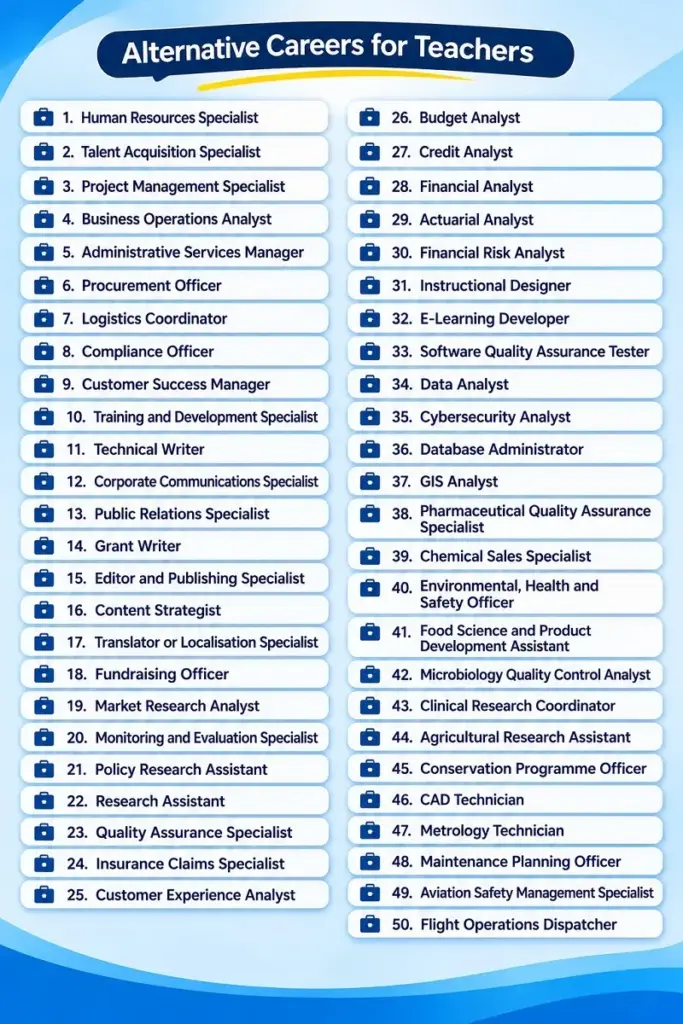
The following careers are organised into broad professional areas. Some are accessible through transferable skills and short courses. Others require substantial additional training or regulated professional qualifications.
Business, Management and Corporate Careers
These roles suit teachers who enjoy organising people, coordinating activities, solving operational problems, and communicating with stakeholders.
1. Human Resources Specialist
Human resources specialists support recruitment, employee relations, onboarding, performance management, and workplace policies. Teachers already have experience communicating with people, assessing performance, resolving conflicts, and maintaining records.
These skills can transfer well into HR. However, employers may prefer candidates with human resource management knowledge. Consider a short course or professional qualification in HR before applying.
2. Talent Acquisition Specialist
Talent acquisition specialists identify, assess, and recruit suitable candidates for organisations. Their work involves reviewing applications, conducting interviews, coordinating recruitment processes, and communicating with applicants.
Teachers who understand assessment criteria and can evaluate individual strengths may find this transition appealing. Recruitment experience, interview training, and familiarity with applicant tracking systems can improve employability.
3. Project Management Specialist
Project management specialists coordinate schedules, budgets, resources, teams, and deliverables. Teachers already plan activities, manage deadlines, coordinate stakeholders, and monitor progress.
These responsibilities provide a useful starting point. However, project management involves commercial risks, budgets, contracts, and stakeholder expectations. Learn tools such as Microsoft Project, Asana, or Jira. Consider a recognised project management certification as your experience develops.
4. Business Operations Analyst
Business operations analysts examine organisational processes and recommend improvements. They may investigate inefficiencies, analyse performance information, and prepare reports for management.
Teachers with strong analytical and problem-solving skills can explore this path. Develop spreadsheet skills, data interpretation, and business process mapping. Knowledge of Power BI or similar reporting tools can also help.
5. Administrative Services Manager
Administrative services managers coordinate facilities, records, office operations, and organisational support services. Teachers with experience handling departmental responsibilities may already possess relevant organisational skills.
The transition becomes easier when applicants demonstrate budgeting, procurement, staff coordination, and records management experience. Senior positions usually require substantial administrative or management experience.
6. Procurement Officer
Procurement officers help organisations source goods and services. Their duties may include preparing purchase requests, evaluating suppliers, managing documentation, and monitoring deliveries.
Teachers who have handled departmental resources or school procurement may have useful experience. However, professional procurement knowledge is important. In Kenya, consider relevant training and qualifications recognised within the procurement profession.
7. Logistics Coordinator
Logistics coordinators organise the movement, storage, and distribution of goods. They work with suppliers, transport providers, warehouses, and internal departments.
Teachers with strong planning and coordination skills can explore entry-level logistics roles. Learn inventory management, supply chain basics, and relevant software. More specialised positions may require logistics or supply chain qualifications.
8. Compliance Officer
Compliance officers help organisations follow laws, regulations, internal policies, and industry standards. Their responsibilities include reviewing procedures, maintaining records, identifying risks, and preparing compliance reports.
Teachers accustomed to following structured guidelines may find some responsibilities familiar. However, compliance is industry-specific. Banking, healthcare, insurance, and manufacturing employers often require relevant regulatory knowledge.
9. Customer Success Manager
Customer success managers help clients achieve value from a company’s products or services. They onboard customers, explain product features, resolve problems, and monitor satisfaction.
Teachers can transfer their ability to explain complicated information and support people with different needs. Technology companies often value customer communication and relationship management. Learn customer relationship management software and basic product analytics.
10. Training and Development Specialist
Training and development specialists design and coordinate employee learning programmes. Unlike classroom teachers, they focus on workplace skills, employee performance, and organisational development.
This is one of the more direct transitions for experienced teachers. Employers operate across finance, healthcare, technology, manufacturing, and professional services. The US Bureau of Labor Statistics projected 11% employment growth for this occupation between 2025 and 2035.
Communications, Writing and Media Careers
Teachers who enjoy writing, explaining ideas, editing documents, and presenting information can explore several communication-focused professions.
11. Technical Writer
Technical writers prepare manuals, product guides, procedures, technical reports, and instructional documents. Their job is to make complex information understandable.
Science and technology teachers may have an advantage when explaining technical concepts. However, applicants need strong writing and editing skills. Build a portfolio containing user guides, standard operating procedures, and technical articles.
The US median annual salary for technical writers was $90,390 in May 2025.
12. Corporate Communications Specialist
Corporate communications specialists manage internal and external organisational communication. They prepare announcements, newsletters, reports, presentations, and executive communications.
Teachers with strong writing and presentation skills can explore this path. Learn corporate writing, communication planning, stakeholder engagement, and digital publishing.
13. Public Relations Specialist
Public relations specialists manage an organisation’s public image and relationships with external audiences. Their work may involve media releases, campaigns, event coordination, and reputation management.
Teachers who communicate confidently and understand audience needs may find this field suitable. A portfolio of writing samples and practical communication experience can strengthen applications.
14. Grant Writer
Grant writers prepare funding proposals for charities, research institutions, universities, and development organisations. They explain project needs, objectives, expected outcomes, budgets, and organisational capacity.
Teachers with strong research and writing abilities can develop this skill. Learn donor requirements, proposal writing, logical frameworks, and basic project budgeting. Experience with nonprofit programmes can be particularly valuable.
15. Editor and Publishing Specialist
Editors review written material for accuracy, clarity, structure, grammar, and consistency. Publishing specialists may coordinate manuscripts, production schedules, authors, and editorial workflows.
English, literature, and language teachers may find this transition particularly relevant. However, editing requires more than correcting grammar. Learn professional editing conventions and build a portfolio of edited documents.
16. Content Strategist
Content strategists plan what an organisation publishes, why it publishes it, and how content supports business objectives. They may manage websites, blogs, social media, newsletters, and educational resources.
Teachers can apply their understanding of audience needs, structured communication, and information organisation. Develop SEO, content analytics, digital marketing, and editorial planning skills.
17. Translator or Localisation Specialist
Translators convert written material from one language into another. Localisation specialists adapt content to suit the language, culture, and expectations of a particular market.
French, English, Kiswahili, and other language teachers may have a useful foundation. Professional translation requires exceptional language proficiency and subject accuracy. Build a specialised portfolio and consider translation credentials.
18. Fundraising Officer
Fundraising officers help organisations secure financial and material support. They research potential donors, coordinate campaigns, prepare proposals, and maintain donor relationships.
Teachers with communication, organisation, and stakeholder engagement experience can explore this career. Learn fundraising strategy, donor reporting, and nonprofit financial management.
Research, Analysis and Programme Careers
Teachers who enjoy investigating questions, interpreting evidence, and preparing reports may find opportunities in research and development organisations.
19. Market Research Analyst
Market research analysts study consumer preferences, competitors, market conditions, and purchasing behaviour. They use surveys, interviews, data, and statistical methods to support business decisions.
Teachers with research and analytical skills can build a pathway into this field. Learn statistics, Excel, survey design, and data visualisation. The US median annual salary was $78,760 in May 2025. Bureau of Labor Statistics+1
20. Monitoring and Evaluation Specialist
Monitoring and evaluation specialists assess whether projects achieve their intended objectives. They develop indicators, collect information, analyse results, and prepare performance reports.
Teachers already assess progress and interpret performance evidence. Those skills can be useful in development programmes, NGOs, public institutions, and research projects. Learn results-based management, survey methods, and data analysis.
21. Policy Research Assistant
Policy research assistants investigate public issues and help prepare evidence for policy decisions. They may review legislation, analyse reports, conduct interviews, and summarise research findings.
Teachers with backgrounds in history, economics, geography, political science, or social sciences may find relevant opportunities. Strong research, writing, and analytical skills are essential. Some employers prefer postgraduate qualifications.
22. Research Assistant
Research assistants support studies by collecting information, reviewing literature, organising datasets, and preparing reports. They work in universities, research institutes, NGOs, government agencies, and private organisations.
Teachers with subject-specific expertise may qualify for some research support roles. However, laboratory, clinical, and advanced statistical positions often require additional technical training.
23. Quality Assurance Specialist
Quality assurance specialists check whether products, services, or organisational processes meet established standards. They document findings, identify problems, and recommend corrective action.
Teachers who have experience developing assessment criteria and reviewing performance can explore non-regulated quality assurance roles. Manufacturing, service delivery, publishing, and business process organisations offer possible pathways. Technical sectors may require specialised qualifications.
24. Insurance Claims Specialist
Insurance claims specialists review claims, examine supporting documents, communicate with policyholders, and assess whether claims meet policy requirements.
Teachers with strong documentation, communication, and analytical skills may be suitable for some entry-level positions. Learn insurance principles, claims procedures, and relevant regulatory requirements. Specialist claims involving engineering or medicine may require additional expertise.
25. Customer Experience Analyst
Customer experience analysts study feedback, complaints, service performance, and customer behaviour. They help organisations identify problems and improve service delivery.
Teachers who understand feedback and performance evaluation can build relevant skills. Learn survey analysis, Excel, customer relationship management systems, and data visualisation.
Finance and Commercial Careers
Teachers with mathematics, economics, business, or accounting knowledge may explore finance-related roles. These positions often require additional professional training.
26. Budget Analyst
Budget analysts help organisations prepare budgets, monitor expenditure, and evaluate financial plans. They compare actual spending with approved budgets and explain financial differences.
Mathematics and business teachers may have a useful foundation. However, employers generally expect accounting, finance, economics, or related knowledge. Develop Excel, budgeting, and financial reporting skills.
27. Credit Analyst
Credit analysts assess whether individuals or businesses can repay borrowed money. They review financial statements, income, credit histories, and other risk indicators.
Mathematics and economics teachers may find the analytical aspects appealing. However, finance-specific training is necessary. Learn financial statement analysis, credit risk, and banking fundamentals.
28. Financial Analyst
Financial analysts examine financial information and evaluate investment, business, or organisational performance. They prepare forecasts, analyse trends, and communicate recommendations.
Teachers with strong mathematics or economics backgrounds can explore this route. However, a teaching degree alone may not satisfy employer requirements. Consider finance training, Excel modelling, accounting fundamentals, and relevant professional qualifications.
Explore finance careers and their qualifications for a deeper look at available pathways.
29. Actuarial Analyst
Actuarial analysts use mathematics, statistics, and financial theory to assess risk. They work in insurance, pensions, consulting, and financial services.
Mathematics teachers may have a strong academic foundation for this career. However, actuarial work requires rigorous professional examinations and specialised technical skills. Learn probability, statistics, programming, and financial mathematics before pursuing this path.
30. Financial Risk Analyst
Financial risk analysts identify and assess risks that could affect financial institutions or businesses. They may examine credit exposure, market movements, operational weaknesses, and financial controls.
Mathematics and economics teachers can investigate this route. Employers often expect finance knowledge, quantitative skills, and familiarity with risk management frameworks. Professional certifications may improve progression prospects.
Hidden STEM Careers for Teachers
Technology offers several alternatives for teachers willing to learn new tools and build practical portfolios. Some roles are accessible through structured training, while others require substantial technical expertise.
31. Instructional Designer
Instructional designers create structured learning experiences for organisations, universities, and digital platforms. They analyse learning needs, design learning materials, and evaluate programme effectiveness.
Although this profession remains connected to learning, it does not require traditional classroom teaching. Teachers can transfer curriculum design and assessment skills. Learn instructional design models, authoring tools, and learning management systems.
32. E-Learning Developer
E-learning developers build interactive digital courses, assessments, and learning modules. They work with instructional designers, subject experts, and software teams.
Teachers who understand learning objectives can develop relevant skills. Learn tools such as Articulate Storyline, Rise, and other authoring platforms. Basic HTML, multimedia editing, and accessibility knowledge can be useful.
33. Software Quality Assurance Tester
Software QA testers examine applications to identify defects, usability problems, and inconsistencies. They document test results and help development teams improve software quality.
Teachers with strong attention to detail and logical reasoning can explore entry-level testing. Learn software testing fundamentals, test case writing, bug reporting, and tools such as Jira. Automation testing requires additional programming skills.
34. Data Analyst
Data analysts collect, clean, interpret, and present information to support decisions. They work in business, healthcare, finance, government, logistics, and other industries.
Mathematics, science, and economics teachers may have an advantage in quantitative reasoning. However, employers expect practical data skills. Learn Excel, SQL, Power BI, and basic statistics. Build a portfolio using real or publicly available datasets.
35. Cybersecurity Analyst
Cybersecurity analysts help protect computer systems, networks, and information from security threats. Their duties may include monitoring alerts, investigating incidents, and supporting security controls.
Computer science teachers may have a useful starting point. However, cybersecurity requires specialised technical training. Learn networking, operating systems, security fundamentals, and incident response. Industry certifications can help demonstrate competence.
36. Database Administrator
Database administrators organise, maintain, secure, and monitor databases. They help ensure information remains accessible, accurate, and protected.
Computer science and ICT teachers can explore this field. Learn SQL, database design, backup procedures, access control, and cloud database platforms. Employers may require practical experience with specific database technologies.
37. GIS Analyst
Geographic information systems analysts use spatial data to create maps, analyse locations, and support planning decisions. They work in urban development, agriculture, environmental management, transport, and public services.
Geography teachers may find this transition particularly relevant. Learn QGIS or ArcGIS, spatial data management, remote sensing, and mapping techniques. Some roles require additional geography, surveying, or geospatial qualifications.
Subject specialisation can create opportunities outside education. However, science and engineering careers often have strict technical or professional requirements.
38. Pharmaceutical Quality Assurance Specialist
Pharmaceutical quality assurance specialists help ensure medicines are manufactured and documented according to quality standards. They may review production records, investigate deviations, and support compliance procedures.
Chemistry and biology teachers may have relevant subject knowledge. However, pharmaceutical employers often require pharmaceutical science, chemistry, microbiology, or related qualifications. Additional Good Manufacturing Practice training is also valuable.
39. Chemical Sales Specialist
Chemical sales specialists supply laboratory chemicals, industrial chemicals, equipment, and related products. They explain technical specifications, advise customers, and manage business relationships.
Chemistry teachers may have a useful advantage when explaining chemical properties and applications. Employers may still require commercial sales experience and product-specific training. Strong communication and negotiation skills are essential.
For more options, explore careers in chemistry that pay well.
40. Environmental, Health and Safety Officer
Environmental, health and safety officers help organisations manage workplace hazards and environmental responsibilities. They may conduct inspections, prepare safety reports, and support compliance programmes.
Chemistry, biology, and geography teachers can explore relevant training pathways. However, employers may require occupational safety qualifications and industry experience.
41. Food Science and Product Development Assistant
Food science professionals examine food quality, safety, ingredients, processing, and product development. They may support laboratory testing, production trials, and quality documentation.
Chemistry and biology teachers can investigate this sector. However, food science positions often require food technology, food science, microbiology, or related qualifications. A teaching degree alone may not be sufficient.
42. Microbiology Quality Control Analyst
Microbiology quality control analysts test samples for microbial contamination and help maintain laboratory quality standards. They work in food processing, pharmaceuticals, healthcare, and manufacturing.
Biology teachers may have a useful academic foundation. However, laboratory roles require practical microbiology skills and appropriate scientific qualifications. Employers may also require experience with laboratory equipment and quality systems.
43. Clinical Research Coordinator
Clinical research coordinators support clinical studies by organising documentation, coordinating participants, and ensuring study procedures are followed.
Biology and chemistry teachers may find the research environment appealing. However, this is a specialised healthcare research role. Employers may require clinical research training, Good Clinical Practice certification, and relevant healthcare or research experience.
44. Agricultural Research Assistant
Agricultural research assistants support studies involving crops, soils, livestock, pests, and farming systems. They may collect samples, record observations, organise experiments, and prepare reports.
Agriculture, biology, and chemistry teachers can explore relevant opportunities. Some roles accept related science backgrounds, while others require agricultural science or specialised research qualifications.
45. Conservation Programme Officer
Conservation programme officers support projects involving biodiversity, natural resources, wildlife, and environmental protection. Their work may include project coordination, field data collection, community engagement, and reporting.
Biology and geography teachers may have transferable subject knowledge. However, conservation employers often prefer environmental science, ecology, natural resource management, or related experience.
These paths can suit teachers with technical subject specialisations. They usually require additional industry training and, in some cases, formal licensing.
46. CAD Technician
Computer-aided design technicians prepare technical drawings and digital models. They work in construction, manufacturing, engineering, architecture, and product development.
Teachers with backgrounds in technical drawing, design, or engineering subjects may find this route relevant. Learn AutoCAD, SolidWorks, Revit, or other software used by target employers. A portfolio of accurate technical drawings can demonstrate practical ability.
47. Metrology Technician
Metrology technicians work with measurement systems, calibration procedures, and equipment accuracy. They may support manufacturing, laboratories, engineering, and quality control.
Physics teachers may have a useful foundation in measurement and experimental methods. However, employers require practical calibration skills and knowledge of measurement standards. Additional technical training is essential.
48. Maintenance Planning Officer
Maintenance planning officers coordinate equipment maintenance schedules, work orders, spare parts, and maintenance records. They help reduce equipment downtime and improve operational reliability.
Physics and technical subjects teachers may have relevant knowledge. However, engineering or maintenance experience is often required. Learn maintenance management systems, asset management, and reliability fundamentals.
49. Aviation Safety Management Specialist
Aviation safety management specialists support safety systems, risk assessments, incident reporting, and compliance within aviation organisations.
Physics, mathematics, and aviation-related teachers may investigate this path. However, aviation safety is a specialised profession. Employers may require aviation experience, safety management training, and knowledge of relevant aviation regulations.
50. Flight Operations Dispatcher
Flight operations dispatchers support the planning and monitoring of aircraft operations. Their work may involve flight planning, weather information, fuel requirements, and operational coordination.
Mathematics, physics, and aviation teachers may find the technical environment interesting. However, this role requires specialised aviation training and regulatory compliance. It is not an automatic transition from a teaching qualification.
Which Alternative Careers for Teachers Pay Well?
Some alternative careers for teachers offer strong earning potential. However, salary depends on location, qualifications, experience, employer, and industry.
The following US figures illustrate potential earnings in selected occupations. They are national median annual wages published by the US Bureau of Labor Statistics for May 2025.
| Occupation | US median annual salary |
|---|---|
| Project management specialists | $102,320 |
| Technical writers | $90,390 |
| Market research analysts | $78,760 |
| Human resources specialists | $75,940 |
| Training and development specialists | $69,280 |
Government Jobs for Teachers Outside Education
Teachers can also explore public service vacancies beyond the education sector. Government departments recruit professionals for administration, research, communication, procurement, planning, and programme implementation.
Potential roles include:
- Human resource management officer.
- Public communications officer.
- Research officer.
- Records management officer.
- Procurement officer.
- Programme officer.
- Statistical officer.
- Administrative officer.
- Project officer.
- Policy research assistant.
Eligibility depends on the advertised job requirements. A teaching degree does not automatically satisfy the academic or professional requirements for these positions.
Companies That Hire Former Teachers
Former teachers work in many sectors. However, employers generally recruit for specific vacancies rather than hiring people simply because they previously taught.
The following organisations and sectors are worth researching:
- Technology companies: Corporate training, customer success, technical writing, software testing, and learning design.
- Consulting firms: Research, project coordination, business analysis, and organisational development.
- Banks and insurers: Recruitment, customer experience, compliance, training, and operations.
- Publishing companies: Editing, content development, proofreading, and production coordination.
- Non-governmental organisations: Programme coordination, monitoring and evaluation, grants writing, and research.
- Manufacturers: Quality assurance, technical documentation, procurement, and safety support.
- Research institutions: Research assistance, project administration, data collection, and scientific communication.
Examples of employers to investigate include Microsoft, Google, Safaricom, banks, insurance companies, publishing houses, and international development organisations. This is not a claim that these organisations have current vacancies for former teachers.
Focus on the job description, not the employer’s brand name. Search for positions that match your transferable skills and qualifications.
How to Transition From Teaching to Another Career
Changing careers requires more than updating your CV. You need to demonstrate how your previous experience solves problems in a different industry.
1. Identify Your Strongest Transferable Skills
Start by reviewing your responsibilities beyond classroom instruction.
Consider experience in:
- Planning and coordinating projects.
- Managing budgets and resources.
- Analysing performance information.
- Writing reports and documentation.
- Resolving conflicts.
- Communicating with stakeholders.
- Managing deadlines.
- Leading teams and activities.
Use these examples to identify suitable career directions. This career strengths assessment guide can help structure the process.
2. Choose One or Two Target Careers
Avoid applying for every vacancy that appears remotely suitable.
Choose a career based on your subject background, transferable skills, interests, qualifications, and financial goals.
For example, a mathematics teacher might explore data analysis, actuarial studies, or financial operations. A chemistry teacher might investigate technical sales, laboratory quality control, or chemical documentation.
3. Identify Your Skills Gaps
Compare your existing skills with actual job advertisements.
Look for recurring requirements such as Excel, SQL, project management, financial reporting, or industry certification.
Separate essential requirements from preferred qualifications. Then prioritise the gaps that appear most frequently in relevant vacancies.
4. Build Practical Evidence
Employers need evidence that you can perform the work.
Create sample reports, project plans, dashboards, technical documents, research summaries, or marketing content. Choose projects that reflect the responsibilities of your target occupation.
A practical portfolio can help demonstrate your abilities when you lack direct industry experience.
5. Rewrite Your CV for the New Industry
Do not describe every responsibility using classroom terminology.
Instead of writing, “Prepared lesson plans,” explain how you developed structured work plans with measurable objectives and deadlines.
Instead of writing, “Marked examinations,” describe how you evaluated performance data and produced feedback to support improvement.
Use accurate examples and measurable results wherever possible. Do not invent business experience or inflate responsibilities.
6. Build Professional Connections
Networking can help you learn about roles that are not widely advertised.
Connect with professionals in your target industry, attend relevant events, and participate in professional communities. Use professional networking sites for jobs to identify useful platforms.
7. Apply Strategically
Target vacancies where you meet most essential requirements. Tailor your CV and application to each role.
You can also explore legitimate freelance and contract opportunities while building experience. Review these legitimate websites for side jobs before accepting online work.
Career transitions take time. A structured approach is usually more effective than sending large numbers of generic applications.
FAQS: Hidden Careers for Teachers
1. What other jobs can teachers do with their degree?
Teachers can explore human resources, recruitment, corporate training, project coordination, communications, research, technical writing, and business operations. Some roles require additional qualifications or experience.
2. What are the best alternative careers for teachers?
Strong options include corporate training, technical writing, human resources, project management, market research, and customer success. The best choice depends on your skills and qualifications.
3. Which companies hire former teachers?
Technology companies, consulting firms, banks, insurance companies, publishers, manufacturers, and NGOs employ professionals with transferable teaching skills. Hiring depends on the specific vacancy and candidate requirements.
4. Can teachers get government jobs outside education?
Yes. Teachers may qualify for public service roles in administration, research, communication, procurement, and programme coordination. Applicants must meet the academic and professional requirements in each advertisement.
5. What alternative careers for teachers pay well?
Project management, technical writing, financial analysis, market research, and specialised technology roles can offer competitive salaries. Pay varies significantly by country, experience, and qualifications.
6. Can a teacher transition into technology without a computer science degree?
Yes, some technology roles are accessible through targeted training and practical portfolios. Examples include software testing, technical writing, data analysis, and customer success. More specialised roles may require formal technical qualifications.
7. How can teachers find jobs outside education?
Identify transferable skills, choose target occupations, close relevant skills gaps, and tailor your CV. Use professional networks, reputable job boards, employer career pages, and industry associations.
Conclusion
A teaching career does not have to define your entire professional future. The skills developed through teaching can support opportunities in many industries.
Some transitions are relatively direct. Corporate training, recruitment, technical writing, and project coordination are useful starting points.
Others require further study, professional certification, or technical experience. This is particularly true for finance, engineering, aviation, healthcare, and regulated scientific occupations.
The most practical approach is to choose a realistic target, understand its requirements, and build evidence of your ability.
You do not need to pursue all 50 careers. Identify the few that match your strengths, then develop a clear transition plan.