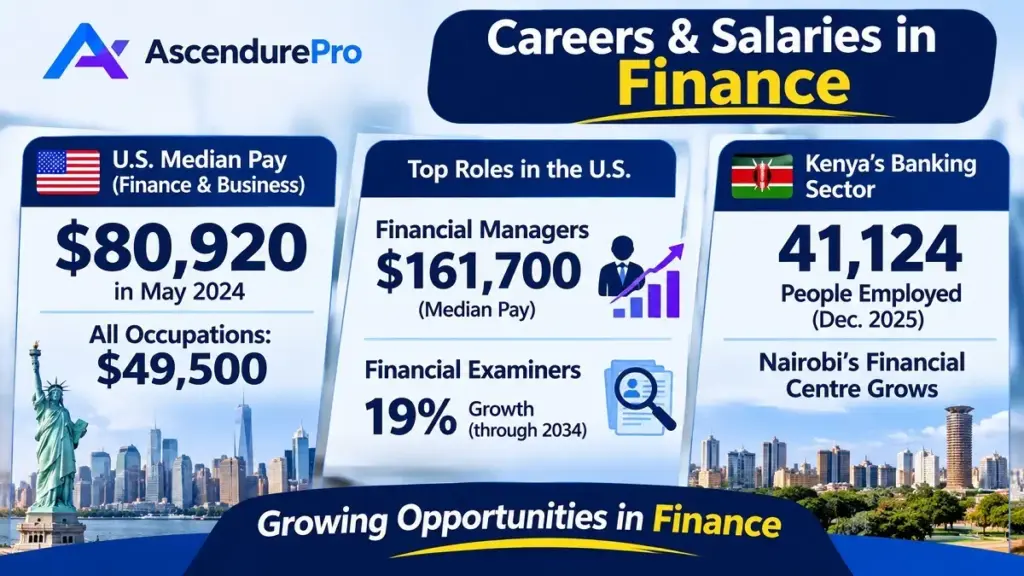
Finance careers offer opportunities in banking, accounting, investment management, corporate finance, insurance, technology and international development. However, choosing the right finance career requires more than comparing salaries.
A financial analyst at an investment bank may earn considerably more than an accountant at a small business. A finance officer at an international NGO may have a different working schedule from an investment banker. Meanwhile, a financial analyst working remotely for an international company may enjoy flexibility unavailable to someone working in a traditional banking branch.
These differences matter when deciding where to start, which qualifications to pursue and what kind of employer to target.
The United States illustrates the earning potential. Financial managers earned a median annual salary of $166,570 in May 2025. In Kenya, accountants with five years of experience earned approximately KSh62,303–KSh162,205 monthly, according to WageIndicator’s 2026 estimates.
Both are finance careers, but their responsibilities, seniority, labour markets and compensation structures differ.
This guide examines more than 30 finance careers, their responsibilities, salary prospects, entry requirements and working conditions. It also compares opportunities across the 20 countries in AscendurePro’s international job-market research.
Whether you are a graduate exploring entry-level finance jobs, an accountant considering a career change or an experienced professional targeting international opportunities, you will find practical guidance on choosing your next career.
Affiliate disclosure: Some links in this guide may be affiliate links. We may earn a commission if you purchase through them, at no additional cost to you. Our recommendations remain independent.
Key Takeaways
- Finance careers cover accounting, corporate finance, banking, investment management, insurance, financial technology, risk and compliance.
- Financial managers earned a US median salary of $166,570 in May 2025. Financial analysts earned $103,570, while accountants and auditors earned $83,680.
- In Kenya, accountants with five years of experience earned approximately KSh62,303–KSh162,205 monthly in 2026.
- Accounting, financial analysis, compliance, risk management and financial technology offer several entry and progression routes.
- Remote finance careers are possible, particularly in financial analysis, bookkeeping, accounting, financial operations and reporting.
- Work-life balance depends heavily on the role, employer, reporting deadlines and industry.
- NGO finance jobs provide opportunities in grants management, donor reporting, project budgeting and financial compliance.
- Professional qualifications such as CPA, ACCA, CFA, CIMA and country-specific accounting designations can strengthen your prospects.
- Artificial intelligence is changing routine finance work. Data analysis, financial judgement, technology literacy and regulatory knowledge are becoming increasingly important.
Contents
Quick Guide: Finance Careers, Qualifications and Tools
| Career goal | Recommended qualification | Software to learn |
|---|---|---|
| Become an accountant | CPA, ACCA | Excel, QuickBooks, Xero |
| Become a financial analyst | Finance degree, FMVA | Excel, Power BI, SQL |
| Enter investment banking | CFA, relevant finance degree | Excel, Bloomberg, financial modelling |
| Become an investment manager | CFA | Bloomberg, Morningstar Direct |
| Become a finance manager | CPA, ACCA, CIMA | Excel, SAP, Oracle |
| Work in financial risk | FRM | Excel, Python, risk analytics |
| Enter corporate FP&A | CIMA, FPAC | Excel, Power BI, ERP |
| Work in NGO finance | CPA, ACCA | Excel, SAP, accounting software |
| Become a treasury professional | CTP | Excel, treasury management systems |
| Enter financial technology | Finance qualification and technology skills | SQL, Python, Power BI |
What Are Finance Careers?
Finance careers are professional occupations involving the management, analysis, movement, reporting, investment or protection of money and financial resources.
They exist in virtually every economic sector. Banks, governments, insurance companies, investment firms, technology companies, universities, hospitals, NGOs and manufacturing businesses all employ finance professionals.
However, finance is not a single career. It comprises several occupational groups with different responsibilities, qualifications, earning potential and working conditions.
For example:
- Accountants maintain financial records and prepare financial statements.
- Financial analysts evaluate financial performance and investment opportunities.
- Financial managers oversee budgets, cash flow and financial strategy.
- Credit analysts assess borrowers’ ability to repay loans.
- Compliance officers monitor regulatory requirements.
- Investment managers oversee portfolios and investment decisions.
- NGO finance officers manage project budgets and donor-funded expenditure.
Understanding these distinctions helps you avoid choosing a career simply because it has an attractive title or advertised salary.
The Five Main Finance Career Families
Most finance occupations fall into five broad families.
1. Accounting, auditing and taxation
These professionals maintain financial records, examine transactions, prepare financial statements, manage tax obligations and verify compliance with accounting standards.
Typical employers include accounting firms, banks, government departments, NGOs and private companies.

2. Corporate finance and financial planning
Corporate finance professionals manage organisational finances. Their responsibilities include budgeting, financial forecasting, cash-flow management, financial modelling and strategic planning.
Common employers include multinational companies, manufacturing businesses, technology firms and consulting organisations.
3. Banking, lending and credit
This family includes professionals who manage customer accounts, evaluate loan applications, assess creditworthiness and facilitate financial transactions.
Employers include commercial banks, microfinance institutions, development finance institutions and digital lenders.
4. Investment, capital markets and asset management
These professionals research investment opportunities, manage portfolios, evaluate companies and support capital allocation.
Career opportunities exist in investment banks, private equity firms, pension funds, asset managers, securities exchanges and venture capital organisations.
5. Risk management, advisory and compliance
These occupations focus on identifying financial risks, protecting institutional resources, monitoring regulatory compliance and advising individuals or organisations.
Employers include financial regulators, insurance companies, banks, consulting firms and government institutions.

Score up to 2000 resumes in batch analysis
Analyze, grade, and rank up to 2000 resumes in 4 batches. Rent or get a Pro plan.
Finance Careers List: 30+ Jobs to Consider
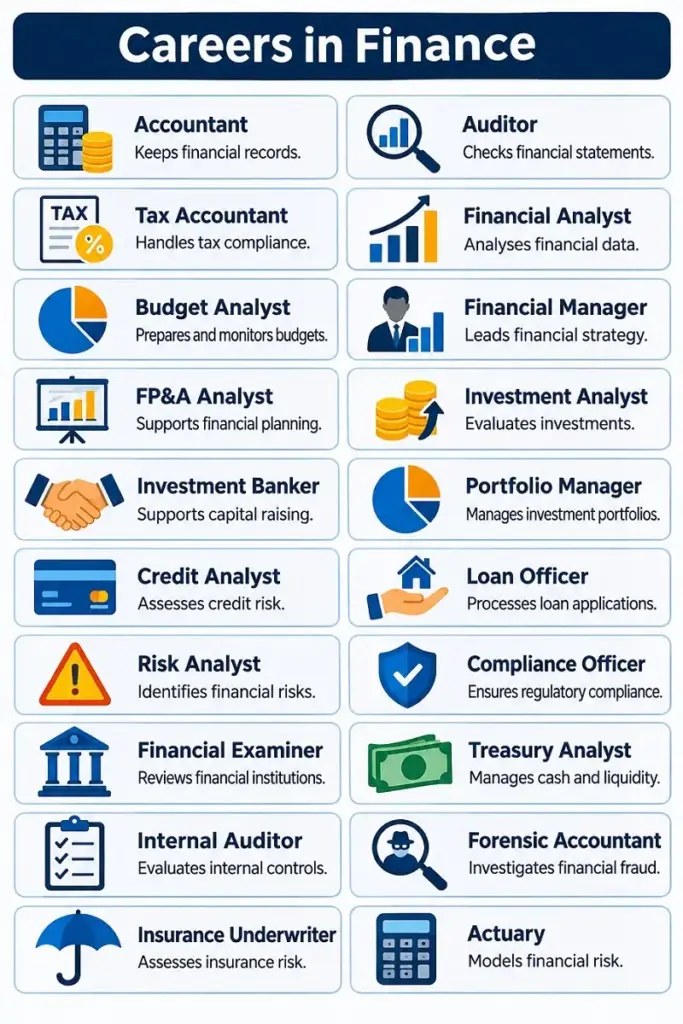
The following finance careers cover different experience levels, specialisations and working environments.
| Finance career | Main responsibilities | Typical entry requirements |
|---|---|---|
| Accountant | Financial records, reconciliations and reporting | Accounting or finance degree; CPA/ACCA advantageous |
| Auditor | Examines financial statements and internal controls | Accounting degree; CPA/ACCA |
| Tax accountant | Tax calculations, planning and compliance | Accounting or taxation qualification |
| Financial analyst | Financial modelling, forecasting and analysis | Finance, economics or accounting degree |
| Budget analyst | Budget preparation and expenditure monitoring | Finance, accounting or economics degree |
| Financial manager | Financial strategy, reporting and resource management | Degree and substantial experience |
| FP&A analyst | Financial planning, forecasting and variance analysis | Finance or accounting degree |
| Investment analyst | Evaluates securities and investment opportunities | Finance, economics or related degree |
| Investment banker | Supports mergers, acquisitions and capital raising | Finance-related degree; strong analytical skills |
| Portfolio manager | Manages investment portfolios | Finance experience; CFA advantageous |
| Credit analyst | Assesses creditworthiness and lending risk | Finance, economics or accounting degree |
| Loan officer | Evaluates and processes loan applications | Finance or business qualification |
| Risk analyst | Identifies and evaluates financial risks | Finance, statistics or quantitative degree |
| Compliance officer | Monitors regulatory and internal compliance | Finance, law or business qualification |
| Financial examiner | Examines financial institutions and regulatory compliance | Accounting or finance degree |
| Treasury analyst | Manages liquidity, cash flow and funding | Finance or accounting degree |
| Internal auditor | Evaluates internal controls and operational risks | Accounting or audit qualification |
| Forensic accountant | Investigates financial irregularities and fraud | Accounting degree; specialist training |
| Insurance underwriter | Evaluates insurance applications and risk | Finance, business or actuarial background |
| Actuary | Models financial uncertainty and insurance risks | Mathematics, statistics or actuarial science |
| Personal financial advisor | Advises clients on financial planning | Finance qualification; licensing where applicable |
| Wealth manager | Manages high-net-worth clients’ financial interests | Finance experience and relevant credentials |
| Fund accountant | Maintains investment fund accounts and valuations | Accounting or finance degree |
| Financial controller | Oversees accounting operations and reporting | Accounting qualification and experience |
| Finance business partner | Supports operational and strategic decisions | Finance degree and business experience |
| Grants accountant | Monitors donor-funded expenditure and reporting | Accounting qualification; grants experience |
| NGO finance officer | Manages programme budgets and financial controls | Finance degree; CPA/ACCA advantageous |
| Fintech financial analyst | Evaluates digital financial products and performance | Finance and data skills |
| Financial data analyst | Analyses financial datasets and trends | Finance, statistics or data background |
| Revenue analyst | Evaluates revenue performance and forecasts | Finance, accounting or analytics background |
| Financial systems analyst | Supports financial software and reporting systems | Finance and technology knowledge |
| Payroll specialist | Processes salaries, deductions and payroll records | Accounting, payroll or HR qualification |
The table provides a starting point rather than an exhaustive occupational classification. Some employers use different job titles for similar responsibilities.
Which Finance Careers Are Suitable for Beginners?
You do not need to become a financial manager or investment banker immediately after graduation.
Many professionals enter finance through junior positions that provide practical experience and exposure to financial systems.
Common entry-level finance jobs include:
- Accounts assistant
- Junior accountant
- Accounts payable officer
- Accounts receivable officer
- Audit associate
- Payroll assistant
- Junior financial analyst
- Credit administration assistant
- Banking operations associate
- Treasury assistant
- Finance graduate trainee
- Junior tax associate
- Junior compliance analyst
- Bookkeeper
- Finance and administration assistant
These positions help graduates develop practical skills in accounting software, financial reporting, reconciliations, budgeting, customer service and regulatory compliance.
A practical starting strategy: Target graduate programmes, accounting internships and assistant-level positions. Build experience before specialising in investment banking, corporate finance, financial management or risk.
For graduates without extensive experience, practical projects can strengthen applications. Examples include preparing a sample set of financial statements, building an Excel-based budget or analysing a company’s financial performance.
Mid-Level Finance Careers
Mid-level finance careers usually require several years of relevant experience, independent responsibility and demonstrated technical competence.
Examples include:
- Senior accountant
- Financial analyst
- Senior auditor
- Finance officer
- Treasury analyst
- Credit risk analyst
- Financial reporting specialist
- FP&A analyst
- Management accountant
- Grants finance officer
- Internal auditor
- Compliance specialist
- Finance business partner
At this stage, employers expect professionals to interpret financial information, identify problems and recommend solutions.
For example, a senior accountant should do more than prepare financial statements. They should understand reporting standards, investigate discrepancies, support audits and improve financial controls.
Similarly, a financial analyst should be capable of interpreting financial performance and communicating recommendations to management.
Senior Finance Careers
Experienced professionals can progress into positions involving financial leadership, investment decisions and organisational strategy.
Examples include:
- Finance director
- Chief Financial Officer (CFO)
- Financial controller
- Head of Finance
- Head of Treasury
- Investment director
- Portfolio manager
- Chief Risk Officer
- Head of Internal Audit
- Head of Compliance
- Corporate finance director
These positions generally require substantial experience, leadership capability and a strong understanding of the relevant industry.
Professional qualifications can help, but employers also assess commercial judgement, strategic thinking, communication and the ability to manage teams.
Which Finance Careers Pay the Most?
Finance careers can offer attractive salaries, but compensation depends on occupation, seniority, location, employer size, qualifications and industry.
Investment banking, financial management, portfolio management, risk management and senior corporate finance positions can offer substantial earning potential.
However, the highest-paying finance career is not necessarily the best starting point. Many senior positions require years of experience and specialised knowledge.
Highest-Paying Finance Careers in the United States
The United States provides a useful benchmark because the Bureau of Labor Statistics publishes detailed occupational wage data.
The following figures are national median annual wages from May 2025.
| Finance occupation | Median annual salary |
|---|---|
| Financial managers | $166,570 |
| Personal financial advisors | $105,070 |
| Financial analysts | $103,570 |
| Financial risk specialists | $117,330 |
| Financial examiners | $94,160 |
| Accountants and auditors | $83,680 |
| Budget analysts | $91,640 |
Source: US Bureau of Labor Statistics, Occupational Outlook Handbook and Occupational Employment and Wage Statistics.
These are national occupational medians, not starting salaries or guaranteed compensation.
A financial manager’s median salary does not mean a graduate entering an assistant accountant position can immediately earn that amount. Financial management normally requires substantial experience.
The industry also matters. Financial managers working in professional, scientific and technical services earned a May 2025 median of $174,170, compared with $169,980 in finance and insurance.
Explore the occupational profiles:
- Financial managers
- Financial analysts
- Accountants and auditors
- Financial examiners
- Budget analysts
- Personal financial advisors
Finance Salaries in Kenya
Kenya offers finance opportunities across commercial banking, insurance, accounting, microfinance, telecommunications, fintech and development organisations.
WageIndicator’s 2026 estimates provide a useful reference for accountants.
| Experience | Monthly salary |
|---|---|
| Starting salary range | KSh41,251–KSh95,021 |
| After five years | KSh62,303–KSh162,205 |
The five-year figures represent a substantial range. They should not be interpreted as a guaranteed salary progression for every accountant.
A professional working in a multinational organisation, financial institution or senior management position may earn more.
Other factors include:
- CPA(K), ACCA or other professional qualifications.
- Experience with financial reporting and audit.
- Knowledge of taxation and regulatory requirements.
- ERP and financial management software proficiency.
- Budgeting and financial forecasting experience.
- Employer size and location.
For current occupation-specific estimates, consult WageIndicator’s Kenya accountant salary data.
Finance Salaries in Other Countries
International salary comparisons require care. Some countries publish annual salaries, others publish hourly wages, and some report average monthly earnings across entire industries.
The following table retains the original research benchmarks, with their respective reference periods.
| Country | Finance occupation or measure | Reported compensation |
|---|---|---|
| United States | Financial managers, May 2025 | $166,570 annually |
| Canada | Financial and investment analysts | C$43.27 hourly |
| Australia | Accountants, full-time median weekly earnings | A$2,003 weekly |
| United Kingdom | Finance director, national salary range | £89,750–£138,000 annually |
| Singapore | Finance and insurance median monthly income, 2025 | S$9,258 monthly |
| Kenya | Accountant after five years | KSh62,303–KSh162,205 monthly |
The Canadian figure comes from Job Bank’s wage data, with a 2023–2024 reference period and a November 2025 update. The Australian figure relates to full-time accountants. The UK figure is a finance director salary range, not a national median.
The Singapore figure represents the broader finance and insurance industry rather than one specific occupation.
These figures should not be converted into a simple salary ranking. Cost of living, taxes, purchasing power, benefits and working hours can change the actual value of compensation.
Original research sources:
- Canada Job Bank: Financial analyst wages
- Jobs and Skills Australia: Accountants
- Robert Half: Finance director salaries in the UK
- Monetary Authority of Singapore: Finance industry policy
Finance Careers in 20 Countries: Where Are the Opportunities?
Finance professionals can pursue careers locally or internationally. However, the opportunities differ considerably between financial centres, emerging economies and countries with specialised financial services industries.
AscendurePro evaluates 20 countries across its international job-market research. The same country universe provides a useful framework for comparing finance career destinations.
The countries are:
Norway, Netherlands, Ireland, Singapore, Denmark, Australia, Switzerland, United Arab Emirates, Sweden, New Zealand, Germany, Canada, United Kingdom, United States, Portugal, Malaysia, Kenya, Ghana, South Africa and Nigeria.
The following analysis examines the industries, employers and career opportunities that make these markets relevant to finance professionals.
Finance Careers in the United States
The United States has one of the world’s largest and most diversified financial services industries.
New York remains a major centre for investment banking, securities trading, asset management and private equity. Other cities, including Chicago, Boston, Charlotte, San Francisco and Dallas, support substantial financial services and corporate finance activity.
Common opportunities include:
- Financial and investment analysis
- Investment banking
- Corporate finance
- Accounting and auditing
- Insurance and actuarial services
- Financial risk management
- Compliance and regulatory supervision
- Wealth management
- Financial technology
The BLS reported a median annual wage of $82,660 for business and financial occupations in May 2025. The occupational group is projected to generate approximately 886,600 openings annually on average over 2025–2035.
Financial management and financial analysis offer attractive long-term earning potential. Accounting also provides a broad employment base because organisations across industries need financial reporting and control functions.
The challenge is access. International applicants must consider work authorisation, employer sponsorship and professional licensing. The H-1B route is subject to an annual cap and selection process, although other immigration routes may apply.
For international professionals, the best strategy is to identify employers that recruit internationally and understand the relevant visa requirements before applying.
Finance Careers in Kenya
Kenya is an important financial services centre in East Africa.
Its finance industry includes commercial banks, microfinance institutions, insurance companies, SACCOs, mobile financial services, investment firms and fintech companies.
Nairobi is particularly important because it hosts financial institutions, regional headquarters, development organisations and professional services firms.
The banking sector employed 41,124 people in December 2025, up from 38,840 in December 2024. This represented 5.9% growth, according to the Central Bank of Kenya’s 2025 Banking Supervision Annual Report.
Interestingly, clerical staff increased by 21.3%, reaching 14,757 employees. This shows why it is important to distinguish between broad automation forecasts and actual employment patterns in individual markets.
Major career opportunities include:
- Bank accountant
- Credit analyst
- Financial analyst
- Treasury officer
- Relationship manager
- Internal auditor
- Compliance officer
- Finance manager
- Insurance accountant
- Grants finance officer
- Financial operations specialist
Kenya’s regulatory and professional environment also makes CPA(K) an important qualification for many accounting positions.
A new hub is forming. In mid-2026, the Nairobi International Financial Centre certified 15 firms expected to mobilise over $200 million and create more than 1,000 jobs. For demand signals, scan the most-searched jobs in Kenya.
Read the Nairobi International Financial Centre investment report.
For job seekers, monitor banking recruitment, fintech expansion, accounting vacancies and international organisations operating in Nairobi.
Finance Careers in the United Kingdom
The United Kingdom has a substantial financial and professional services industry.
London remains a major centre for investment banking, insurance, financial technology, asset management and international finance.
However, financial services employment is not restricted to London. Other cities support banking, accounting, insurance and corporate finance operations.
Common opportunities include:
- Chartered accountant
- Financial controller
- Financial analyst
- Investment analyst
- Tax consultant
- Compliance specialist
- Actuary
- Finance director
- Risk analyst
Accountancy firms also provide structured graduate recruitment and professional development routes.
The CityUK’s research on financial and related professional services provides a useful overview of the sector’s national contribution.
Read its 2026 UK financial and professional services facts.
International applicants should investigate employer sponsorship and the relevant professional recognition requirements.
Finance Careers in Canada
Canada offers opportunities in banking, insurance, asset management, public finance, accounting and financial technology.
Toronto is the principal financial centre, while Montreal, Vancouver, Calgary and Ottawa provide additional employment opportunities.
Financial and investment analysts are among the occupations with established wage data.
Job Bank reports a national median of C$43.27 per hour for financial and investment analysts, based on its 2023–2024 reference period.
Relevant qualifications depend on the role. Accounting applicants may pursue CPA Canada pathways, while investment professionals may consider the CFA designation.
International candidates should investigate credential recognition and immigration eligibility before relocating.
Finance Careers in Australia and New Zealand
Australia has opportunities in banking, accounting, insurance, superannuation, investment management and corporate finance.
Sydney and Melbourne are major financial centres. Brisbane and Perth also provide opportunities across banking, resources, insurance and corporate finance.
Accountants, auditors, financial analysts and financial managers are among the occupations worth investigating.
New Zealand has a smaller financial market, with opportunities in banking, accounting, insurance, financial advice and corporate finance.
For professionals considering these markets, research registration requirements, professional qualifications and regional salary differences.
Finance Careers in Singapore
Singapore is one of Asia’s leading financial services centres.
The country supports banking, wealth management, insurance, investment management, financial technology and international fund administration.
Its financial sector employed almost 200,000 people according to the original research.
Potential career paths include:
- Fund accountant
- Investment analyst
- Treasury specialist
- Risk manager
- Compliance officer
- Wealth management associate
- Financial technology analyst
- Financial controller
The Monetary Authority of Singapore’s financial industry policy provides useful context on the sector’s development.
Foreign professionals should consider employment sponsorship and the applicable work-pass requirements.
Finance Careers in the United Arab Emirates
The UAE offers opportunities through Dubai and Abu Dhabi’s financial centres.
Banks, international investment firms, insurance companies, fintech businesses and multinational corporations employ finance professionals.
The Dubai International Financial Centre reported 50,200 professionals in 2025, adding 4,122 jobs during the year. It also hosted 1,677 firms across AI, fintech and innovation activities.
Relevant careers include:
- Financial analyst
- Corporate accountant
- Investment associate
- Risk specialist
- Treasury manager
- Compliance officer
- Financial controller
- Wealth management professional
The expansion of financial services and technology creates opportunities for people with finance, accounting, analytics and regulatory expertise.
Read the Dubai International Financial Centre’s 2025 results.
Finance Careers in Ireland
Ireland is an important international financial services location.
Its financial services industry includes fund administration, investment management, banking, insurance, financial technology and professional services.
The original research identified approximately 61,000 employees across 600 international financial services firms, alongside a government ambition to expand employment to 70,000 by 2030.
Fund accounting, financial reporting, compliance, risk management and investment operations are relevant career paths.
The government’s Ireland for Finance strategy provides additional information on sector priorities.
Finance Careers in Germany, Netherlands, Switzerland and the Nordic Countries
These markets offer opportunities across banking, insurance, asset management, corporate finance, financial technology and professional services.
Germany has a large corporate and industrial economy. This creates demand for accountants, controllers, treasury professionals and financial analysts.
The Netherlands has an international financial services environment, particularly in Amsterdam and other commercial centres.
Switzerland is important for wealth management, private banking, insurance and asset management.
Norway, Sweden and Denmark have established financial institutions and corporate finance operations. Sustainability finance, insurance, pension management and financial technology also offer areas for specialisation.
However, applicants should assess language requirements. English may be sufficient for some international employers, but local-language proficiency can be important in accounting, tax, client-facing and regulatory positions.
Finance Careers in Portugal and Malaysia
Portugal provides opportunities in banking, accounting, financial services outsourcing and international business operations.
Lisbon and Porto are relevant locations for finance professionals exploring international employers and shared-service operations.
Malaysia offers opportunities in banking, Islamic finance, insurance, accounting, investment services and financial technology.
Kuala Lumpur is the principal financial and business centre, while other regions support banking and corporate finance activities.
These markets may be worth considering for professionals seeking alternatives to the most competitive financial centres.
Finance Careers in Ghana, South Africa and Nigeria
Africa’s financial services sector offers opportunities in banking, insurance, fintech, accounting, investment services and development finance.
Ghana
Accra supports commercial banking, insurance, investment services, fintech and professional accounting.
Potential opportunities include financial analysis, accounting, credit management, compliance and financial operations.
South Africa
South Africa has a mature financial services sector, particularly in Johannesburg and Cape Town.
It offers opportunities in banking, investment management, insurance, accounting, audit and financial technology.
The CA(SA) designation is particularly important for the professional accounting pathway. The South African Institute of Chartered Accountants explains how the designation extends beyond traditional audit work into business leadership.
Read SAICA’s explanation of the CA(SA) designation.
Nigeria
Nigeria’s finance sector includes commercial banks, fintech companies, insurance providers, investment firms and microfinance institutions.
Bank recapitalisation has been an important industry development. The Central Bank of Nigeria’s new capital requirements prompted banks to raise substantial funds ahead of the March 2026 deadline.
This restructuring is relevant to finance professionals because it affects institutional capital, mergers, risk management and banking strategy.
However, recapitalisation does not automatically mean every bank will increase its workforce.
Read the original reports:
- Nigeria’s bank recapitalisation programme
- Banks meeting the recapitalisation target
- CBN recapitalisation developments
Finance Careers With Good Work-Life Balance
A high salary is attractive, but it should not be the only factor when choosing a finance career.
Some finance professionals work long hours during reporting periods, transactions or regulatory deadlines. Others enjoy relatively predictable schedules.

Work-life balance depends on several factors:
- Employer culture and management practices.
- Weekly working hours.
- Financial reporting deadlines.
- Client expectations.
- Staffing levels.
- Remote or hybrid working arrangements.
- Regulatory responsibilities.
- Travel requirements.
Finance Careers Worth Considering for Work-Life Balance
The following roles may offer more predictable working arrangements in suitable organisations.
| Career | Potential work-life advantage | Important consideration |
|---|---|---|
| Government accountant | Established reporting schedules and structured employment | Budget and audit deadlines |
| Budget analyst | Regular planning and reporting cycles | Annual budget periods can be demanding |
| Payroll specialist | Recurring work schedules | Payroll deadlines are fixed |
| Financial examiner | Structured regulatory responsibilities | Investigations may require additional hours |
| Corporate accountant | Predictable monthly and annual reporting | Month-end and year-end peaks |
| Compliance officer | Defined monitoring and reporting responsibilities | Regulatory changes can increase workload |
| Internal auditor | Planned audit programmes | Travel and investigation demands vary |
| NGO finance officer | Often structured around project cycles | Donor reporting deadlines can be demanding |
| FP&A analyst | Regular forecasting and planning cycles | Budget seasons may be intensive |
These are tendencies rather than guarantees.
For instance, an NGO finance officer working across multiple countries may have a demanding schedule. A corporate accountant in a well-staffed company may enjoy a better work-life balance than someone working in a smaller organisation.
Which Finance Careers Have More Demanding Hours?
Investment banking is well known for intensive working schedules, particularly in mergers and acquisitions, capital raising and transaction execution.
Other potentially demanding positions include:
- Private equity associate
- Investment banking analyst
- Corporate finance transaction specialist
- External audit associate during busy season
- Senior tax consultant during filing periods
- Portfolio manager during volatile markets
Before accepting an offer, ask about actual weekly hours, overtime arrangements, reporting cycles and flexibility.
Do not assume a company offers good work-life balance simply because its job advertisement describes the environment as flexible.
Remote Finance Careers: Which Jobs Can You Do From Home?
Finance is not exclusively an office-based profession.
Many organisations use cloud accounting platforms, enterprise resource planning systems, financial reporting software and collaborative tools. This allows certain finance responsibilities to be performed remotely.
However, not every finance job is suitable for remote work.
Positions involving cash handling, physical documentation, branch operations, confidential client interactions or regulated in-person activities may require office attendance.
Finance Careers With Remote Work Potential
1. Remote accountant
Accountants can perform bookkeeping, reconciliations, financial reporting and tax preparation remotely when they have secure access to the relevant systems.
2. Remote financial analyst
Financial analysts can research companies, prepare financial models, analyse performance and develop reports from different locations.
3. Remote bookkeeper
Bookkeepers maintain financial records, process transactions and reconcile accounts using cloud accounting software.
4. Remote FP&A analyst
FP&A professionals prepare budgets, forecasts, variance reports and management presentations. Many of these responsibilities can be completed remotely.
5. Remote payroll specialist
Payroll professionals can manage salary calculations, deductions and payroll reporting through digital systems.
6. Remote financial data analyst
Financial data analysts work with datasets, dashboards, performance indicators and financial reporting tools.
7. Remote tax consultant
Tax professionals can prepare returns, review documents and advise clients remotely, subject to local regulations and licensing requirements.
8. Remote finance operations specialist
Finance operations professionals support invoicing, accounts payable, accounts receivable, reconciliations and financial administration.
Skills Needed for Remote Finance Jobs
Remote finance employers often expect candidates to demonstrate:
- Advanced Microsoft Excel.
- Financial reporting and reconciliation.
- Cloud accounting software proficiency.
- ERP systems knowledge.
- Data analysis and visualisation.
- Written communication.
- Time management.
- Cybersecurity awareness.
- Ability to work independently.
Useful technologies include Excel, Power BI, QuickBooks, Xero, SAP, Oracle and Microsoft Dynamics.
A finance professional who combines accounting knowledge with data analysis and digital systems expertise can access opportunities beyond traditional office-based roles.
Where to Find Remote Finance Opportunities
Search for positions using terms such as:
- Remote accountant
- Financial analyst remote
- Remote bookkeeping jobs
- Remote accounts payable
- Remote accounts receivable
- Financial reporting analyst
- Remote FP&A analyst
- Remote finance operations
- International finance officer
Always check the employer’s geographical restrictions. A remote position advertised by a US company may only be available to candidates authorised to work in the United States.
NGO Finance Jobs: A Career Path Worth Exploring
NGO finance jobs are an important option for accountants and finance professionals interested in development, humanitarian assistance, public health, education and international programmes.
Non-governmental organisations manage substantial financial resources from governments, foundations, development agencies, private donors and institutional funding partners.
They therefore need professionals who can manage budgets, monitor expenditure, prepare financial reports and demonstrate accountability.
Common NGO Finance Jobs
- Finance assistant
- Finance officer
- Senior finance officer
- Grants accountant
- Grants finance officer
- Programme finance officer
- Project accountant
- Financial controller
- Finance manager
- Regional finance manager
- Finance and administration manager
What Does an NGO Finance Officer Do?
An NGO finance officer typically supports the financial management of projects and organisational operations.
Responsibilities may include:
- Preparing programme and departmental budgets.
- Monitoring expenditure against approved budgets.
- Preparing monthly and quarterly financial reports.
- Reviewing supporting documents for payments.
- Reconciling bank and general ledger accounts.
- Managing donor-funded financial records.
- Supporting internal and external audits.
- Monitoring grant utilisation and expenditure.
- Ensuring compliance with donor requirements.
- Preparing financial forecasts and cash-flow reports.
Grants finance positions may require additional knowledge of restricted funding, donor eligibility rules, project costing and financial reporting across multiple programmes.
Qualifications for NGO Finance Jobs
Employers commonly seek:
- Bachelor’s degree in accounting, finance, commerce or business administration.
- CPA, ACCA or another recognised professional qualification.
- Experience in financial reporting and budgeting.
- Knowledge of donor-funded project management.
- Strong Excel and financial systems skills.
- Familiarity with audit and compliance requirements.
For senior positions, employers may require several years of NGO, development or international programme experience.
A recent example from Kenya illustrates these expectations. A Grants and Programme Finance Officer vacancy advertised by This Ability required a relevant bachelor’s degree, CPA(K) and approximately four to five years of experience. Responsibilities included donor budgets, expenditure monitoring, grant reporting and financial forecasting.
Another NGO finance vacancy involving grant management required experience with donor-funded programmes and ERP systems.
These examples demonstrate that NGO finance work requires more than general bookkeeping experience.
To improve your prospects, learn grant accounting, budget monitoring, donor compliance and programme financial reporting.
What Qualifications Do You Need for a Finance Career?
Most professional finance careers require a relevant university degree, professional certification or a combination of academic and practical experience.
However, the exact requirements depend on the occupation and country.
A financial analyst may enter the profession with a bachelor’s degree in finance or economics. A practising accountant may need a professional qualification and relevant experience. An investment professional may benefit from the CFA designation.
Common Finance Degrees
Relevant university programmes include:
- Bachelor of Accounting.
- Bachelor of Finance.
- Bachelor of Commerce.
- Bachelor of Economics.
- Bachelor of Business Administration.
- Bachelor of Banking and Finance.
- Bachelor of Actuarial Science.
- Bachelor of Financial Engineering.
- Bachelor of Statistics or Mathematics.
Not every finance employer requires a degree with the word finance in its title. Economics, mathematics, business and accounting graduates can qualify for many finance positions.
Professional Finance Qualifications
CPA – Certified Public Accountant
CPA qualifications are relevant to accounting, auditing, taxation and financial reporting.
The specific licensing and membership requirements vary by country.
In Kenya, KASNEB administers professional qualifications including CPA(K), CIFA and CCP.
CPA(K) is particularly relevant for people targeting accounting, audit, financial reporting and management positions.
ACCA – Association of Chartered Certified Accountants
ACCA is an internationally recognised professional accounting qualification.
It covers financial reporting, management accounting, taxation, audit, financial management and professional ethics.
It can support careers in accounting firms, multinational companies, NGOs and financial institutions.
CFA – Chartered Financial Analyst
The CFA programme is particularly relevant to investment analysis, portfolio management, asset management and financial research.
It is not a universal requirement for all finance careers.
The examination requires considerable preparation. In August 2026, 43% of the 28,145 candidates who sat for Level I passed.
The long-term historical average pass rates are approximately:
- Level I: 41%.
- Level II: 46%.
- Level III: 55%.
The CFA Institute publishes official examination results and pass rates.
CIMA – Chartered Institute of Management Accountants
CIMA is relevant to management accounting, business performance, budgeting, strategic finance and financial decision-making.
It is particularly useful for professionals interested in corporate finance leadership and business partnering.
Country-Specific Accounting Qualifications
Other professional pathways include:
- CA(SA) in South Africa.
- CPA Canada pathways in Canada.
- CPA licensing in the United States.
- Chartered accounting pathways in the United Kingdom and Ireland.
- CA ANZ pathways in Australia and New Zealand.
Before registering for any qualification, check its recognition, practical experience requirements, examination structure and relevance to your intended career.
A qualification should support a specific career objective rather than simply add another certificate to your CV.
Best Finance Certifications and Professional Qualifications by Career Path
Professional certifications can improve your competitiveness, demonstrate specialised knowledge and help you qualify for positions with specific technical requirements. However, the right qualification depends on the finance occupation you intend to pursue.
Some certifications focus on accounting and financial reporting. Others target investment management, risk, treasury, financial planning or corporate finance.
The following qualifications are worth considering when planning a finance career.
1. Certified Public Accountant (CPA)
CPA is an important accounting qualification, although its licensing and examination structure differs between countries.
In Kenya, CPA(K) is administered by the Kenya Accountants and Secretaries National Examinations Board (KASNEB). It is relevant to professionals targeting accounting, auditing, taxation, financial reporting and finance management positions.
CPA qualifications are also available through different regulatory and professional bodies in the United States and other countries.
Career opportunities:
- Accountant
- Financial accountant
- Internal auditor
- Tax accountant
- Finance manager
- Financial controller
- Chief Financial Officer
Explore KASNEB professional qualifications.
2. Association of Chartered Certified Accountants (ACCA)
ACCA is an international professional accounting qualification covering financial reporting, taxation, audit, management accounting, financial management and business strategy.
It is particularly relevant to graduates and professionals seeking opportunities in multinational companies, accounting firms, financial institutions and international development organisations.
Career opportunities:
- Chartered accountant
- Audit manager
- Financial reporting specialist
- Management accountant
- Finance business partner
- Financial controller
- Finance director
ACCA can be particularly useful when pursuing international accounting opportunities. However, applicants should check local statutory audit and licensing requirements because an international qualification does not automatically grant practising rights in every country.
Explore the ACCA qualification.
3. Chartered Financial Analyst (CFA)
The CFA designation is designed primarily for professionals pursuing investment analysis, portfolio management, asset management and financial research.
The programme has three examination levels. Its curriculum covers quantitative methods, economics, financial statement analysis, equity investments, fixed income, derivatives, alternative investments and portfolio construction.
The Level III pathways include Portfolio Management, Private Markets and Private Wealth.
Career opportunities:
- Investment analyst
- Equity research analyst
- Portfolio manager
- Investment strategist
- Private wealth manager
- Investment consultant
- Asset management specialist
The CFA is a demanding qualification. Successful candidates should be prepared for substantial study commitments and relevant professional experience requirements.
Explore the CFA Program.
4. Chartered Institute of Management Accountants (CIMA)
CIMA is particularly relevant to professionals interested in management accounting, corporate finance, business performance and strategic decision-making.
Unlike qualifications focused primarily on external financial reporting, management accounting places substantial emphasis on using financial information to guide organisational decisions.
Career opportunities:
- Management accountant
- FP&A analyst
- Finance business partner
- Financial planning manager
- Commercial finance manager
- Finance director
Explore the CIMA professional qualification.
5. Financial Risk Manager (FRM)
The FRM certification, administered by the Global Association of Risk Professionals (GARP), focuses on identifying, measuring and managing financial risks.
It is particularly relevant to banks, investment firms, insurance companies and financial regulators.
The programme covers areas such as quantitative analysis, financial markets, valuation, market risk, credit risk, operational risk and risk management.
Career opportunities:
- Financial risk analyst
- Credit risk manager
- Market risk specialist
- Enterprise risk manager
- Risk consultant
- Banking risk specialist
Explore the GARP FRM certification.
6. Certified Treasury Professional (CTP)
The CTP qualification is relevant to professionals managing organisational cash, liquidity, funding and treasury operations.
Treasury departments help businesses maintain sufficient liquidity, manage financial exposures and make effective funding decisions.
Career opportunities:
- Treasury analyst
- Treasury manager
- Cash management specialist
- Corporate finance manager
- Liquidity risk specialist
Explore the Certified Treasury Professional qualification.
7. Financial Planning and Analysis (FP&A) Certifications
FP&A professionals support organisational planning through budgeting, forecasting, financial modelling and performance analysis.
The Certified Corporate Financial Planning & Analysis Professional (FPAC) credential is one option for professionals pursuing this specialisation.
Career opportunities:
- FP&A analyst
- Senior financial analyst
- Finance business partner
- Financial planning manager
- Corporate finance manager
Explore the AFP certification programmes.
8. Certified Financial Planner (CFP)
The CFP certification is relevant to professionals who advise individuals and families on financial planning.
Its subject areas include investment planning, retirement, insurance, taxation, estate planning and client financial management.
Career opportunities:
- Financial planner
- Personal financial advisor
- Wealth management advisor
- Retirement planning specialist
- Private wealth consultant
Explore the Financial Planning Standards Board to identify recognised certification pathways and local requirements.
Best Online Finance Courses and Training Platforms
A professional qualification is not always the first step. You can begin with shorter courses to develop specific competencies before committing to a demanding examination programme.
Online finance courses are particularly useful for graduates, career changers and professionals who want to specialise without immediately enrolling in another university programme.
Here are several learning platforms worth considering.
| Platform | Relevant finance training | Suitable learners |
|---|---|---|
| Coursera | Accounting, corporate finance, financial modelling, investment management and fintech | Beginners and experienced professionals |
| edX | Financial analysis, corporate finance, investment banking and accounting | Graduates and working professionals |
| Corporate Finance Institute (CFI) | Financial modelling, valuation, FP&A and investment banking | Aspiring financial analysts and corporate finance professionals |
| Wall Street Prep | Financial modelling, equity research, investment banking and private equity | Investment banking and financial modelling candidates |
| LinkedIn Learning | Excel, financial analysis, accounting software and business skills | Beginners and professionals updating their skills |
| Udemy | Excel, bookkeeping, financial modelling and accounting software | Budget-conscious independent learners |
| FutureLearn | Finance, economics, business and financial services | Students and career changers |
Recommended Courses for Different Finance Careers
For aspiring accountants
Start with financial accounting, bookkeeping, taxation and financial reporting. Learn how to prepare financial statements, reconcile accounts and interpret accounting information.
Consider accounting courses offered through Coursera and edX.
For aspiring financial analysts
Prioritise financial statement analysis, Excel, financial modelling, valuation and forecasting.
The University of Pennsylvania’s Introduction to Finance and Accounting Specialization provides foundational exposure to corporate finance and accounting.
For aspiring investment bankers
Focus on financial modelling, company valuation, mergers and acquisitions, equity research and investment analysis.
Wall Street Prep’s financial modelling programmes provide specialised training in these areas.
For aspiring FP&A professionals
Learn budgeting, forecasting, variance analysis, financial planning and management reporting.
CFI and Wall Street Prep offer relevant specialised training.
For aspiring fintech professionals
Develop knowledge of financial technology, digital payments, financial data, financial regulation and technology-driven financial services.
Coursera and edX offer courses covering fintech and digital financial services.
How to Choose the Right Finance Course
Before paying for a course, consider five factors:
- Career relevance: Does the curriculum cover skills required in your target occupation?
- Provider credibility: Is the course offered by a recognised university, professional body or established training provider?
- Practical learning: Does it include projects, financial models, case studies or software exercises?
- Credential value: Is the certificate recognised by relevant employers, or is it simply proof of course completion?
- Cost and flexibility: Can you complete the course within your available budget and schedule?
A short online certificate does not automatically replace a professional designation or statutory licence. Treat training certificates as evidence of additional skills, not substitutes for regulated qualifications.
Skills That Make Finance Professionals More Employable
Finance employers increasingly expect professionals to combine technical financial knowledge with analytical, digital and communication skills.
A degree establishes foundational knowledge. Practical skills demonstrate that you can apply it.
Essential Technical Skills
Financial reporting
You should understand income statements, balance sheets, cash-flow statements and financial reporting standards.
Financial modelling
Financial modelling involves using financial data to forecast business performance, evaluate scenarios and support decisions.
Budgeting and forecasting
Employers need professionals who can prepare budgets, monitor expenditure and identify financial variances.
Advanced Excel
Excel remains an important finance tool. Learn formulas, PivotTables, Power Query, financial functions and data analysis.
Accounting software
Familiarity with QuickBooks, Xero, SAP, Oracle and other accounting or ERP platforms can improve your employability.
Data analytics
Power BI, SQL and other analytical tools help finance professionals interpret financial information and communicate insights.
Professional and Transferable Skills
Technical competence alone is insufficient.
Finance professionals also need:
- Attention to detail.
- Ethical judgement.
- Problem-solving.
- Written communication.
- Presentation skills.
- Stakeholder management.
- Critical thinking.
- Commercial awareness.
- Time management.
For professionals interested in international finance careers, cross-cultural communication and knowledge of international reporting requirements can also be valuable.
Explore in-demand AI skills to understand how technology-related competencies are influencing professional employment.
Best Finance Tools, Apps and Software for Finance Professionals
Finance professionals use specialised software to record transactions, analyse financial information, prepare budgets, manage investments and produce reports.
Knowing how to use these tools can improve your employability. Employers increasingly expect finance candidates to demonstrate practical software proficiency alongside their academic and professional qualifications.
The right software depends on your specialisation. An accountant may need cloud accounting software, while an investment analyst may require market data and financial research platforms.
Below are some important finance tools and applications worth learning.
1. Accounting and Bookkeeping Software
Accounting software helps organisations record transactions, reconcile accounts, prepare financial statements, monitor expenditure and manage invoices.
These applications are particularly relevant to accountants, bookkeepers, finance officers, auditors and small-business finance teams.
QuickBooks Online
<underline>Best for: Accounting, bookkeeping and small-business financial management.</underline>
QuickBooks Online is cloud-based accounting software used for invoicing, expense management, bank reconciliation and financial reporting.
Its features support routine accounting operations and provide accountants with access to financial information.
Skills worth developing include:
- Bank reconciliation.
- Invoicing and accounts receivable.
- Expense categorisation.
- Financial reporting.
- Accounts payable.
- Payroll workflows where supported.
Xero
<underline>Best for: Cloud accounting and accounting practice management.</underline>
Xero provides accounting features covering invoicing, bank reconciliation, cash-flow visibility and financial reporting.
It is particularly relevant to accountants and small-business finance professionals working with cloud-based accounting systems.
Sage Accounting
<underline>Best for: Accounting, financial administration and business reporting.</underline>
Sage Accounting offers invoicing, expense management, financial reporting and accounting workflows.
Its Kenyan offering includes VAT-related functionality and integration with KRA eTIMS requirements.
This makes it worth investigating for finance professionals supporting businesses operating in Kenya.
Zoho Books
<underline>Best for: Cloud accounting, invoicing and financial automation.</underline>
Zoho Books supports invoicing, expense management, bank reconciliation, inventory and financial reporting.
Its Kenyan edition includes eTIMS-compliant invoicing. It also offers a free plan for eligible businesses.
This is a useful platform for accountants, bookkeepers and finance professionals working with small and growing organisations.
2. Spreadsheet and Financial Analysis Tools
Spreadsheet applications remain fundamental to finance work.
They help professionals organise financial information, calculate ratios, analyse performance and prepare forecasts.
Microsoft Excel
<underline>Best for: Financial modelling, budgeting and reporting.</underline>
Microsoft Excel is one of the most important tools for finance professionals.
Learn:
- Financial formulas and functions.
- PivotTables and PivotCharts.
- XLOOKUP and other lookup functions.
- Power Query.
- Scenario analysis.
- Financial modelling.
- Budgeting and forecasting.
- Data validation and reporting.
Excel proficiency is particularly valuable for accountants, financial analysts, treasury professionals and FP&A specialists.
Microsoft Power BI
<underline>Best for: Financial dashboards and business intelligence.</underline>
Power BI helps finance professionals transform financial datasets into interactive reports and dashboards.
It is useful for monitoring revenue, expenditure, profitability, cash flow and operational performance.
Learn data modelling, Power Query, DAX and dashboard development.
Tableau
<underline>Best for: Financial data visualisation and reporting.</underline>
Tableau enables professionals to analyse datasets and communicate findings through interactive visualisations.
It is particularly useful when finance teams need to present financial trends and performance indicators to management.
SQL and Python
<underline>Best for: Financial data analysis and automation.</underline>
SQL helps finance professionals retrieve and organise information stored in databases.
Python supports financial data processing, statistical analysis, automation and financial modelling.
Useful libraries include pandas, NumPy and Matplotlib.
You do not need to become a software developer to benefit from these technologies. However, understanding how to work with financial datasets can distinguish you from candidates who rely exclusively on spreadsheets.
3. Financial Research and Investment Analysis Platforms
Investment analysts, portfolio managers, equity researchers and financial advisers require reliable financial information.
These platforms provide market data, company information, research, valuation resources and portfolio analytics.
Bloomberg Terminal
<underline>Best for: Investment banking, trading, market research and portfolio management.</underline>
Bloomberg Terminal provides financial market data, news, analytics, research and trading-related tools.
It is particularly relevant to investment banks, asset managers, institutional investors and financial market professionals.
Familiarity with Bloomberg workflows can be valuable when applying for investment research and capital markets positions. However, access to a professional subscription may be expensive for individual learners.
LSEG Workspace
<underline>Best for: Financial market intelligence, investment research and analytics.</underline>
LSEG Workspace provides financial data, market news, analytics and research tools.
It is relevant to investment analysts, portfolio managers, wealth advisers and financial institutions.
Note that Refinitiv’s former data and analytics business now operates under LSEG branding.
Morningstar Direct
<underline>Best for: Investment research and portfolio analysis.</underline>
Morningstar Direct supports investment research, portfolio analysis, product evaluation and asset management.
It is particularly relevant to professionals working in wealth management, investment research and institutional asset management.
4. Enterprise Resource Planning and Financial Management Systems
Large organisations often require integrated systems that connect accounting, procurement, budgeting, payroll, inventory and financial reporting.
ERP knowledge can be valuable when targeting multinational companies, large NGOs, banks and established businesses.
SAP
SAP offers enterprise software used for financial accounting, management accounting, financial operations and business planning.
SAP knowledge can support careers in financial accounting, financial controlling and ERP finance consultancy.
Oracle Fusion Cloud ERP
Oracle Fusion Cloud ERP supports enterprise financial management, accounting, procurement, project management and financial reporting.
It is particularly relevant to professionals working in large organisations with complex financial operations.
NetSuite
Oracle NetSuite provides cloud-based ERP and financial management capabilities.
It supports accounting, financial reporting, revenue management and business operations.
Finance professionals working with growing businesses and multinational organisations may encounter NetSuite in their daily responsibilities.
5. Financial Modelling and Valuation Tools
Financial modelling is an important competency for professionals pursuing investment banking, corporate finance, equity research, private equity and FP&A.
Specialised training and modelling resources can help you develop practical capabilities.
Corporate Finance Institute (CFI)
CFI provides financial modelling, valuation, investment analysis and corporate finance training.
Its FMVA certification programme is particularly relevant to aspiring financial analysts and corporate finance professionals.
Wall Street Prep
Wall Street Prep provides financial modelling and investment banking training.
Its programmes cover financial statement modelling, valuation, equity research, private equity and FP&A.
These resources can help candidates build practical models and understand how financial analysis is used in professional environments.
6. Career Development and Job Application Tools for Finance Professionals
Technical expertise is only one part of securing a finance position. You must also communicate your experience effectively and demonstrate that you meet an employer’s requirements.
The following tools can support your job search.
AscendurePro Launchpad
AscendurePro Launchpad provides career development and job application tools.
Finance candidates can use relevant features to improve their application documents, evaluate job requirements, prepare for interviews and develop their professional profiles.
Teal
Teal provides job search and resume management features. Its tools can help candidates organise applications, track opportunities and tailor resumes.
Jobscan
Jobscan helps candidates compare their resumes against job descriptions and identify potential keyword and content gaps.
This can be useful when applying for financial analyst, accountant, finance officer and management positions.
LinkedIn Learning
LinkedIn Learning provides professional development courses covering Excel, accounting, data analysis, business communication and technology.
It can complement formal accounting and finance qualifications.
Which Finance Software Should You Learn First?
You do not need to master every finance application before applying for a job.
Prioritise tools according to your intended occupation.
| Target finance career | Software and tools to prioritise |
|---|---|
| Accountant | Excel, QuickBooks, Xero, Sage |
| Auditor | Excel, accounting software, ERP systems |
| Financial analyst | Excel, Power BI, SQL, Python |
| FP&A analyst | Excel, Power BI, financial modelling software |
| Investment analyst | Excel, Bloomberg Terminal, LSEG Workspace |
| Portfolio manager | Bloomberg Terminal, Morningstar Direct |
| Treasury analyst | Excel, ERP and treasury management systems |
| NGO finance officer | Excel, accounting software, SAP or Oracle |
| Financial controller | Excel, ERP systems, Power BI |
| Financial data analyst | SQL, Python, Power BI, Tableau |
| Credit analyst | Excel, financial analysis tools and credit risk systems |
| Compliance analyst | Regulatory monitoring and compliance management systems |
Start with Excel because it applies across many finance occupations. Add accounting software or data analytics tools depending on your specialisation.
For example, an aspiring accountant in Kenya could begin with Excel, accounting fundamentals and Zoho Books or Sage Accounting. An aspiring investment analyst could prioritise Excel, financial modelling and investment research platforms.
The objective is to demonstrate practical competence, not accumulate software names on your CV.
Ready to build your finance career?
Choose a relevant qualification, develop practical software skills and prepare an application that demonstrates your abilities. Explore AscendurePro Launchpad for career development, resume improvement and interview preparation tools.
How Artificial Intelligence Is Changing Finance Careers
Artificial intelligence is changing how finance departments process information, detect anomalies, prepare reports and support decision-making.
Automation can reduce the time spent on repetitive tasks. However, it does not eliminate the need for professional judgement, accountability and financial expertise.
The World Economic Forum’s Future of Jobs Report 2025 identifies bank tellers and related clerical positions among roles facing significant decline by 2030. Technology-related positions, including fintech engineering, are among the faster-growing areas.
However, employment patterns differ by country.
Kenya’s banking sector, for example, recorded a 21.3% increase in clerical staff between December 2024 and December 2025. This demonstrates why global forecasts should not automatically be treated as predictions for every national labour market.
Finance Tasks Most Exposed to Automation
- Routine data entry.
- Invoice processing.
- Basic bookkeeping.
- Transaction categorisation.
- Standard reconciliations.
- Routine financial report generation.
- Basic document processing.
Finance Skills That Remain Important
- Financial judgement.
- Audit and assurance.
- Strategic planning.
- Regulatory interpretation.
- Risk management.
- Fraud investigation.
- Client advisory.
- Financial modelling.
- Complex financial analysis.
The best response is not to avoid technology. It is to develop the ability to use it effectively.
Finance professionals should learn how AI tools work, understand their limitations and verify outputs before using them in financial decisions.
How to Choose the Best Finance Career
Which career is best in finance?
There is no single answer. The right career depends on your financial goals, academic background, strengths, preferred working environment and the opportunities available in your target market.
Use the following six-step approach.
Step 1: Identify Your Financial and Lifestyle Priorities
Start by defining what you want from your career.
Consider:
- Your minimum acceptable salary.
- Your preferred working hours.
- Whether you want remote or office-based work.
- Your preferred country or city.
- Your willingness to undertake professional examinations.
- Your long-term earning and leadership ambitions.
Someone prioritising predictable working hours may prefer corporate accounting, payroll or financial compliance.
Someone targeting higher long-term earnings may consider financial management, investment banking or portfolio management.
Your priorities will help eliminate unsuitable options.
Step 2: Match Your Strengths to a Finance Specialisation
Different finance careers require different strengths.
| Your strengths or interests | Careers to explore |
|---|---|
| Accuracy and attention to detail | Accounting, audit and taxation |
| Mathematics and quantitative analysis | Actuarial science, financial modelling and risk |
| Business strategy | Corporate finance and FP&A |
| Research and investment analysis | Investment analysis and asset management |
| Communication and relationship building | Financial advisory and relationship banking |
| Regulation and governance | Compliance and financial examination |
| Technology and data | Fintech, financial data analysis and systems |
| Development and social impact | NGO finance and grants management |
If you are uncertain, start by assessing your strongest abilities rather than selecting a career based on salary alone.
Use AscendurePro’s career assessment approach to explore which professional directions align with your strengths and interests.
You can also read how to choose a career.
Step 3: Choose Your Target Country
Finance qualifications, salary expectations and employment opportunities differ by country.
A CPA qualification may be relevant in Kenya or the United States, but licensing and recognition requirements are not identical.
Similarly, the CFA can support investment careers internationally, but it does not replace local regulatory requirements.
Compare your target markets using:
- Financial sector size.
- Finance occupation demand.
- Average and median salaries.
- Professional qualification requirements.
- Cost of living.
- Work authorisation.
- Working conditions.
- Career progression opportunities.
AscendurePro’s 20-country job market and career prospects research provides a starting point for comparing employment environments.
Also explore the best countries to work in for English speakers when considering international opportunities.
Step 4: Select the Right Employer Type
Finance professionals work in different organisational environments.
| Employer type | Potential opportunities | What to consider |
|---|---|---|
| Commercial banks | Credit, treasury, risk and banking operations | Targets, regulation and customer demands |
| Accounting firms | Audit, tax and advisory | Busy seasons and professional training |
| Multinational companies | Corporate finance and financial planning | Reporting standards and career progression |
| Fintech companies | Financial operations, analytics and product finance | Technology changes and business growth |
| NGOs | Grants, programme finance and compliance | Donor requirements and project funding |
| Government | Public finance, budgeting and financial examination | Recruitment requirements and public-sector structures |
| Investment firms | Research, portfolio management and investment banking | Competition and performance pressure |
| Insurance companies | Actuarial, underwriting and financial risk | Technical specialisation and licensing |
Research the employer’s working environment, professional development opportunities and actual responsibilities before accepting an offer.
Step 5: Choose a Relevant Qualification
Do not register for a professional qualification simply because it is popular.
Match your qualification to your intended occupation.
For example:
- Accounting and audit: CPA, ACCA or country-specific chartered accounting.
- Investment analysis: CFA.
- Corporate and management accounting: CIMA.
- Actuarial careers: recognised actuarial examinations.
- Risk and compliance: relevant risk, audit or regulatory qualifications.
Review the job advertisements of employers you want to work for. Their requirements can help you identify the most valuable qualification.
Step 6: Build Practical Experience and Apply
Employers want evidence that you can perform the job.
Develop practical projects relevant to your target career.
Examples include:
- Build a financial model for a listed company.
- Prepare a sample monthly management report.
- Create an organisational budget.
- Complete a financial statement analysis.
- Prepare a cash-flow forecast.
- Develop a sample donor-funded project budget.
- Build a Power BI financial dashboard.
Document your projects in a professional portfolio where appropriate.
Then prepare a targeted CV, practise technical interview questions and apply for relevant vacancies.
AscendurePro provides tools that can support this process:
- Launchpad – access career development and job application tools.
- Resume and application tools – assess and improve your application.
- Interview preparation tools – prepare for interviews.
- AscendurePro jobs – explore advertised opportunities.
You can also review skills-based hiring trends to understand how employers evaluate candidates beyond academic credentials.
How to Progress From an Entry-Level Finance Job to Senior Management
A successful finance career usually involves gradual progression.
Your first position may focus on bookkeeping, reconciliations or financial administration. With experience, you can move into analysis, reporting, financial control and management.
A possible accounting career progression looks like this:
| Career stage | Example positions | Main development priorities |
|---|---|---|
| Entry level | Accounts assistant, junior accountant | Accounting systems and reconciliations |
| Early career | Accountant, audit associate | Financial reporting and professional qualifications |
| Mid-level | Senior accountant, finance officer | Budgeting, controls and independent reporting |
| Experienced | Finance manager, financial controller | Team leadership and financial strategy |
| Senior leadership | Finance director, CFO | Organisational strategy and executive leadership |
Not everyone needs to become a CFO.
You can build a rewarding specialist career in taxation, investment analysis, treasury, financial technology, compliance, audit or risk management.
The important thing is to develop expertise that employers value.
Conclusion: Which Finance Career Should You Pursue?
Finance offers more than accounting and banking. It provides career opportunities in investment management, financial technology, corporate finance, insurance, risk management, taxation and international development.
The best finance career depends on what you want to achieve.
If you enjoy accuracy and structured work, accounting or auditing may be suitable. If you enjoy research and analytical problem-solving, financial analysis and investment management are worth exploring. If you prefer strategic responsibilities, corporate finance and financial planning may offer a better long-term direction.
Your location also matters. The United States offers a deep financial labour market and strong earning potential. Kenya provides opportunities in banking, accounting, insurance, fintech and development finance. Other international markets offer specialised opportunities in asset management, investment services, corporate finance and financial technology.
Start by identifying your strongest abilities, comparing the available opportunities and choosing a qualification that supports your intended career.
Then build practical experience, demonstrate your skills and target employers that offer the right combination of compensation, professional growth and working conditions.
A finance career becomes more rewarding when your skills, qualifications and employment decisions work together.
Frequently Asked Questions About Finance Careers
1. What are the best finance careers?
Some of the strongest options include financial analyst, accountant, financial manager, investment analyst, risk analyst, financial examiner, corporate finance specialist, actuary and financial data analyst.
The best choice depends on your interests, qualifications, earning expectations and preferred working conditions.
2. Which finance careers pay the most?
In the United States, financial managers earned a median annual wage of $166,570 in May 2025. Financial risk specialists earned $117,330, while financial analysts earned $103,570.
Senior investment banking, portfolio management and executive finance positions can also offer high compensation, depending on the employer and market.
3. What jobs can I have in finance?
You can work as an accountant, auditor, financial analyst, investment analyst, budget analyst, credit analyst, financial manager, tax accountant, compliance officer, treasury analyst, risk specialist, grants accountant or finance officer.
Your qualifications and experience determine which positions you can pursue.
4. Are there entry-level finance jobs?
Yes. Entry-level finance jobs include accounts assistant, junior accountant, audit associate, payroll assistant, finance trainee, junior financial analyst, credit administration assistant and bookkeeping assistant.
Internships and graduate programmes are also useful entry routes.
5. What are the best mid-level finance careers?
Popular mid-level options include senior accountant, financial analyst, finance officer, treasury analyst, internal auditor, FP&A analyst, financial reporting specialist and grants finance officer.
These roles usually require relevant professional experience and independent technical responsibilities.
6. Which finance careers offer good work-life balance?
Corporate accounting, payroll, government finance, budgeting, compliance and some financial examination positions may offer relatively predictable schedules.
However, working conditions depend on the employer, workload and reporting requirements.
7. Can I work remotely in finance?
Yes. Remote opportunities exist in accounting, bookkeeping, financial analysis, FP&A, payroll, financial reporting, tax consulting and finance operations.
Employers may impose country-specific work authorisation and data-security requirements.
8. Are NGO finance jobs good career options?
Yes. NGO finance jobs provide opportunities in budgeting, grants accounting, donor reporting, project financial management and compliance.
They are particularly relevant to professionals interested in international development, humanitarian assistance, education and public health.
9. What qualifications do I need for finance careers?
Common qualifications include degrees in accounting, finance, economics, business, mathematics and statistics.
Professional options include CPA, ACCA, CFA and CIMA. Requirements vary by occupation and country.
10. What are the best finance careers in Kenya?
Kenya offers opportunities in accounting, banking, credit analysis, financial management, insurance, fintech, audit, compliance and NGO finance.
CPA(K) is an important professional qualification for many accounting and finance positions.
11. What are the best finance careers in the United States?
The United States offers opportunities in financial management, investment banking, financial analysis, accounting, asset management, insurance, financial technology and regulatory compliance.
New York, Chicago, Boston, Charlotte, San Francisco and Dallas are among the cities worth researching.
12. Will AI replace finance professionals?
AI will automate some repetitive financial activities, including data entry, transaction processing and basic reporting.
However, financial judgement, strategic planning, regulatory interpretation, auditing, risk management and advisory responsibilities remain important.
Finance professionals should develop data and technology skills alongside their financial expertise.
13. Can I enter finance without an accounting degree?
Yes. Graduates in economics, mathematics, statistics, business administration and related fields can qualify for various finance positions.
Some specialist accounting and regulated positions require additional professional qualifications.
14. Is finance a good career for the future?
Finance remains important because businesses, governments and institutions need professionals to manage money, evaluate investments, control risks and support financial decisions.
However, the strongest prospects are likely to favour professionals who combine financial knowledge with technology, data analysis, communication and professional judgement.
Research Sources and Further Reading
The following sources support the salary, employment, qualification and industry research presented in this guide.
United States and occupational statistics
- US Bureau of Labor Statistics – Business and Financial Occupations
- Accountants and Auditors
- Budget Analysts
- Financial Analysts
- Financial Examiners
- Financial Managers
- Personal Financial Advisors
Kenya and African financial services
- WageIndicator – Accountants in Kenya
- Central Bank of Kenya – Banking Supervision Annual Report 2025
- KASNEB – Professional Qualifications
- ICPAK – TAPEF Student Handbook
- Nigeria Bank Recapitalisation – Nairametrics
- SAICA – CA(SA) Professional Designation
International finance markets
- Canada Job Bank – Financial Analyst Wages
- Jobs and Skills Australia – Accountants
- TheCityUK – Financial Services Industry
- Government of Ireland – Ireland for Finance Strategy
- Monetary Authority of Singapore
- Dubai International Financial Centre – 2025 Results
- Robert Half – UK Finance Director Salaries
Professional qualifications and future employment
- CFA Institute – Exam Results and Pass Rates
- CFA Institute – May 2026 Examination Results
- World Economic Forum – Future of Jobs Report 2025
- World Economic Forum – Jobs Outlook
AscendurePro career research and resources
- 20-Country Job Market and Career Prospects Research
- Best Countries to Work in for English Speakers
- How to Choose a Career
- How to Identify Your Strongest Career Options
- In-Demand AI Skills
Research note: Salary figures represent different reporting periods, occupational classifications and compensation measures. They are not directly interchangeable. National medians are not starting salaries, and advertised salary ranges are not guaranteed earnings. Country comparisons should account for taxation, purchasing power, benefits, working hours and professional recognition.