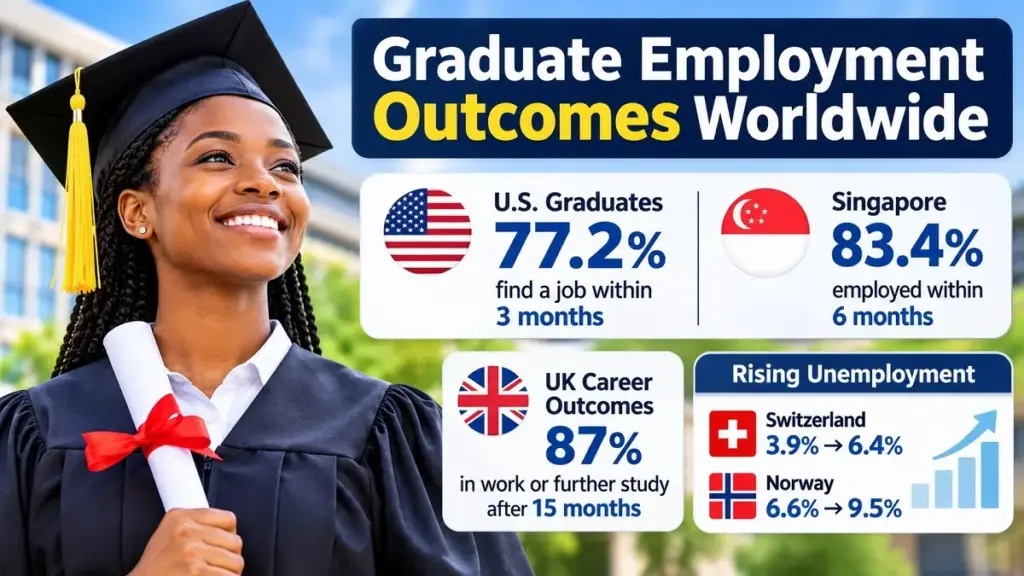
How long does it take to find a job after college? In the United States, 77.2% of recent graduates landed a role within three months. In Norway, nine in ten new master’s graduates were working six months after finishing. In South Africa, the national jobless rate reached 33.6%.
These figures reveal how differently graduates experience the transition from university to employment. Some enter the workforce within weeks. Others spend months searching, accept temporary positions or pursue additional qualifications before securing suitable work.
The waiting period depends on your country, field of study, professional experience and the demand for your skills. It also depends on whether you are looking for any paid employment or a position that matches your qualifications.
I examined graduate employment data from the 20 countries in our career market research. Each country measures the transition from classroom to workplace differently. Some track graduates at six months. Others measure employment at nine, 12 or 15 months. A few publish youth unemployment rather than graduate-specific statistics.
I distinguish these measures throughout the analysis. I also examine what they reveal about graduate job prospects and the practical steps you can take to shorten your search.
Key Takeaways
- Most graduates who find work do so within three to six months. ZipRecruiter reports that 77.2% of surveyed US graduates landed a role within three months. Singapore’s universities report 83.4% employment among graduates seeking work within six months.
- Graduate employment outcomes vary considerably by country. The US recorded an 85.7% career outcomes rate within six months. The UK reported 87% of graduates in work or further study after 15 months.
- Graduate unemployment is rising in several developed markets. Swiss university master’s graduates moved from 3.9% to 6.4% between 2023 and 2025. Norway’s rate increased from 6.6% to 9.5%.
- African graduate employment data is limited. South Africa’s graduate unemployment rate is 12.4%. Ghana’s unemployment rate for people aged 15 to 24 averaged 32.5% in 2025.
- Starting early improves your employment prospects. US graduates with work experience were more likely to start searching before graduation: 73.4% against 43.7%.
- Internships can shorten the transition into full-time employment. NACE reports that 63.1% of interns from the 2024-25 cohort converted into full-time hires.
Contents

20% off on annual plans
Tailor your resume, get your resume analysis, create portfolio, become a career coach & more
How I Compared the Time to Find a Job After Graduation
No country publishes one consistent figure for the number of days between graduation and a first job. Statistics offices and universities survey graduates at different points. Some ask at four months. Others ask at nine or 15 months.
I followed three rules:
- Official statistics came first. These include labour force surveys, national graduate surveys and ministry reports.
- Employer and job-platform surveys came second. I identify these separately because they rely on survey respondents rather than national administrative records.
- I never convert one measure into another. A six-month employment rate and a 15-month employment rate answer different questions.
Our 20-country job market ranking uses ILO-modelled unemployment figures. Local statistics offices publish age and education breakdowns that modelled figures may not capture. I use local figures here because they describe graduates and younger job seekers more closely.
Where pay appears, I show US dollars for easier comparison.
One distinction is particularly important. Employment rates show how many people are working at a particular point. Time-to-hire statistics show how long it took to secure employment. A country can have high graduate employment but still have graduates who spend several months searching before finding their first jobs.
How Long Does It Take to Find a Job After College?
For many graduates, finding a first job takes three to six months. However, the actual waiting period varies considerably by country, industry and individual circumstances.
The strongest evidence comes from surveys that ask graduates directly about their job-search experience.
ZipRecruiter’s 2026 graduate research found that 77.2% of surveyed US graduates landed a role within three months. A joint study by Baden-Württemberg’s universities found that graduates there find work two to three months after graduating on average, according to the University of Stuttgart’s graduate research.
In the Netherlands, the HBO Monitor reports that 83% of applied-sciences graduates found a job immediately.
A smaller group waits considerably longer. Monster’s 2026 survey found that 35% of US graduates expect a search of four months or more. Another 15% expect more than six months.
These results suggest that three to six months is a reasonable planning benchmark, not a guaranteed waiting period. Graduates entering highly competitive professions or struggling to demonstrate relevant experience may need longer.
What “Finding a Job” Means in the Data
Definitions change the answer. The National Association of Colleges and Employers (NACE) found that 85.7% of 2024 bachelor’s graduates were employed or enrolled in study within six months, according to its First Destinations report.
Slightly under 55% held full-time jobs.
This difference matters. A graduate who enters further study has a different employment outcome from someone who secures a permanent position. Both may appear in a combined graduate outcomes figure.
A job is also not always a career-track job. The New York Fed’s college labour market data puts underemployment among recent US graduates at 42.5%. These graduates work in roles that usually do not require a degree.
Therefore, the time to find any job may be shorter than the time to secure suitable graduate employment. When evaluating your progress, consider three outcomes: securing paid work, obtaining a full-time position and finding employment that uses your qualifications.
Score up to 2000 resumes in batch analysis
Analyze, grade, and rank up to 2000 resumes in 4 batches. Rent or get a Pro plan.
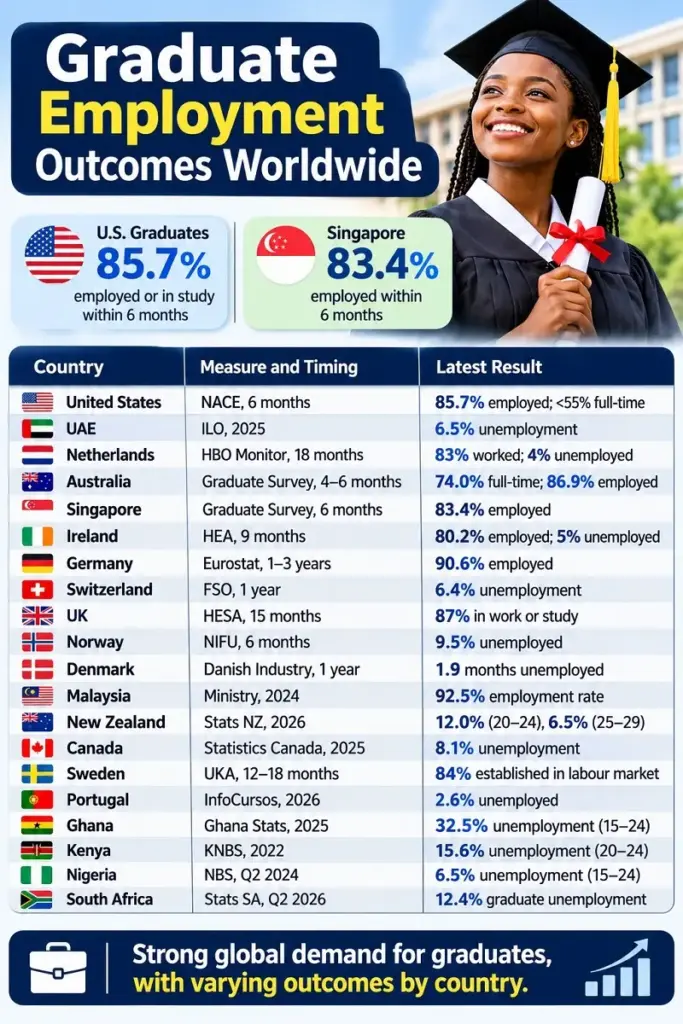
Job Search After College in 20 Countries: Comparison Table
The table follows the order of our job market ranking. Read each row against its own measure and timing. The results provide an overview of graduate employment conditions, not a direct ranking of how quickly graduates secure their first jobs.
| Country | Measure and timing | Latest result |
|---|---|---|
| United States | NACE first destinations, six months | 85.7% employed or in study; under 55% full-time |
| United Arab Emirates | ILO-modelled youth (15-24) unemployment, 2025 | 6.5%; no graduate timing survey found |
| Netherlands | HBO Monitor 2025, 18 months | 83% worked immediately; 4% unemployed |
| Australia | Graduate Outcomes Survey 2024, 4-6 months | 74.0% full-time; 86.9% employed |
| Singapore | Graduate Employment Survey 2025, six months | 83.4% employed; 74.4% full-time permanent |
| Ireland | HEA Class of 2024, nine months | 80.2% employed; 5% unemployed |
| Germany | Eurostat 2025, 1-3 years after finishing | 90.6% employed |
| Switzerland | FSO survey 2025, one year after | Unemployment 6.4% (university master’s) |
| United Kingdom | HESA 2023/24, 15 months | 87% in work or study; unemployment about 7% |
| Norway | NIFU Candidate Survey 2025, six months | About 9 in 10 master’s graduates working; 9.5% unemployed |
| Denmark | Danish Industry analysis, first year | Social-science master’s graduates unemployed 1.9 months on average |
| Malaysia | Ministry tracer study 2024 | 92.5% employment rate; graduate unemployment 3.2% |
| New Zealand | Stats NZ, June 2026 quarter | Unemployment 12.0% at ages 20-24; 6.5% at 25-29 |
| Canada | Statistics Canada, September 2025 | 8.1% unemployment, bachelor’s or higher, ages 20-29 |
| Sweden | UKÄ, 12-18 months | 84% established in the labour market |
| Portugal | InfoCursos 2026 | 2.6% of recent graduates registered as unemployed |
| Ghana | Ghana Statistical Service, 2025 | Unemployment 32.5% at ages 15-24 |
| Kenya | KNBS data | 15.6% unemployment at ages 20-24 (2022) |
| Nigeria | NBS labour force survey, Q2 2024 | 6.5% unemployment at ages 15-24 (revised method) |
| South Africa | Stats SA, Q2 2026 | 12.4% graduate unemployment |
The comparison highlights an important pattern. Strong graduate employment outcomes do not necessarily mean that every graduate finds a job immediately. Equally, high youth unemployment does not tell us precisely how long university graduates spend searching.
The country-level findings below provide more context.
Time to Find a Job After Graduation in North America
United States
The New York Fed’s third-quarter 2026 data show unemployment for recent graduates at 5.2%. That is the lowest rate in more than a year. Underemployment edged up to 42.5%.
NACE’s figures show the full-time employment gap. Bureau of Labor Statistics data cited by NACE put unemployment among bachelor’s graduates aged 20 to 24 at 7.6% in September 2026, down from 9.5% a year earlier.
The pipeline is narrower than it was. Entry-level roles made up 38.6% of postings in March 2026, down from 44% in 2023, according to Fortune’s analysis of graduate employment and entry-level hiring.
Yet ZipRecruiter’s data show that graduates adapted. They applied more widely and accepted different kinds of work.
This creates a more demanding entry-level market. A degree alone may not distinguish an applicant from hundreds of other candidates. Graduates who demonstrate practical skills, relevant experience and a clear understanding of employer requirements have a stronger basis for competing.
Free Listing
Canada
Statistics Canada reports that unemployment among 20- to 29-year-olds with a bachelor’s degree or higher reached 8.1% in September 2025. That compares with 6.4% in 2022 and 5.9% in 2019. Youth unemployment at ages 15 to 24 hit 14.7% that month.
These figures measure joblessness, not days to hire. They show a market where a graduate job search after college runs longer than before the pandemic.
The trend also highlights the importance of understanding employer demand before choosing a career direction. Graduates may need to broaden their search beyond traditional entry-level positions and consider related occupations where their qualifications remain relevant.
How Long a Graduate Job Search Takes in Europe
United Kingdom and Ireland
HESA’s latest survey found that 87% of 2023/24 UK graduates were in work or further study 15 months after graduating. The Graduate Outcomes release provides the broader employment picture, while Jisc’s data release reports unemployment at around seven per cent.
Competition explains part of the wait. UK employers received more than 1.2 million applications for fewer than 17,000 graduate vacancies in 2024. That is about 140 applications per vacancy, the highest level in more than three decades, according to Euronews’ analysis of European graduate employment.
Ireland’s Higher Education Authority tracks graduates at nine months. In its Class of 2024 survey, 80.2% were employed, 10.7% were in further study and 5% were unemployed. The field matters: education graduates reached 91.6% employment, while arts and humanities graduates reached 63.1%.
These differences demonstrate why graduates should evaluate employment prospects by discipline. National employment rates can conceal significant differences between professions.
Netherlands, Germany and Switzerland
The Netherlands moves graduates into work fastest among the Dutch-speaking and German-speaking markets in this study. The HBO Monitor found that 83% of applied-sciences graduates worked immediately, down from 85% a year earlier. Unemployment at 18 months was 4%.
Germany shows similar speed. Eurostat’s 2025 data put employment among recent graduates at 90.6% in Germany and 90.1% in the Netherlands. The EU average was 83%, according to European graduate employment comparisons.
At the University of Stuttgart, half of respondents found work within a month. After six months, 93% had a job.
Switzerland is moving the other way. The Federal Statistical Office reports that unemployment one year after graduation rose from 3.9% to 6.4% for university master’s graduates between 2023 and 2025. For applied-sciences bachelor’s graduates, it rose from 3.4% to 4.9%. The Swiss government announcement provides the underlying employment findings.
More Swiss graduates also struggle to find suitable work. Among university master’s graduates, that share rose from 30% to 44.1%. About two-thirds cited insufficient experience, according to Le News’ report on graduate unemployment.
This is an important finding for students considering postgraduate education. An advanced qualification can improve professional opportunities, but it does not automatically compensate for a lack of practical experience.
Norway, Denmark and Sweden
Norway’s NIFU survey tracks master’s graduates six months after finishing. Nine in ten were working. Yet unemployment among new master’s graduates rose from 6.6% in 2023 to 9.5% in 2025, and about half said finding relevant work was harder than expected.
The Norwegian government’s graduate employment findings highlight the changing employment environment. Norway’s parliament was told that this is the highest level in at least 25 years, according to parliamentary proceedings.
Denmark measures the first year. Danish Industry found that social-science master’s graduates were unemployed for 1.9 months on average in the first year after graduating. Health-science graduates had the lowest unemployment share, at 12.4%. The Danish Industry analysis examines how graduate unemployment informs higher-education planning.
Sweden’s university authority checks again at 12 to 18 months. It found that 84% of graduates were established in the labour market. “Established” means stable work with income above a threshold, according to the Swedish Higher Education Authority.
Portugal
Portugal’s InfoCursos portal counts graduates who register as unemployed at job centres. The 2026 edition shows that 2.6% of recent graduates were registered. In 2017, the rate at public institutions was 7.2%, according to The Portugal News.
The measure undercounts unemployment. Graduates who never register, or who leave the country, do not appear.
Nevertheless, the figures suggest that registered unemployment among recent graduates has declined considerably over the period.
Finding a Job After College in Asia-Pacific and the Middle East
Singapore and Malaysia
Singapore’s six autonomous universities survey graduates six months after final exams. In 2025, 83.4% of graduates seeking work were employed, down from 87.1% in 2024. Full-time permanent roles reached 74.4%. Median pay held at S$4,500, about US$3,500.
The 2025 Graduate Employment Survey results show that Singapore remains a relatively strong graduate employment market, although employment outcomes have weakened slightly.
Malaysia reports the Ministry of Higher Education’s tracer study. Graduate employment rose from 90.9% in 2023 to 92.5% in 2024. The Ministry’s reported graduate employment figures provide the broader context.
The Department of Statistics adds that graduate unemployment fell to 3.2% in 2024. Many graduates still work below their level: skill-related underemployment stood at 32.2%, according to the DOSM graduate statistics.
The distinction between employment and suitable employment is important. A graduate may find work relatively quickly but still struggle to secure a position that uses their qualifications.
Australia and New Zealand
Australia surveys graduates four to six months after completion. The 2024 survey found that full-time employment for domestic undergraduates fell from 79.0% to 74.0%. Overall employment was 86.9%, according to the Quality Indicators for Learning and Teaching graduate survey.
Time closes the gap. For the 2022 cohort, full-time employment rose from 79.5% right after graduation to 91.7% three years later. The Graduate Outcomes Survey longitudinal research illustrates how employment outcomes improve as graduates gain experience.
New Zealand’s market has softened. Stats NZ data show that unemployment at ages 20 to 24 reached 12.0% in the June 2026 quarter, up from 9.8% a year earlier. At ages 25 to 29, it reached 6.5%, according to the latest labour market analysis.
The figures suggest that younger job seekers face a more challenging entry-level market. Graduates should therefore consider internships, professional networks and related occupations when planning their first career move.
United Arab Emirates
The UAE does not publish a graduate timing survey that I could verify. ILO-modelled data put youth unemployment at 6.5% in 2025, according to the World Bank’s youth unemployment series.
Private-sector foreign hiring runs through employer sponsorship, so a confirmed offer comes before residency, as the 20-country job market comparison explains.
For international graduates, this creates an additional consideration. You must identify employers willing to recruit foreign candidates and understand the relevant work authorization requirements before applying.
How Long It Takes to Find a Job After College in Africa
African statistics offices report unemployment by age more often than by graduate status. So these figures show the market you graduate into. They do not show days to hire.
The distinction is particularly important in countries where informal employment and self-employment account for a large share of available work. Securing an income-generating opportunity is not necessarily the same as finding formal graduate employment.
Kenya
KNBS data put unemployment at ages 20 to 24 at 15.6% in 2022, up from 14.6% in 2021, as reported by Business Daily Africa.
The Economic Survey 2026 shows that Kenya created 822,100 jobs in 2025, and nearly nine in ten were informal. The formal share of employment fell from 18.5% in 2010 to 15.5% in 2024, according to The Standard’s analysis of graduate employment.
So a Kenyan graduate job search often runs through short contracts, online gigs and informal work first. A university qualification does not always translate into immediate access to formal employment.
This makes it important to identify sectors with active recruitment and develop skills that employers can use immediately. The most-searched jobs in Kenya provide a useful starting point for understanding where job seekers are looking and where opportunities exist.
Ghana
The Ghana Statistical Service reports that national unemployment averaged 12.8% in the first three quarters of 2025. For ages 15 to 35 it averaged 21.9%, according to its labour market findings.
Unemployment at ages 15 to 24 averaged 32.5%, and it reached 49.3% in Greater Accra in the third quarter, according to Ghana’s latest labour market reporting.
These are youth unemployment figures, not graduate-specific rates. They nevertheless show the competition facing young people entering the labour market.
Ghana also runs a national service year for graduates. That year shapes the timeline for the first job after graduation. Graduates should use this period to build experience, establish employer connections and identify permanent opportunities.
Nigeria
The National Bureau of Statistics reported 6.5% unemployment at ages 15 to 24 in the second quarter of 2024. That figure followed a change in method, as reported by Nairametrics.
Under the earlier method, 53.4% of 15- to 24-year-olds and 37.2% of 25- to 34-year-olds were unemployed in 2020, according to the earlier labour market estimates.
Some analysts view the older figures as closer to conditions on the ground. Treat any single Nigerian number with care. The methodological change makes direct comparisons difficult.
Nigerian graduates also complete the one-year National Youth Service Corps, which adds to the wait for paid work. The service year can provide valuable experience and employer exposure, but it does not guarantee permanent employment.
South Africa
Stats SA’s second-quarter 2026 survey shows national unemployment at 33.6%. Graduates recorded 12.4%, against 39.2% for people without matric, according to the official government statement on the Q2 labour force survey.
Unemployment among ages 15 to 34 reached 47.4%. A degree still cuts the risk sharply. Yet graduate unemployment rose during the quarter.
In the first quarter, unemployment stood at 60.9% for ages 15 to 24 and 40.6% for ages 25 to 34, according to Stats SA’s quarterly labour force reporting.
The figures reveal an important difference between educational attainment and employment security. Graduates generally face a lower unemployment risk than people without matric, but they still compete for limited professional vacancies.
Why Some Graduates Wait Longer to Find a Job After College
Field of Study
Your major moves the timeline. In the New York Fed’s February 2026 table, anthropology graduates faced 7.9% unemployment and computer engineering graduates 7.8%, against 5.6% overall, as reported in research on US graduate unemployment by degree.
The pattern repeats elsewhere. Irish education graduates reached 91.6% employment while arts and humanities graduates reached 63.1%. In Switzerland, unemployment one year out ran at 10.8% for music and performing arts and 1.6% for medicine and pharmacy.
The differences reflect variations in employer demand, professional licensing requirements and the number of graduates competing for available positions.
This does not mean that you should choose a degree based only on current unemployment rates. Instead, understand the occupations your qualification can lead to and the additional skills employers expect.
Experience
Employers hire for proof, not potential. About two-thirds of Swiss master’s graduates cited insufficient experience as a barrier.
In the US, ZipRecruiter found that work experience made graduates nearly twice as likely to land a role before the diploma: 20.8% against 12.7%.
Experience reduces the uncertainty employers face when hiring new graduates. Internships, volunteer assignments, research projects and freelance work demonstrate that you can apply classroom knowledge in practical settings.
The earlier you build this evidence, the less you depend on your degree certificate alone when competing for entry-level positions.
Competition and Application Volume
The UK’s 140 applications per vacancy sets the tone. In the US, more graduates now send 20 or more applications before landing one offer, according to Interview Query’s 2026 new-graduate hiring research.
A longer job search after college often reflects volume, not weak candidates. Employers may receive hundreds of applications for a single position, making it harder for qualified graduates to stand out.
Application quality also matters. Sending more applications will not necessarily improve your results if your resume does not match the role or your experience is difficult to identify.
Work Authorization
Your visa route changes how you search. Points-based systems let you build a profile before you have an offer. Employer-sponsored systems demand the offer first.
Your nationality, qualification, occupation and work authorization can therefore influence the countries and employers you can realistically target.
The best countries to work in for English speakers comparison explains how different immigration and employment systems affect international job seekers.
How to Shorten Your Job Search After College
Begin Before You Graduate
Graduates with work experience were far more likely to start searching before graduation. ZipRecruiter measured 73.4% against 43.7%.
Open your search in your final year. Identify employers, follow their recruitment announcements and begin applying for suitable graduate programmes.
Offers arrive earlier for candidates who apply earlier. You also gain time to identify skill gaps, improve your resume and prepare for recruitment assessments.
Treat Internships as a Hiring Channel
NACE reports that interns converted to full-time hires at a rate of 63.1% for the 2024-25 cohort. That is the highest rate in five years, according to its intern conversion research.
Browse live programmes such as Amazon internships, Cisco internship opportunities and the World Bank Treasury summer internship.
Internships give employers an opportunity to assess your performance before making permanent hiring decisions. They also help you develop professional relationships and understand workplace expectations.
Treat every internship as a potential route into employment rather than simply another item to add to your resume.
Show Skills, Not Only a Degree
Employers increasingly screen for proof of ability. The shift towards skills-based hiring shows which work samples and assessments carry weight.
Pair practical experience with the most in-demand AI skills to understand what employers ask for now.
Build a portfolio that demonstrates your ability to solve real problems. Include relevant projects, certifications, technical assignments and measurable achievements.
A graduate who can demonstrate practical competence has more evidence to offer than someone whose application lists academic qualifications alone.
Build a Resume That Passes Screening
Most graduate applications meet software before they meet a person. Build an ATS-friendly resume in the Launchpad resume builder.
Tailor it to each posting because generic resumes lengthen the search. Use relevant keywords from the job description and place your strongest qualifications where recruiters can find them quickly.
Highlight internships, projects, achievements and transferable skills. Avoid filling your resume with unrelated responsibilities that do not demonstrate your suitability for the position.
Practise Interviews Before You Need Them
Interview skill separates a four-week search from a six-month one. Use these interview preparation tools to rehearse.
Prepare for availability questions too, such as when you can start working.
Practise explaining your experience, academic projects and career interests. Prepare specific examples that demonstrate communication, problem-solving and teamwork.
Research employers before interviews. Understand their products, services and industry challenges so you can connect your skills to their actual needs.
Search Where Vacancies Are Not Advertised
Many roles never reach the big boards. Go straight to employer career pages and message hiring teams.
Finding high-paying hidden jobs online explains the method. You can also browse current vacancies on the AscendurePro job board.
Build a list of employers in your preferred industry. Follow their recruitment pages, connect with professionals and monitor opportunities that may not appear on mainstream job boards.
This approach also helps you learn about upcoming vacancies before application competition becomes intense.
Use Bridge Jobs Wisely
ZipRecruiter found that 18% of employed graduates intentionally applied below their level to gain a foothold.
A bridge job pays bills and builds references. It can also help you develop transferable skills while looking for a position that matches your qualifications.
Keep applying to target roles while you work. Set clear career goals and review your progress regularly so that a temporary position does not become an unplanned career destination.
What to Do at 3, 6 and 12 Months
At Three Months
Audit your results. No interviews points to a resume or targeting problem. Interviews without offers point to an interview problem.
If your direction is unclear, use this method to identify your strongest career options.
Review your applications. Identify which employers responded, which qualifications appeared most frequently and where your applications stopped progressing.
Do not simply increase application volume. Improve the match between your skills and the positions you target.
At Six Months
Widen the net. Add contract work, short courses and bridge roles.
Australia’s data show why patience and continued career development matter. Full-time employment for one graduate cohort rose from 79.5% right after graduation to 91.7% three years later.
Consider industries where your skills transfer easily. Improve your technical abilities and seek feedback from professionals in your target field.
You should also reassess your expectations. If you are only applying for a narrow group of positions, related occupations may offer a more realistic entry point.
At Twelve Months
Consider a change of route. That may mean further study, a new field or a move to a market with faster hiring.
In Canada, 27.3% of unemployed youth who were not students said they were very likely to return to education within a year, according to Statistics Canada’s labour market research.
If you are weighing a switch, read how to choose a career that fits the job market and consider career transition services.
A year without suitable employment is a good time to reassess your strategy. Identify the qualifications, experience and professional connections that could open a different route.
Conclusion
How long does it take to find a job after college? For many graduates, the answer is three to six months. The Netherlands, Germany, Singapore and the US report relatively strong graduate employment outcomes, although their statistics measure different periods and definitions.
Switzerland, Norway and Canada show more challenging employment conditions in some graduate groups. Their figures also demonstrate that a strong education system does not guarantee immediate employment.
African markets face considerable employment challenges, and the available graduate-specific timing data are thinner. South Africa shows the difference clearly: 12.4% graduate unemployment against 39.2% for people without matric.
Your field, experience and start date matter more than the national average. Start in your final year. Treat internships as hiring channels. Demonstrate practical skills and tailor every application.
Most importantly, distinguish between finding any job and building a career. Your first position may not be your ideal role, but it can provide the experience and professional connections needed for your next move.
Ready to begin? Build your resume in Launchpad and check open roles on the AscendurePro job board today.
FAQs
How long does it take to find a job after college?
Many graduates find work within three to six months, although the timeline varies by country, industry and experience. In the US, ZipRecruiter found that 77.2% of recent graduates landed a role within three months. In the Netherlands, 83% of applied-sciences graduates worked immediately. Weak labour markets and competitive professions can take longer.
Is it normal to have no job six months after graduation?
Yes. Some graduates need more than six months to secure suitable employment. Monster found that 15% of surveyed US graduates expected a search longer than six months.
In Singapore, 83.4% of graduates seeking work were employed six months after final exams in 2025. The remaining job seekers had not secured employment by the survey date.
Which country has the fastest graduate job search?
The Netherlands reports that 83% of applied-sciences graduates found work immediately. Germany and the Netherlands also posted the highest recent-graduate employment rates in Eurostat’s 2025 data: 90.6% and 90.1%.
Singapore and Malaysia also report strong results. However, the measures differ by country, so compare employment trends and survey periods rather than treating these figures as a direct ranking of job-search speed.
Does an internship help me find a job faster?
Yes. Internships provide practical experience, professional connections and exposure to employer expectations. NACE reports a 63.1% intern-to-hire conversion rate for the 2024-25 cohort.
ZipRecruiter also found that graduates with work experience were nearly twice as likely to hold a job before receiving their diplomas. Applying for internships before graduation can therefore improve your chances of securing employment after college.
How long does it take to find a job after college in Kenya?
Kenya has no national figure for the number of days between graduation and a first job. KNBS data show 15.6% unemployment among people aged 20 to 24 in 2022.
Nearly nine in ten additional jobs created in 2025 were informal. Many graduates therefore start with contract work, online gigs or informal opportunities before securing formal employment.
Does my degree choice change how long the search takes?
Yes. Your degree influences the industries you can enter, the number of available positions and the competition you face.
In Switzerland, unemployment one year after graduation was 10.8% in music and performing arts and 1.6% in medicine and pharmacy. In the US, anthropology and computer engineering graduates faced higher unemployment than the 5.6% overall figure in the cited February 2026 data.
Research employment prospects before choosing a degree. Also consider the practical skills, certifications and professional experience you can build alongside your qualification.
Join Us
Get clear roadmaps, in-demand skills insights, and proven strategies to help you move into high-growth, future-proof careers — no fluff.